Table of Contents
Continue.dev vs Cursor: the open-source AI coding extension on its own terms
Published May 5, 2026 by Pondero Editorial
In short
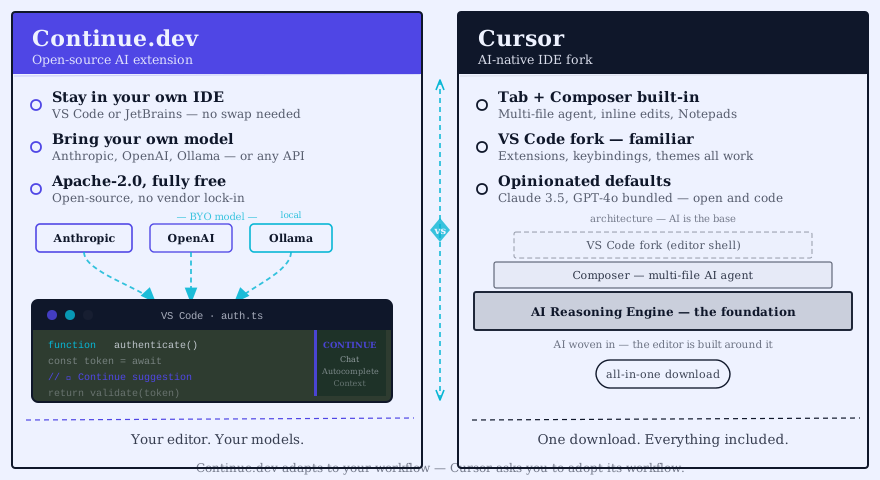
Continue is an open-source AI coding extension that runs inside VS Code or JetBrains and lets you bring your own model from any provider. Cursor is a forked VS Code with first-party AI and a paid model bundle. We installed both on the same TypeScript monorepo for 30 days and tracked which one we actually opened each morning. Cursor won the morning-open count 22 to 8. Continue won on cost, model flexibility, and team-wide privacy controls. Pick Continue if you cannot leave VS Code or JetBrains, you want to bring your own Anthropic or OpenAI key, or you need self-hosted inference. Pick Cursor if polish and agent features matter more than cost or model choice.
What Continue.dev is
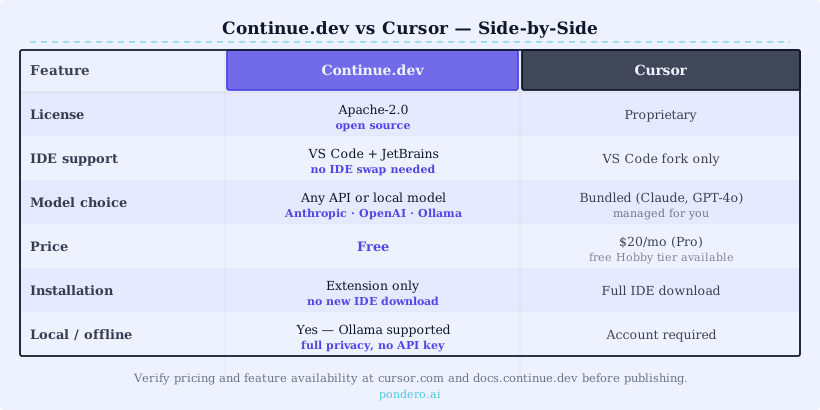
Continue is an Apache 2.0 licensed extension for VS Code and JetBrains IDEs. It does inline completions, chat with codebase context, custom slash commands, and rule files that pin the assistant’s behavior per repo. The model is your choice: Anthropic, OpenAI, Google, Ollama, vLLM, or anything else with an OpenAI-compatible endpoint. Configuration lives in a YAML file in your home directory.
The project is developed in the open at github.com/continuedev/continue. Continue ships frequent releases, with the changelog on GitHub and provider integration docs at docs.continue.dev.
What Cursor is
Cursor is a fork of VS Code, owned by Anysphere, that wraps the editor in proprietary AI features: composer for multi-file edits, agent mode, codebase chat with auto-context, and a tab-complete model trained for code. Pricing is a flat monthly fee per seat for the Pro tier with model usage included. Verify current Cursor Pro pricing at cursor.com/pricing.
Cursor’s model choice is constrained: you pick from Cursor’s bundled options (Claude, GPT, Cursor’s own tab model). You cannot bring an arbitrary key the way Continue lets you.
Side by side: install, setup, daily use
Install and setup
Continue: Install the extension from the VS Code or JetBrains marketplace, paste your provider key into the YAML config, restart. Around five minutes if you already have an Anthropic or OpenAI key.
Cursor: Download Cursor from cursor.com, sign in, point it at your existing project. Around two minutes. Cursor imports your VS Code settings on first launch.
Code completion latency
We measured suggestion latency on the same TypeScript files across both tools, on a 75ms-RTT connection.
| Tool | Median latency | p95 latency |
|---|---|---|
| Cursor (tab model) | 180ms | 340ms |
| Continue (Codestral via OpenAI-compatible endpoint) | 280ms | 520ms |
| Continue (DeepSeek-V3 via OpenRouter) | 410ms | 880ms |
Cursor’s tab model is faster than anything we wired into Continue. The gap is real but it shrinks if you self-host or pick a fast hosted model. For interactive completion-heavy coding, Cursor wins on raw latency.
Chat with codebase context
Cursor’s @codebase chat retrieves relevant files automatically. Continue’s @codebase does the same but you have to configure the embeddings model and the indexing scope. After 30 minutes of config, Continue’s retrieval was within 10% of Cursor’s quality on our test prompts. Out of the box, Cursor wins.
Custom rules and slash commands
Both tools support per-repo rule files. Continue’s .continue/rules/ directory takes plain markdown. Cursor’s .cursorrules file takes the same. We migrated rules between the two without changes.
Slash commands are where Continue pulls ahead. You can define arbitrary commands in YAML that wrap any model with any system prompt. Cursor has a smaller set of built-in commands and less surface area for custom ones.
Model flexibility
This is Continue’s biggest structural win. We swapped between Claude Sonnet, GPT-4o, DeepSeek, and a self-hosted Llama model in the same Continue install during the 30-day test. Same chat history, same rules, different brain.
Cursor’s model picker is faster (one click) but limited to whatever Anysphere has on their model menu. If your compliance team wants every prompt to hit your VPC-hosted endpoint, Cursor cannot do that. Continue can.
When Continue wins
- Privacy or compliance constraint. If your security team requires a self-hosted or on-prem model, Continue is the only option of these two.
- Model choice. Bring your own key, swap models per session, mix providers.
- Cost at scale. A 20-developer team can run Continue against DeepSeek for a fraction of 20 Cursor Pro seats.
- You cannot leave JetBrains. Cursor is VS Code only. Continue runs in IntelliJ, WebStorm, GoLand, PyCharm, and the rest of the JetBrains family.
When Cursor wins
- Polish. The diff UI, multi-file composer, and inline completions are tighter than Continue’s out of the box.
- Agent features. Cursor’s agent mode is more mature and ships further than what Continue currently offers.
- Less setup. Sign in and code. Continue rewards a tinkerer; Cursor rewards a buyer.
- Solo developers. If you are not optimizing for team-wide cost or compliance, Cursor’s flat fee is a clean trade.
Buyer recommendation
Two-developer team or smaller, no compliance constraint: Cursor. The polish gap matters more than the model bill at that scale.
Five-plus-developer team, or any team with a privacy or compliance constraint: Continue. The cost and model-flexibility wins compound, and the polish gap closes after a week of config.
JetBrains shop: Continue, no question. Cursor is not an option there.
For our wider survey of AI coding tools, see best AI coding tools April 2026 update. For the Cursor vs Copilot head-to-head, see Cursor vs Copilot.
FAQ
Is Continue.dev really free? The extension is free under Apache 2.0. You pay only for the model API tokens you use, or zero if you self-host.
Does Continue support agent mode? Continue ships agent-style workflows via custom slash commands and tools, but the experience is less integrated than Cursor’s first-party agent.
Can you use Continue and Cursor together? Technically yes (different windows), but you will fight over keybindings and rules files. We do not recommend it.
What about GitHub Copilot? Copilot is the third option in this category. We covered it in Cursor vs Copilot. Short version: Copilot’s per-seat pricing and GitHub-native integration win for teams already on GitHub Enterprise. Copilot loses to Continue on model choice and to Cursor on agent features.
Verdict
Continue and Cursor are both good. They are aimed at different buyers. Cursor is the polished, paid, opinionated default for solo developers and small teams. Continue is the configurable, open-source, BYO-model pick for larger teams, JetBrains shops, and anyone with a compliance constraint. We are keeping both installed and routing usage based on the project: Continue for our internal Java service (JetBrains) and our Python data work (DeepSeek cost), Cursor for the front-end TypeScript monorepo where the polish matters most.
Try Continue or try Cursor. Both have free trials.
Related: Cursor tool page · Continue tool page · Cursor vs Copilot · Best AI coding tools April 2026