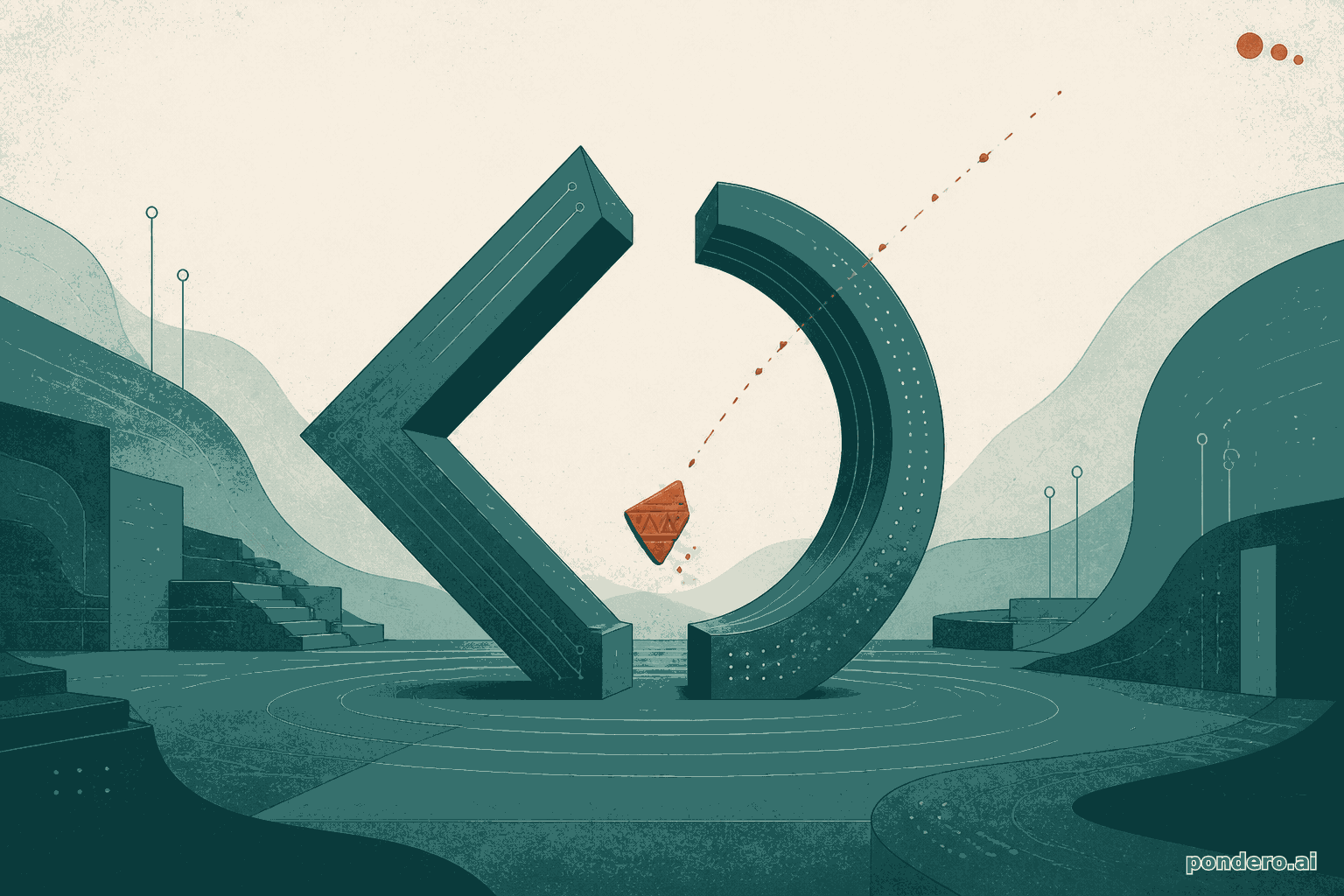
CrowdStrike and NVIDIA Launch SafeMind, the First Agentic Offense-Defense AI Loop for Cybersecurity
Adversary breakout times dropped to 27 seconds in 2026 and AI-enabled attacks climbed 89% year-over-year, per CrowdStrike's 2026 Global Threat Report. Those numbers are the design constraint behind CrowdStrike SafeMind, introduced September 1 at Fal.Con 2026 in Las Vegas: two purpose-built AI models, one offensive and one defensive, running against each other in a closed loop inside a digital twin of customer infrastructure, finding attack paths and closing them continuously rather than waiting for a human to trigger a scan.
What CrowdStrike launched
SafeMind is a family of cybersecurity-specific AI models and harnesses produced by CrowdStrike's Cyber Superintelligence Lab, per the CrowdStrike press release. The system operates natively inside the CrowdStrike Falcon platform. Security teams can subscribe without deploying a new agent or separate tooling.
The launch ships two distinct models. Red Tempest is an offensive red-team model built to emulate AI adversaries and execute attack scenarios against enterprise infrastructure. Blue Solano is the defensive blue-team model built to close the paths Red Tempest finds, deploying battle-tested detection measures used by CrowdStrike's own incident response teams. The two models run inside proprietary harnesses that pit them against each other continuously, each cycle feeding results back to improve both sides.
Training data for SafeMind drew on CrowdStrike Falcon sensor telemetry, the company's threat intelligence corpus, Falcon Complete MDR event annotations, and 15 years of incident response fieldwork collected from breach responses on the front lines.
NVIDIA contributed open Nemotron model weights to the build. Nemotron 3 Ultra orchestrates the defensive agent harness. A fine-tuned Nemotron 3 Super powers Blue Solano's rule-generation sub-agent, per the NVIDIA blog. CoreWeave's AI Cloud handles training and inference.
CrowdStrike CEO George Kurtz, speaking alongside Jensen Huang to an audience of 10,000 security professionals, put the positioning plainly: "The future of cybersecurity won't be defined by AI that simply identifies threats, it will be defined by AI that defeats them."
How the loop runs
The red-agent harness deploys Recon, Assault, and Compromise sub-agents inside a high-fidelity digital twin of the customer environment, per the NVIDIA blog. The blue-agent harness monitors via Falcon sensors, generates detection candidates, validates them, and promotes actionable detection rules to the live environment. Each iteration hardens the customer environment further, as each side adapts to what the other finds.
NVIDIA validated the architecture by running SafeMind against a digital twin of NVIDIA's own accelerated computing infrastructure, tested against NVIDIA's actual threat landscape. The results fed into what NVIDIA described as a "high-fidelity cyber agent environment."
Kurtz also announced Falcon IQ at the conference, a companion agentic product using more than 50 agents to automate assessment, prioritization, and remediation workflows inside Charlotte AI. SafeMind and Falcon IQ are separate products addressing different layers of the SOC workflow.
What evaluations show
CrowdStrike published evaluation results from its own internal testing, comparing SafeMind against leading frontier models and open-source baselines. Per those evaluations, Blue Solano delivered a 29% higher detection rate, 6x faster end-to-end remediation, and 99% lower cost on detection and remediation tasks compared to the evaluated alternatives, per the press release. The evaluations were conducted by CrowdStrike and have not been independently reproduced.
Jensen Huang framed the underlying approach as domain-specific model post-training at scale: "There are many applications in the world where you must have the ability to fine-tune, to post-train, to create an AI that is super good at a particular domain. Nemotron was created for precisely that." Because Nemotron is an open model, CrowdStrike's security teams post-trained on their own threat data without sending it to an outside provider, keeping proprietary incident response data inside the organization.
Dr. Bartley Richardson, CrowdStrike's chief AI and autonomous systems officer, described the combined system as "the foundation for the next decade of AI security" and said the stack covers sensor to harness to model as a single integrated architecture, per the press release.
SafeMind's harnesses are also designed to accept frontier and open-source models beyond the Nemotron base. Security organizations can substitute or supplement the provided weights while retaining the harness structure. Trusted access for standalone models and harnesses will be offered through Project QuiltWorks, CrowdStrike's industry partner program.
Falcon customers get SafeMind without a new procurement cycle
Security teams running the Falcon platform have a direct upgrade path with no new procurement cycle. If CrowdStrike's cost figures hold in production, the 99% reduction in detection and remediation spend compared to generic frontier models represents a substantial budget case for switching from general-purpose AI to domain-specific security models.
SafeMind is also the first production deployment of an autonomous red-versus-blue loop inside live customer infrastructure by a major security vendor. Prior agentic security tools either ran in isolated sandboxes or required a human to initiate each attack simulation. SafeMind's continuous loop changes the operational model: defenders see attack paths and tested detection rules generated automatically, not on demand.
For operators evaluating SafeMind, the key variable is how well the digital twin matches the real environment. A twin that drifts from production will find paths that do not exist and miss ones that do. CrowdStrike has not yet published methodology details on twin fidelity or update frequency.
The 27-second breakout time and 89% rise in AI-enabled attacks are both figures from CrowdStrike's own research. Independent corroboration of the threat velocity is needed, but the directional case for automation in detection and response has broad support from MITRE ATT&CK evaluation results and CrowdStrike's Falcon telemetry base.
Context and reactions
NVIDIA founder and CEO Jensen Huang opened his Fal.Con keynote appearance with a framing of the supply-side problem: "We're at an inflection point in cybersecurity. Attacks are now automated. Defense has to be, too." He described SafeMind's adversarial-loop framework as broadly applicable to robotics, edge computing, and enterprise computing beyond the security domain.
Michael Intrator, co-founder and CEO of CoreWeave, said the company was "proud to power SafeMind across training and inference as CrowdStrike puts specialized AI to work against real-world threats," per the press release.
CrowdStrike also used Fal.Con 2026 to expand its Guardian AI safety product, which covers AI detection and response for agentic workloads across endpoints, cloud, and SaaS. The Guardian expansion was announced alongside SafeMind and Falcon IQ as part of CrowdStrike's broader agentic security positioning.
Competitors have not yet announced comparable dual-model autonomous loops. SentinelOne, Palo Alto Networks, and Microsoft Defender each have AI-assisted SOC features, but none has disclosed a closed red-versus-blue loop against a live customer digital twin.
What to watch next
The 2026 MITRE ATT&CK evaluations will be the first independent test likely to include SafeMind-class systems and will serve as external validation or counterpoint to CrowdStrike's internal figures. Whether SafeMind's detection rate advantage holds against adversaries specifically probing the AI loop is the durability question.
CrowdStrike has not published a public roadmap for third-party benchmark results. Watch for SentinelOne and Palo Alto Networks to respond with architectural announcements in the months following Fal.Con, as both vendors have active AI platform roadmaps and the same customer base.
Sources
- CrowdStrike Launches Frontier Models for Cybersecurity, Created with NVIDIA: CrowdStrike press release, September 1, 2026
- NVIDIA and CrowdStrike Strengthen Agentic Cybersecurity Frontier: NVIDIA Blog, September 1, 2026
- CrowdStrike unveils SafeMind AI frontier models to let defenders fight fire with fire: Cyber Daily, September 2, 2026
- CrowdStrike 2026 Global Threat Report: CrowdStrike research