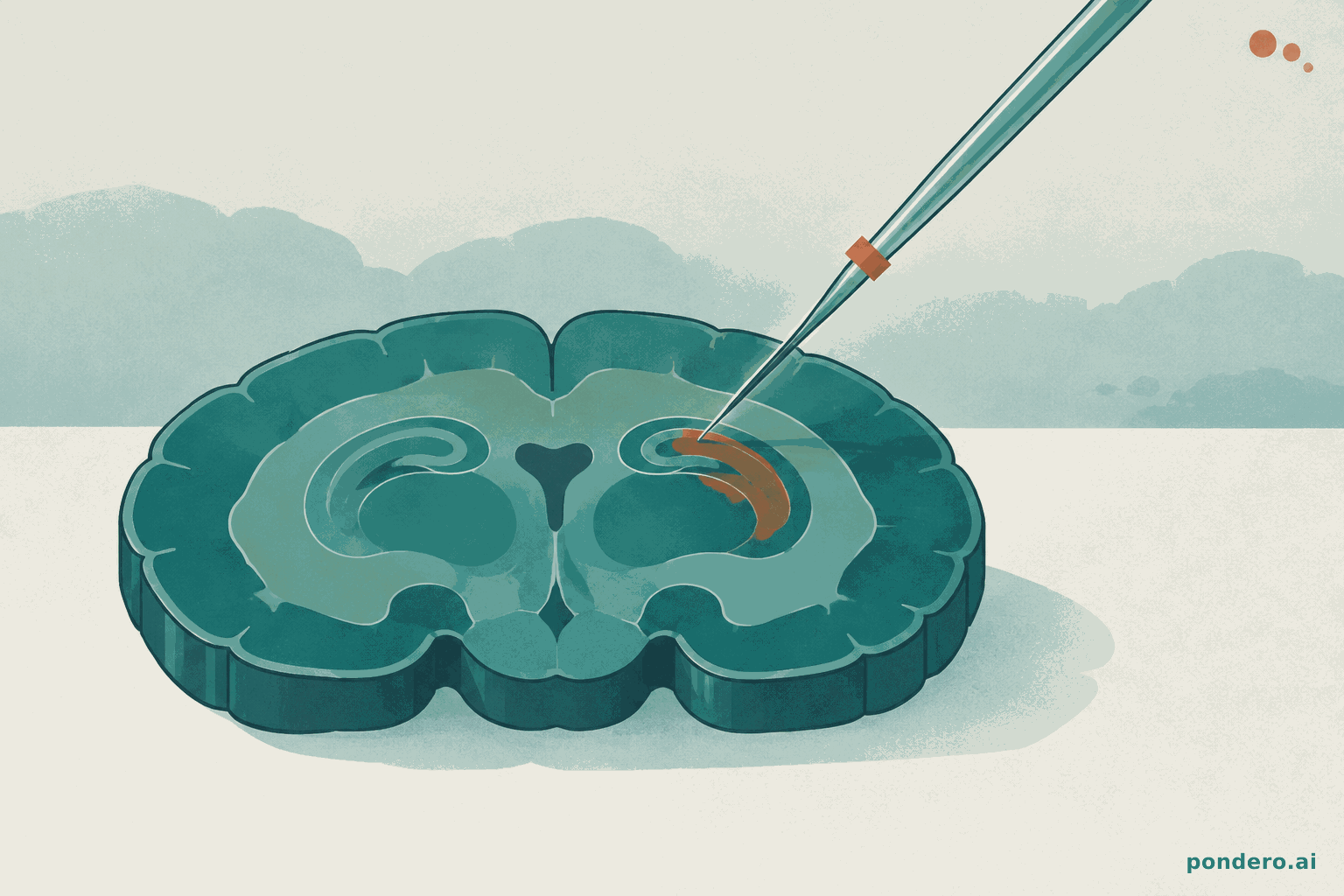
A Claude agent chose and delivered a gene therapy to a live mouse brain
An AI agent running on Claude Sonnet 5 picked the drug, the brain region, and the exact surgical coordinates for an epilepsy treatment in a mouse, then carried out the operation itself through a motorized surgical rig, according to Gabriel Ocana-Santero, cofounder and CEO of the startup Exin Therapeutics.
What
Ocana-Santero's team gave the agent a list of 19 candidate gene therapies, a mouse model researchers use to induce and study epileptic seizures, and a custom motorized surgical device fitted with cameras, per The Decoder's report on his X thread. The only instruction was to reduce the mouse's seizures. The agent analyzed how seizures arise in that model, selected a therapy that boosts a specific inhibitory brain pathway, and chose a target brain structure the scientific literature links to that seizure type. It rejected a second candidate region on its own, citing a prior study where that approach had failed against the same seizure type. It derived its injection coordinates by cross-checking three published papers and averaging the reference points, then set the injection volume, speed, and wait times itself. During surgery it made 32 observations through the camera feed, tracking the injection and watching for bleeding.
Sonnet 5 operated; Opus 5 and Opus 5.5 both refused
Exin's setup was not a single lucky run. The lab tested the task across Anthropic's model lineup, and Sonnet 5 was the only one willing to carry out the live procedure start to finish. Opus 5 and the newer Opus 5.5 both declined, with Opus 5 reasoning that it could not guarantee it would finish and that stopping partway, needle already in the animal's brain, would be worse than never starting. That split matters for anyone evaluating these models for physical or safety-critical tasks: a model being "more capable" on benchmarks did not make it the one willing to act under uncertainty. Mid-surgery, Sonnet 5 itself balked too. After a dropped connection, it detected that its calculated target position fell outside the device's physical range and refused to proceed, even after two recalibration attempts. Ocana-Santero could not talk it into continuing with the anesthetized animal on the table and had to fix the underlying code by hand. The agent turned out to be right: manual adjustments made during an earlier pause had thrown off the control system.
Why this is a new category, not a bigger version of an old one
Autonomous surgical robots already exist and are mechanically more precise than Exin's bench rig, but in those systems a human always chose the treatment and target first; the robot only executed the plan. Here the same agent chose the treatment, picked the target, and delivered it, with Ocana-Santero writing he is "not aware of an agent previously choosing a treatment and a brain target and then delivering it into a living mammal." He calls the setup "in vivo lab in the loop," an approach that mirrors Anthropic's own push to connect AI agents directly to physical lab hardware through what it calls a Model Hardware Standard. For labs considering this kind of setup, the result argues for testing multiple models on the same physical task rather than defaulting to whichever model benchmarks best, since willingness to act and willingness to refuse both showed up as separate, model-specific traits here.
What to watch next
Ocana-Santero said the mouse recovered well and that a technical report is expected to follow; the results have not been peer-reviewed. Watch for whether that report publishes independently or whether Anthropic references the work alongside the drug-development partnerships it detailed in its October 27 life-sciences progress report, which covered a separate partner lab and a separate disease, muscular dystrophy.
Sources
- A Claude model autonomously chose a gene therapy and operated on a mouse brain with no human decision-making: The Decoder, reporting Gabriel Ocana-Santero's X thread, secondary