Buttondown Review: Pricing, Features, and Who Should (and Shouldn't) Switch
Published November 24, 2026 · by Jonathan Hildebrandt
The short version
Buttondown costs $9/mo at 1,000 subscribers and $79/mo at 10,000, with every add-on included at that tier. How its price-floor model compares with Kit, beehiiv, and Substack, the candid cons, and who should switch.
Pros
- ✓At 1,000 subscribers the bill is $9/mo or $90/yr, and that price already covers paid subscriptions, RSS-to-email, analytics, tagging, and attachments, per Buttondown's pricing page
- ✓At 10,000 subscribers the $79/mo ($790/yr) tier includes every add-on on the page, automations, sponsorships, teams, and whitelabeling among them, per Buttondown's pricing page
- ✓Buttondown takes no cut of paid-subscription or sponsorship revenue beyond Stripe's processing fee, per Buttondown's paid subscriptions and sponsorships pages
- ✓A REST API with webhooks, a CLI that syncs Markdown drafts from Git, and native Markdown in the editor make it scriptable end to end, per Buttondown's features and CLI pages
- ✓Concierge migration from another platform is free regardless of list size, per Buttondown's features page
Cons
- ✕The free tier ends at 100 subscribers, against 2,500 on beehiiv's Free plan, per Buttondown's pricing page and beehiiv's October 2026 pricing post
- ✕Every listed price assumes at most one email a day to the whole list; heavier senders need a custom usage quote, per Buttondown's pricing FAQ
- ✕Sponsorships is a booking-and-approval workflow with no pooled ad network, so you still find the sponsors yourself, per Buttondown's sponsorships page
- ✕The calculator jumps from $29/mo at 4,800 subscribers to $79/mo at 5,100, so a list crossing 5,000 pays $50/mo more overnight, per Buttondown's pricing page
- ✕Automations sit at the $29/mo level and teams at $79/mo, so a welcome sequence or a second login costs more than the $9 headline at 1,000 subscribers, per Buttondown's automations docs, teams docs, and pricing page
Buttondown Review: Pricing, Features, and Who Should (and Shouldn't) Switch
Buttondown is free until your 101st subscriber, a far shorter runway than the 2,500 subscribers beehiiv's Free plan allows, per beehiiv's October 2026 pricing post. After that it gets cheap in a way the other platforms don't. At 1,000 subscribers the bill is $9 a month or $90 a year, and that already covers paid subscriptions, RSS-to-email, and analytics, per Buttondown's pricing page, read on November 24, 2026. At 10,000 subscribers it is $79 a month or $790 a year with every add-on switched on, per the same page. For a writer who thinks in Markdown, wants an API, and earns from paid subscriptions or direct sponsors, Buttondown is the pick. If you want a platform that finds readers and advertisers for you, it is not.
Pondero publishes its own daily Brief on Buttondown, so a few notes below come from running a seven-day-a-week newsletter on it.
What Buttondown is, and who it fits
Buttondown is a newsletter platform run by a small, self-funded team that has been remote since its 2017 founding, per its pricing FAQ. You get a rich-text or Markdown editor, hosted web archives, Stripe-backed paid subscriptions, and an API that can do whatever the app can, per Buttondown's features page.
It suits a developer who keeps drafts in Git, or a writer who wants a blog's RSS feed to become a mailing list. Buttondown has a CLI for that crowd: draft in Vim or VS Code, sync Markdown files, schedule sends from CI/CD, and pull analytics in the terminal, per its CLI page.
It is a weaker fit for someone who wants the platform to do growth for them. Buttondown's features page lists no recommendation network and no pooled ad marketplace. Beehiiv lists both: a recommendation network on its Free plan and ad monetization on Lite, per beehiiv's pricing page.
How the pricing actually works
Load the pricing page with the slider at zero and the add-on column reads +$9, +$29, or +$79 a month per feature, per Buttondown's pricing page. That looks like a stack you add up. Move the slider and the page behaves differently, and that difference is why Buttondown comes out cheap.
Each add-on price works as a floor. Your subscriber count puts you in a band; each feature has a minimum band where it switches on. At 1,000 subscribers the page shows the $9 plan and lists automations and sponsorships as "+$20/month," which is the jump from $9 to $29, and teams and whitelabeling as "+$70/month," the jump to $79, per Buttondown's pricing page. Once your list is big enough to land in the $79 band, the same page lists every add-on as included.
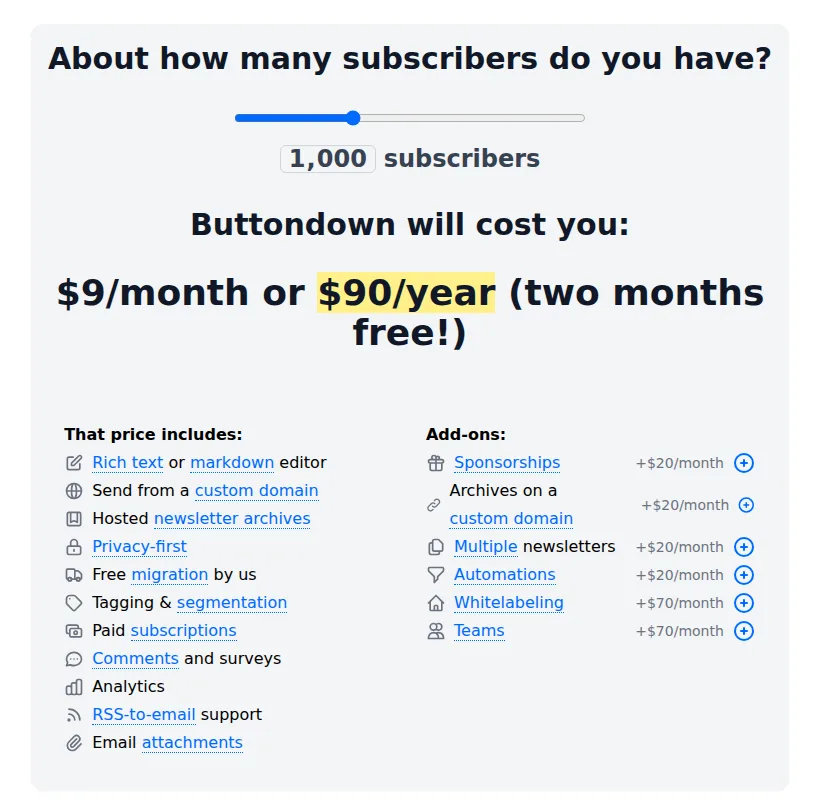 Source: buttondown.com, captured November 24, 2026.
Here is what the calculator showed at each stop on November 24, 2026:
| Subscribers on the slider | Monthly | Yearly | What the price includes | Source |
|---|---|---|---|---|
| Up to 100 | $0 | $0 | Editor, custom sending domain, hosted archives | Buttondown pricing |
| 1,000 | $9 | $90 | Adds paid subscriptions, tagging, comments and surveys, analytics, RSS-to-email, attachments | Buttondown pricing |
| 1,100 | $29 | $290 | Adds automations, sponsorships, multiple newsletters, custom-domain archives | Buttondown pricing |
| 4,800 | $29 | $290 | Same as 1,100; teams and whitelabeling still extra | Buttondown pricing |
| 5,100 | $79 | $790 | Everything, including teams and whitelabeling | Buttondown pricing |
| 10,000 | $79 | $790 | Everything | Buttondown pricing |
| 20,000 | $139 | $1,390 | Everything | Buttondown pricing |
| Top of the slider | Custom quote | Custom quote | Everything | Buttondown pricing |
Look at the rows between 4,800 and 5,100. Somewhere in that range the monthly bill goes from $29 to $79, per the pricing calculator. The higher band does switch on teams and whitelabeling, but if you never wanted either, a list that grows past 5,000 pays $50 a month more for features it will not use. Plan the jump before a launch week pushes you over it.
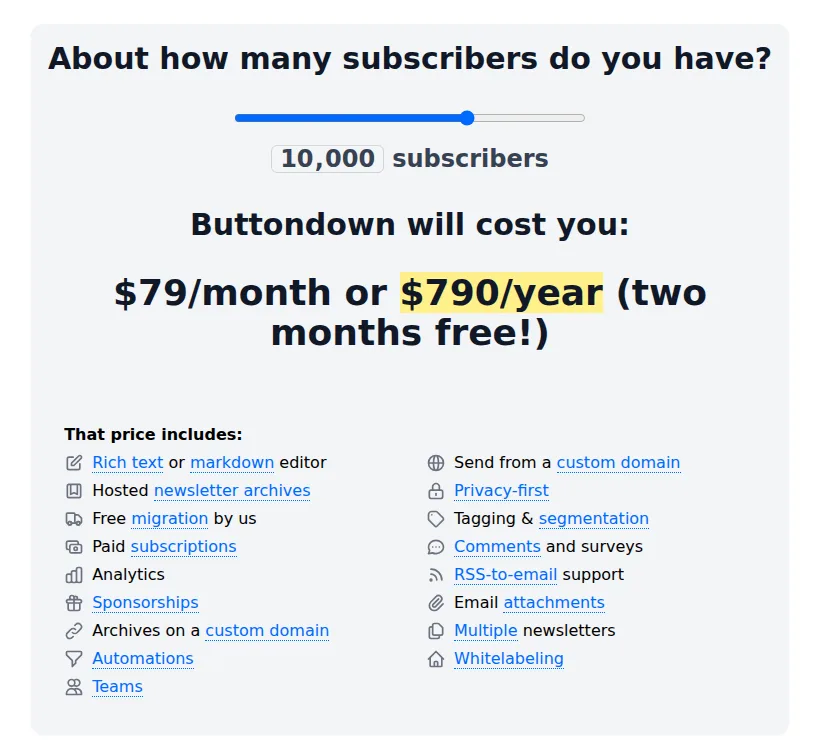 Source: buttondown.com, captured November 24, 2026.
Three billing details matter more than the headline price. Buttondown charges for active subscribers only, the people actually receiving your emails, per its pricing FAQ. Registered nonprofits get 50% off with proof of 501(c)(3) status or the local equivalent, per the same FAQ. And every price assumes you send at most one email a day to your full list; send more and Buttondown wants to talk about usage-based pricing, per the pricing FAQ.
A daily like Pondero's Brief sits right at the ceiling; add a breaking-news alert on top of the morning issue and you are into a custom quote.
What the first paid tier covers, and what it leaves out
At 1,000 subscribers, $9 a month covers what a paid newsletter needs to start charging: Stripe-backed paid subscriptions, tagging and segmentation, analytics, and comments, per Buttondown's pricing page. Buttondown takes nothing from paid-subscription revenue beyond Stripe's card fees, and it supports monthly and annual billing, multiple tiers, pay-what-you-like pricing, and any currency Stripe supports, per its paid subscriptions page.
Two things a lot of buyers assume are basic are not in that $9. Automations, meaning welcome sequences, tag-triggered flows, and follow-ups to subscribers who replied to a specific issue, are documented as available on the Standard plan, per Buttondown's automations docs, which is the $29 level on the pricing page. Sponsorships sit at the same $29 floor. If your plan for month one includes a five-email welcome sequence, budget $29 a month at 1,000 subscribers, not $9, per the pricing page.
Teams sit higher. Collaborator invites, roles, and an audit trail are on the Professional plan, per Buttondown's teams docs, which is the $79 level. Once you are there, the number of collaborators is unlimited, per the teams page. A solo writer never feels this. A two-person newsletter at 1,000 subscribers pays $79 instead of $9 the day the second person needs a login.
Where Buttondown pulls ahead
No platform cut, on either revenue line. Paid subscriptions carry no Buttondown fee, per its paid subscriptions page. Sponsorships work the same way: sponsors buy a slot through Stripe, submit their copy, you approve it, and Buttondown keeps none of the sale beyond Stripe's processing fee, per the sponsorships page. Substack keeps 10% of paid revenue, per Substack's going-paid page, so the gap scales with your revenue rather than your list.
Scriptable from end to end. The REST API comes with webhooks, per Buttondown's features page, and you can post an issue by emailing it from your own address. The CLI keeps drafts as plain Markdown files you can version in Git and review through pull requests, per the CLI page. Automations can be triggered from outside: apply a tag through the API or Zapier and the matching flow runs, per Buttondown's automation page.
The product keeps shipping, including features that make leaving easier. On November 10, 2026, Buttondown cut a new API version that gives the events endpoint the same event types as webhooks, flagged as a breaking change, per its changelog post. November 4 brought survey and snippet creation inside the editor via slash commands, per the changelog. On October 20 it turned a hidden archive-redirect setting into a public Redirect add-on, so a departing writer can point the old subscribe page and archive at a new home, per Buttondown's post.
Free migration in. Buttondown will move your list over for free, no matter its size, per its features page.
Candid cons
The 100-subscriber free tier is short. A writer testing whether a newsletter has legs gets 25 times more free room on beehiiv, 2,500 subscribers, per beehiiv's pricing post. The $9 band is cheap enough that this rarely decides anything; you just start paying sooner.
Nothing in the box brings you readers or advertisers. Sponsorships handles booking, payment, approval, and auto-inserting the ad into your issue, per the sponsorships page, but the sponsor has to find your slot first. Beehiiv's recommendation network and ad monetization, per beehiiv's pricing page, and Substack's Explore directory cover that job, and Buttondown does not try to.
The one-send-a-day assumption is a real limit for high-frequency publishers, per the pricing FAQ. So is the abuse protection, which is aggressive. In June 2026, a burst of API edits Pondero made while re-theming its archived issues during a rebrand tripped Buttondown's automated abuse check and paused sending until we completed a verification form in the dashboard. If you plan a bulk rewrite of your archive through the API, throttle it.
Buttondown vs Kit, beehiiv, and Substack
| Axis | Buttondown | Kit | beehiiv | Substack | Source |
|---|---|---|---|---|---|
| Free plan | Up to 100 subscribers | Newsletter plan, 1 basic automation | Up to 2,500 subscribers | No plan fee; takes a cut of paid revenue | Buttondown, Kit, beehiiv, Substack |
| Price with automations, 1,000 subscribers, yearly billing | $290/yr | $390/yr (Creator) | $49/mo billed yearly (Lite) | No plan fee | Buttondown, Kit, beehiiv |
| Price at 10,000 subscribers, yearly billing | $790/yr, all add-ons | Above $390/yr; set by Kit's calculator | $119/mo billed yearly (Lite) | No plan fee | Buttondown, Kit, beehiiv |
| Platform cut of paid subscriptions | None | Keeps 0.6 percent inside a 3.5 percent plus 30 cent fee | None on Lite and Pro | 10 percent | Buttondown, Kit, beehiiv, Substack |
| Growth and ad demand | None built in | Newsletter sponsorships, Paid Recommendations | Recommendation network, ad monetization | Explore directory and Substack app | Buttondown, Kit, beehiiv, Substack |
At 1,000 subscribers with automations on, Buttondown costs $290 a year against Kit Creator's $390, per Buttondown and Kit. At 10,000 subscribers the yearly bill is $790 on Buttondown against $1,428 for beehiiv Lite ($119 a month billed yearly), per Buttondown and beehiiv's pricing page, and Buttondown's figure already includes teams and whitelabeling. Our beehiiv review and Kit review cover what those prices buy on each side, and beehiiv vs Kit settles the call between the two of them.
The verdict, by who you are
Buttondown gets 4.2 out of 5. It loses points for the 100-subscriber free tier, the one-send-a-day pricing assumption, and having no growth or ad engine of its own. It keeps the rest for two reasons: the price-floor model came in under Kit Creator at 1,000 subscribers and under beehiiv Lite at both 1,000 and 10,000, per Buttondown, Kit, and beehiiv, and the API and CLI let you run the whole newsletter from scripts and CI, per Buttondown's CLI page.
The developer or technical writer. Buttondown. Start free, and expect $9 a month at 1,000 subscribers, per the pricing page. Wire your blog's RSS feed or your CI pipeline to it and stop copying posts into a web editor. If you want to try it, sign up for Buttondown through our referral link; the referral program pays Pondero in account credit, not cash.
The paid newsletter without a team. Buttondown, with the $29 level budgeted if you want a welcome sequence. No platform cut on subscriptions, per Buttondown, beats Substack's 10%, per Substack, once revenue is real. Where it flips: if you are counting on a platform network to grow the list, Substack or beehiiv earn their keep.
The ad-funded publication. Beehiiv. Its recommendation network and ad monetization do the selling Buttondown leaves to you, per beehiiv's pricing page. Where it flips: if you already have sponsor relationships, Buttondown's no-cut sponsorship workflow at 10,000 subscribers costs $790 a year, per Buttondown, against beehiiv Lite's $119 a month billed yearly, per beehiiv.
The course or product seller. Kit, for its commerce layer and visual automations; the Kit review has the plan math. Buttondown can take a payment, but it is a newsletter tool first.
Ready to move an existing list? Buttondown migrates it free, per its features page, so open a Buttondown account and ask for the concierge migration before you export anything yourself.
Review history
- November 24, 2026: Initial review. Rating 4.2.
Ready to try it?
Try buttondown →