
Table of Contents
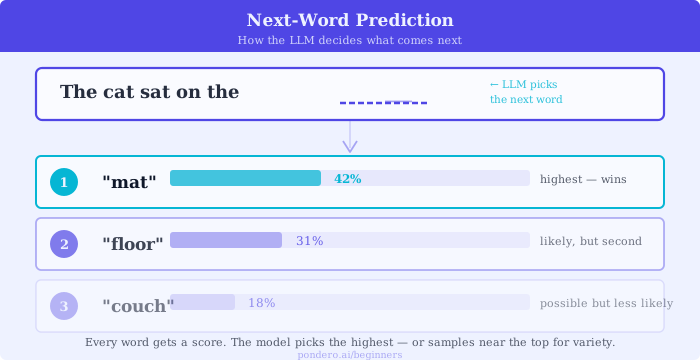
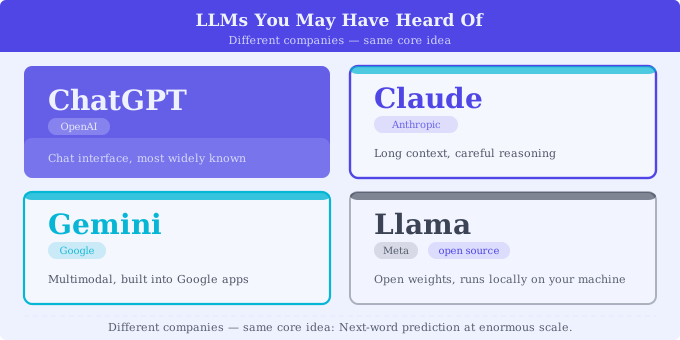
You keep hearing "LLM" because it is the engine under ChatGPT, Claude, and almost every AI tool that writes back to you in sentences. Here is what it actually is, and the one consequence that matters more than the definition.
The definition that does the work
Your phone's keyboard suggests the next word from the few you just typed. An LLM does the same job, with two differences that change everything. It read a far larger pile of text, roughly books plus articles plus most public web pages plus a lot of code. And it does not stop at one suggestion. It picks a likely next word, adds it, then predicts the next from everything so far, and keeps going until it has written a paragraph or a working function.
That is the entire mechanism. There is no fact lookup, no rulebook, no understanding step. It is one prediction, repeated, fast.
The consequence that actually matters
Because an LLM learned patterns from text rather than checking the world, you can predict its behavior without knowing anything technical. Topics written about a million times have strong, consistent patterns, so the model is sharp and usually right. Topics written about rarely, or that changed after its training, have weak patterns, so it gets vague or confidently wrong, and it sounds equally fluent either way. The fluency is not evidence of correctness. Producing fluent text is the only thing it was ever trained to do.
That single point is why the practical rule for using one is: trust it on common ground, verify it on anything rare, recent, or high-stakes.
Why this is different from older software and old chatbots
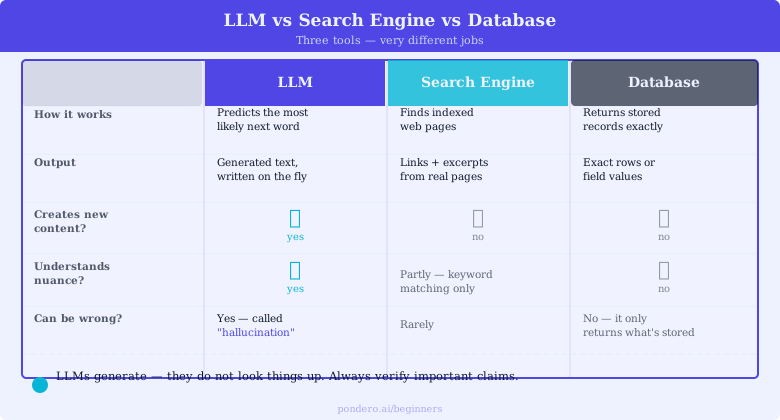
Ordinary software follows rules a programmer wrote, step by step, and does exactly that and nothing else. An LLM was not given the rules. It was shown enough text that the patterns to write, translate, and code emerged from prediction alone. That is why it is flexible where rule-based software is brittle.
The old chatbots picked from answers a human wrote in advance, so they broke the moment you asked something off-script. An LLM builds a new sentence for almost any topic it saw text about. Same reason it is powerful and the same reason it can confidently make things up: it is composing, not retrieving.
What to do with this, by who you are
If you run operations, point an LLM at high-volume tasks with clean, repetitive text and keep a person checking anything that feeds a decision. If you build apps, the LLM is a flexible component, not a source of truth; wrap it with retrieval or validation wherever a wrong answer costs something. If you are a student, it is a strong drafting and brainstorming partner and a poor citation; verify every fact it hands you. If you are just curious, the one thing worth remembering is that it predicts text, so a confident answer and a correct answer are not the same event.
Want to see one driving an AI agent that takes actions, not just words? Lindy is an easy first one to try.