Table of Contents
CodeRabbit vs Greptile vs Sourcery: Which AI Code Reviewer Catches Bugs Without Drowning Your PRs in Comments
The benchmark gap looks decisive and is not: Greptile catches 82% of bugs on its own benchmark, CodeRabbit 44%, but Greptile also fires 11 false positives per PR against CodeRabbit's 2. The reason this is not a tiebreaker is structural, not incidental. Catch rate and false-positive rate are the same dial. Greptile's coverage comes from indexing the whole repository and reasoning about a diff in that wider context; that same context is what lets it flag things that look wrong from across the codebase but are fine, which is most of what a false positive is. You cannot buy Greptile's 82% without buying its 11. So the real decision is not "which tool is most accurate," it is "what is your team's tolerance for noise before they start batch-dismissing the bot," because a bot your engineers have learned to skip catches 0% regardless of its benchmark. At 20 PRs a week, Greptile's defaults generate 220 bogus comments weekly. That is the number that decides this, not the 82.
Q1 2026 forced the comparison: GitHub Copilot moved code review behind the paid tier, every other vendor had to justify price, and teams ran head-to-head tests that came back messier than the marketing. Below: where each tool sits on that catch-versus-noise curve, three concrete PR scenarios run side by side, and the matrix that maps the curve to your review cadence.
{{catch-rate-scatter}}
The benchmark numbers and what they actually measure
The headline numbers in this article come from two sources. The catch rates (Greptile 82%, CodeRabbit 44%, Copilot 54%) come from Greptile's own benchmarks page, updated April 2026. The study ran 50 real-world bugs across five open-source repositories in Python, TypeScript, Go, Java, and Ruby, using each tool's default settings. Because Greptile authored the study, treat those catch-rate numbers as the ceiling, not the floor.
The false-positive figures (Greptile 11 per PR, CodeRabbit 2 per PR) come from a separate independent comparison by Panto.ai, published April 2026, which evaluated both tools across a sample of PRs and logged flagged items that reviewers marked as incorrect.
For Sourcery, DeployHQ's April 2026 AI code review comparison puts the catch rate around 58% with roughly 5 false positives per PR. That puts Sourcery squarely between the other two on both axes.
One more data point worth knowing: the DevTools Academy Macroscope 2025 study ran a different evaluation scope, focusing on self-contained runtime bugs and excluding style issues. In that test, CodeRabbit scored 46% and Greptile came in at 24%. Different methodology, different result. The benchmark question is not just "which tool is better" but "which tool is better for the kinds of bugs your team actually ships."
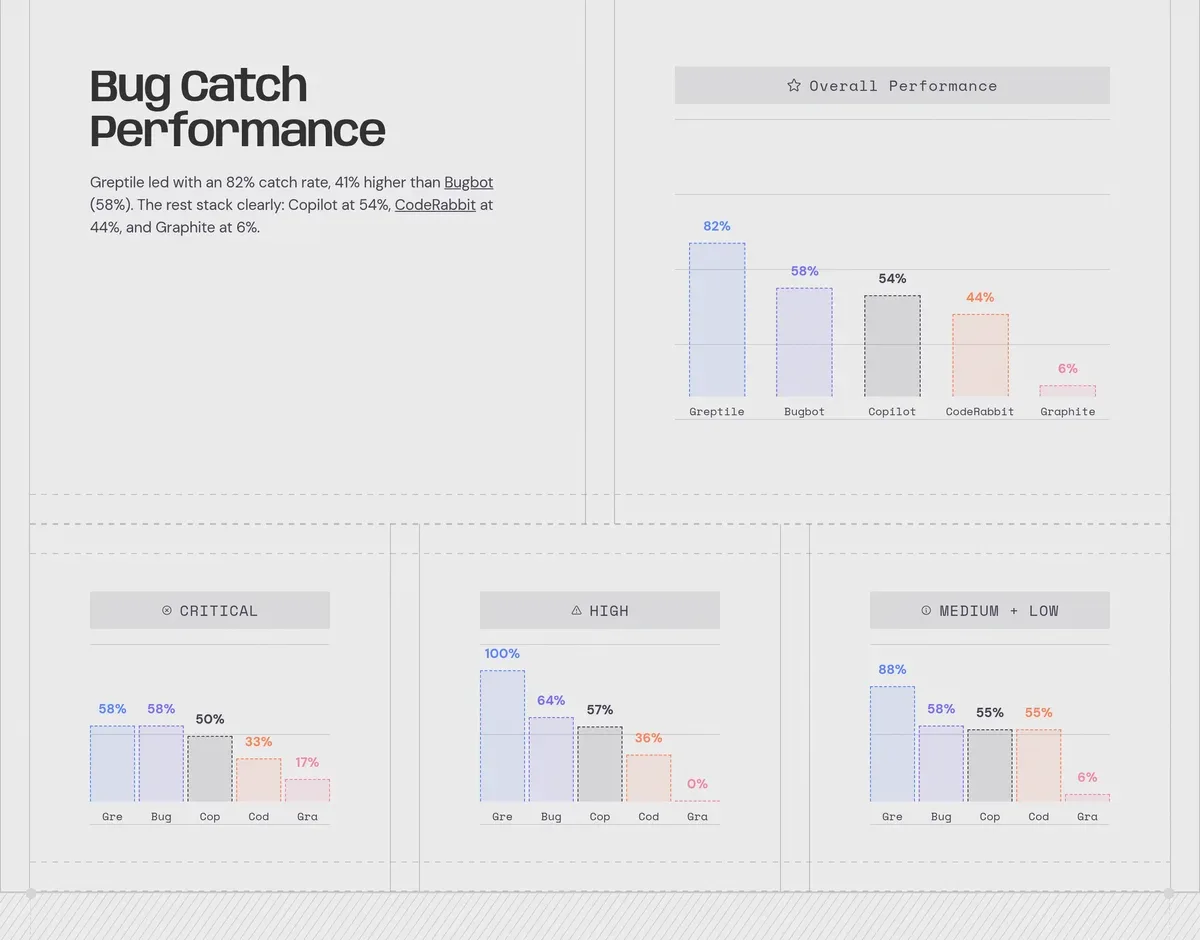 Source: greptile.com, captured October 21, 2026.
None of these studies measures tuned configurations. Every tool was tested at defaults. If your team invests time in custom rulesets, the numbers shift.
| Tool | Catch rate (Greptile benchmark) | False positives per PR | Best for |
|---|---|---|---|
| Greptile | 82% | 11 | Teams that can absorb noise and need maximum bug coverage |
| Sourcery | ~58% | ~5 | Teams wanting refactor suggestions alongside bug flags |
| GitHub Copilot Review | 54% | baseline | Teams already paying for Copilot |
| CodeRabbit | 44% | 2 | Teams that value low noise over maximum coverage |
CodeRabbit: quiet by design
CodeRabbit's 44% catch rate isn't a selling point you'll see in its marketing. What CodeRabbit does market, accurately, is that it keeps comments actionable. Two false positives per PR means engineers are unlikely to build up a "skip this bot" habit.
The setup is a one-click GitHub App install with a YAML config that drops into your repo root. Here's the minimal setup:
# .coderabbit.yaml
language: "en-US"
tone_instructions: "Be concise. Flag only actionable issues."
reviews:
  request_changes_workflow: false
  high_level_summary: true
  poem: false
  review_status: true
  collapse_walkthrough: false
  auto_review:
    enabled: true
    drafts: false
    base_branches:
      - "main"
      - "develop"
CodeRabbit shines on teams with tight review SLAs. If a PR should be reviewed and merged in under 4 hours, you need bot comments that engineers can triage quickly. Greptile's 11 false positives per PR (per Panto.ai's comparison) at a 4-hour SLA means your reviewer spends the first stretch of the review just dismissing noise before they read a single line of real code.
The weakness is real bugs that require cross-file context. On Greptile's own benchmark, CodeRabbit caught 33% of critical issues against Greptile's 58%. A null-pointer regression that spans three files is exactly the class of bug CodeRabbit is most likely to miss.
Where CodeRabbit wins: consumer apps with rapid release cycles, solo devs shipping fast, any team where reviewer bandwidth is already thin and the marginal cost of a false positive is high.
Greptile: the high-coverage bet
Greptile's standout number is 100% on high-severity bugs in the Greptile benchmark. That's a remarkable claim, and the methodology backs it enough to take seriously: the tool indexes the full codebase and reasons about a PR in that broader context rather than reading only the diff.
In the Greptile vs CodeRabbit comparison, the vendor shows three specific bugs CodeRabbit missed that Greptile caught: an import of a non-existent OptimizedCursorPaginator in the Sentry codebase, raw SQL queries vulnerable to injection in cal.com, and missing database cleanup when immediateDelete is true in cal.com. These are exactly the bugs that matter, the kind that get through human review precisely because they require knowing the rest of the codebase.
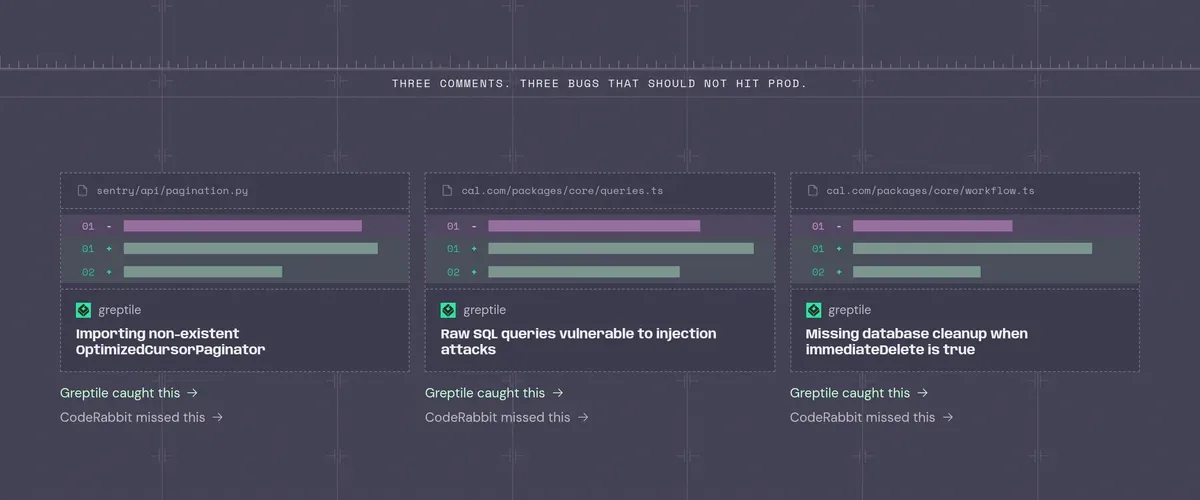 Source: greptile.com, captured October 21, 2026.
The tradeoff is the comment volume. Here's what the Greptile setup looks like, and why you'll want to configure noise reduction from day one:
# greptile.yaml
version: "1"
review:
  min_severity: "medium"       # skip low-severity style nits
  max_comments_per_pr: 15      # hard cap to limit noise
  suppress_refactor: true      # refactor suggestions go to a separate channel
  context_depth: "full"        # the feature that makes the catch rate work
Setting min_severity: medium and capping comments per PR are the two controls that make Greptile usable. Without them, you get 11+ comments per PR and half of them are things your linter should catch anyway.
Greptile works best on security-sensitive codebases, fintech and healthcare teams where a missed SQL injection or an unguarded credential exposure is a production incident, not a tech debt ticket. The false-positive tax is worth paying when the cost of a missed critical bug is high enough.
Where Greptile wins: security-critical repos, backend services with complex cross-module dependencies, teams with dedicated reviewers who have bandwidth to triage bot output before merging.
Sourcery: the refactor angle
Sourcery sits around 58% catch rate and 5 false positives per PR in DeployHQ's April 2026 comparison, and that middle position is somewhat deliberate. Sourcery's product vision is different from both CodeRabbit and Greptile: it's as interested in code quality over time as in catching bugs in the current PR.
The refactor suggestions are genuinely useful. Sourcery looks at patterns like duplicated logic, unnecessary nesting, and functions that have grown past their natural scope, and flags them alongside actual bugs. CodeRabbit flags these occasionally; Greptile mostly skips them (the Panto.ai comparison showed Greptile filing one refactoring suggestion versus CodeRabbit's eight across the same PRs).
# Install Sourcery CLI for local pre-push review
pip install sourcery
sourcery login --token <YOUR_SOURCERY_TOKEN>

# Review a branch before opening a PR
sourcery review --diff main...feature/my-branch

# Output shows:
# [HIGH] src/payments/process.py:47 - Possible None dereference on `result.data`
# [MED]  src/payments/process.py:88 - Function `validate_order` is 94 lines; consider splitting
# [LOW]  src/utils/helpers.py:12 - Duplicate of `format_currency` in src/billing/format.py
The Sourcery CLI is one feature CodeRabbit and Greptile don't have in the same form. You can run it locally before a PR is even opened, catching issues before they hit CI. For teams where PR review is a bottleneck, that shift-left capability changes the workflow. The package to install is sourcery on PyPI, not the older sourcery-cli package, which hasn't shipped a release since mid-2024.
Where Sourcery wins: Python-heavy teams (it's strongest there), teams investing in a refactor cycle alongside feature work, solo or small-team setups where one tool doing both bug-catch and code-quality is more practical than two separate bots.
Three PR scenarios, side by side
{{pr-comments-comparison}}
The most useful way to see the difference is to run the same bugs through all three tools.
Scenario 1: null-pointer regression
A PR adds a new helper function that calls .user.settings.theme without guarding against a null user. The bug only triggers if a guest session hits a certain route.
# src/views/dashboard.py
def get_theme(request):
    # BUG: request.user can be AnonymousUser with no .settings attribute
return request.user.settings.theme- CodeRabbit: Likely misses it. Null dereference that requires knowing
AnonymousUserdoesn't carry.settingsis context-dependent; CodeRabbit reads the diff, not the user model. - Greptile: Catches it. Full codebase context means it knows the user model and the guest session path.
- Sourcery: Mixed. Sourcery flags the pattern as a potential None dereference with medium confidence if it can trace the type, but the Sourcery docs note it's strongest on typed Python (3.10+ with type hints). Without type hints, this may not surface.
Scenario 2: off-by-one in a pagination loop
A PR modifies a paginator to fetch records. The loop runs range(1, page_count) instead of range(1, page_count + 1), dropping the last page of results silently.
# src/api/paginator.py
def fetch_all_pages(client, endpoint):
    page_count = client.get_page_count(endpoint)
    results = []
    for page in range(1, page_count):   # BUG: should be page_count + 1
        results.extend(client.fetch(endpoint, page=page))
return results- CodeRabbit: Off-by-one bugs are in its sweet spot. This is a self-contained diff-readable mistake. CodeRabbit catches this class well.
- Greptile: Also catches it, but may bury the flag in longer comment output.
- Sourcery: Catches it at medium-to-high confidence. Off-by-one in a loop is a pattern Sourcery's static analysis covers explicitly.
Scenario 3: flaky test smell
A PR adds a test that sleeps for 2 seconds to wait for an async event instead of using a proper assertion helper or mock.
// tests/notifications.test.js
it('sends notification after order completes', async () => {
  placeOrder(testOrder);
  await new Promise(resolve => setTimeout(resolve, 2000)); // SMELL: hardcoded sleep
  expect(notificationService.sent).toBe(true);
});- CodeRabbit: Flags hardcoded timeouts in tests. This is exactly the kind of low-noise, high-signal comment CodeRabbit's default config surfaces.
- Greptile: May flag it, but given its focus on security and logic bugs, the flaky-test smell competes with higher-severity items in the comment cap.
- Sourcery: Strong here. Test quality is part of Sourcery's refactor lens, and it suggests the proper
waitForor event-driven pattern rather than just flagging the sleep.
Setting up all three for a trial run
If your team wants to run a structured evaluation before committing, here's the install sequence:
# CodeRabbit: GitHub App install (no CLI needed)
# Visit https://github.com/apps/coderabbitai and install on target repos
# Then drop .coderabbit.yaml into your repo root (see config above)

# Greptile: GitHub App + API key
# Visit https://app.greptile.com and connect your GitHub org
# Generate an API key, then add greptile.yaml to your repo root

# Sourcery: pip + GitHub App (Python) or GitHub App only (other languages)
pip install sourcery
sourcery login --token <YOUR_SOURCERY_TOKEN>
# For GitHub integration: visit https://github.com/apps/sourcery-ai
Run all three on the same repo for two weeks. Log every comment in a shared doc with three columns: "Valid bug", "Refactor suggestion", "False positive." At the end of two weeks, you'll have the only benchmark that matters: the one calibrated to your codebase.
Pairing any of these with GitHub Copilot Workspace
PR bots and GitHub Copilot Workspace solve different problems. A PR bot reviews what your engineers submitted. Copilot Workspace helps engineers write the code before they submit it.
The pairing that works: Copilot Workspace for complex feature work (where the AI-assisted drafting generates the initial implementation), then a PR bot to catch what Workspace missed. We cover the Workspace side in more depth in our Copilot Workspace 30-day notes, but the short version is that Workspace tends to miss cross-service integration bugs and flaky test patterns. That's exactly where CodeRabbit and Sourcery add value on top of it.
Greptile's full-codebase context also pairs well with Workspace specifically because Workspace generates code that looks locally correct but may not fit the broader repository patterns. Greptile catches the mismatch. The combination is genuinely useful for teams shipping features at speed.
Which one to pick
Three team archetypes map cleanly to the three tools.
You're a fast-shipping consumer product team with 15+ PRs a week, a 4-hour merge SLA, and reviewers who already feel stretched. Start with CodeRabbit. Its 44% overall catch rate on Greptile's benchmark leaves bugs on the table, but the 2 false positives per PR (per Panto.ai) means your reviewers actually engage with the comments instead of batch-dismissing them. The bugs CodeRabbit misses are usually the complex cross-file logic errors that need a human reviewer anyway.
You're a backend team in fintech, healthcare, or any security-critical domain. Greptile's 82% overall catch rate and 100% on high-severity bugs on its own benchmark justifies the noise. Assign one reviewer per sprint specifically to triage Greptile's output, configure the severity threshold and comment cap, and treat it as a second senior engineer reading every PR. The operational overhead is real. So is the cost of a missed SQL injection.
You're a Python team or a team mid-way through a refactor. Sourcery. The bug catch rate is solid and the refactor angle is something neither competitor offers in the same integrated way. The CLI-first workflow also fits teams that want to catch issues before they become PR comments at all.
One condition flips each of these. CodeRabbit's call inverts the moment you put it on a security-critical service, where a missed SQL injection costs more than a quarter of dismissed noise and Greptile's coverage becomes mandatory regardless of volume. Greptile's call inverts if you cannot dedicate a reviewer to triage its output, because an untriaged 11-per-PR firehose decays to the same batch-dismissed 0% as a weak bot. Sourcery's call inverts away from it on a TypeScript-heavy or non-refactor codebase, where its Python strength and refactor lens are inert and you are just back to the catch-versus-noise question between the other two. No bot replaces the senior engineer who knows the codebase; the bot's job is to catch what that reviewer misses while staying quiet enough that the team never learns to skip it.