
Table of Contents
GitHub Copilot Plans Compared: Free, Pro, Pro+, Business, Enterprise (2026)
The short version: Free is fine for students and occasional use, Pro ($10/month) handles most solo developers, Pro+ ($39/month) makes sense only if you hit request limits regularly and need Claude Opus 4.7 or GPT-5.5, Business ($19/user/month) is the pick for any team that needs admin controls, and Enterprise ($39/user/month) adds SSO, audit logs, and knowledge bases for organizations that require them. Three plan-level changes landed this week that make those lines matter more than they did a month ago, and the June 1 billing transition is five days out.
Here is what changed, what each plan costs in practice, and where Cursor is the cleaner choice.
Quick pick
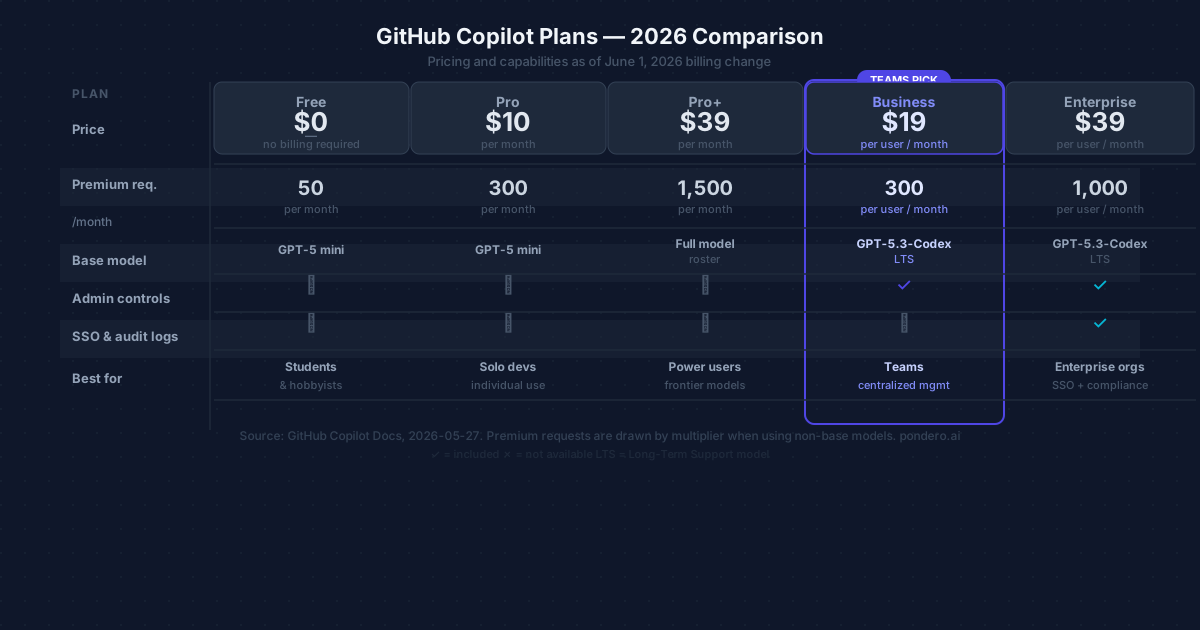
| Plan | Price | Best for | Premium requests/month | Base model |
|---|---|---|---|---|
| Free | $0 | Students, occasional use, evaluating before paying | 50 | GPT-5 mini (included) |
| Pro | $10/mo | Solo developers who write code daily | 300 | GPT-5 mini / GPT-5.3-Codex at 1x |
| Pro+ | $39/mo | Power users who exhaust Pro limits or need top models | 1,500 | Full model roster |
| Business | $19/user/mo | Teams needing admin controls and usage reporting | 300/user | GPT-5.3-Codex (LTS, 1x) |
| Enterprise | $39/user/mo | Orgs requiring SSO, audit logs, fine-tuned models | 1,000/user | GPT-5.3-Codex (LTS, 1x) |
Overages cost $0.04 per additional premium request on all paid plans (per GitHub Copilot plans docs). The full plan and features overview is at github.com/features/copilot.
GitHub Copilot Free
What you get
The Free plan gives you 2,000 inline code completions and 50 premium chat requests per month. Claude Haiku 4.5 is available across all plans including Free. The heavier models, GPT-5.3-Codex, Claude Sonnet, Gemini 2.5 Pro, are not available to Free users.
Inline completions on the Free plan are unlimited on included models (GPT-5 mini). The 50-request ceiling is on premium chat and agent interactions only.
After June 1, the GitHub docs indicate a move to usage-based billing for paid plans. The Free plan treatment post-June 1 is not spelled out explicitly in the current docs. We have confirmed from the premium requests reference page that Free users receive a fixed monthly allocation (50 requests) now, but GitHub has not yet published specific Free-tier behavior after the June 1 cutover. Check the docs before assuming the ceiling changes.
Who it makes sense for
Students, developers who use AI coding assistance a few hours a week at most, and anyone evaluating whether GitHub Copilot fits their workflow before committing to a paid plan. If you hit the 50-request ceiling before mid-month, Pro is the right next step.
GitHub Copilot Pro ($10/month)
What changed in May 2026
Auto model selection landed in VS Code on May 20 and routes your requests to the right model by task type. It evaluates reasoning complexity, code generation difficulty, bug diagnosis, and tool orchestration needs in real time, then picks the best available model. You can hover over any response to see which model was used, and you can switch to a specific model manually at any time.
Auto selection is limited to models with 0x to 1x premium request multipliers. It also applies a 10% discount on the multiplier for paid plan users, so Claude Sonnet 4.6 (normally 1x) runs at 0.9x when the router picks it. The feature respects admin-set model policies, which matters more for Business and Enterprise (see below). For Pro users on VS Code, it is available without admin configuration.
The May 20 changelog does not explicitly list Free plan access to auto model selection. The 10% discount applies to paid plan users only. We are not asserting Free plan eligibility because we cannot confirm it from the source.
300 premium requests per month
At a 1x multiplier, GPT-5.3-Codex costs one premium request per request. Claude Sonnet 4.6 is also 1x (0.9x with auto selection). Claude Haiku 4.5 runs at 0.33x. An active development day that uses Copilot Chat heavily, say 20 substantive exchanges, consumes roughly 18-20 premium requests with a mix of Sonnet and Haiku. At that pace, 300 requests per month is enough for most developers who do not run long multi-turn agent sessions every day.
Where Pro starts to pinch: if you run Copilot's agent mode for extended debugging sessions or let it orchestrate multi-step tasks, the request count climbs faster. One Claude Opus 4.7 session at a 15x multiplier burns 15 requests in a single exchange.
When Pro is enough vs when to upgrade
Pro handles the majority of individual developer use cases. The upgrade to Pro+ makes sense if you consistently exhaust your 300 requests before the month ends, or if your work genuinely benefits from Claude Opus 4.7 (15x multiplier) or GPT-5.5 (7.5x multiplier). Those models cost enough per request that a meaningful session can consume a week's Pro budget in an afternoon. Pro+ is not a casual upgrade.
GitHub Copilot Pro+ ($39/month)
1,500 premium requests and what the extra budget unlocks
Pro+ gives you 1,500 premium requests per month, five times the Pro allocation. The practical difference is not just headroom, it is model access. Pro+ unlocks the full model roster, including Claude Opus 4.7 at 15x and GPT-5.5 at 7.5x.
At 1,500 requests, a daily 10-request session using Sonnet 4.6 at 0.9x (with auto selection) consumes about 270 requests per month. That leaves over 1,200 requests for heavier work. A developer who runs two or three deep debugging sessions per week with Claude Opus 4.7, each burning 30-40 requests, still fits inside the Pro+ envelope without overages.
Claude Opus 4.7 and GPT-5.5: when the premium models justify the price
Claude Opus 4.7 at 15x is Anthropic's best available model in Copilot as of May 2026. GPT-5.5 at 7.5x is similarly positioned for complex reasoning tasks. These are not everyday completion models. They make sense when you are working through a genuinely hard problem: a system design decision with many variables, a bug that has resisted two sessions, a large refactor where you want the model to reason carefully about side effects rather than pattern-match quickly.
For work that is primarily code completion and routine chat, Sonnet 4.6 or even Haiku 4.5 will cover most of it. The premium models earn their multiplier at the high end of the complexity curve.
Is Pro+ worth $39/month for a solo developer?
Pro+ costs the same per month as an Enterprise seat. That comparison comes up naturally, so name it plainly: Pro+ and Enterprise are both $39, but they solve different problems. Pro+ buys an individual developer 1,500 premium requests and the full model roster. Enterprise buys a seat in an organization-level product with SSO, audit logs, custom fine-tuning, and 1,000 requests per user in a managed policy environment.
For a solo developer, Pro+ is worth it if you are running complex, daily agent-mode sessions and need Opus 4.7 regularly. If your usage is lighter, Pro at $10 covers it and the $29 difference goes elsewhere. If your primary need is a high-capability agent for large-scale refactors and you are not locked into the GitHub ecosystem, the Cursor comparison later in this piece is worth reading before deciding.
GitHub Copilot Business ($19/user/month)
GPT-5.3-Codex as the new base model
On May 17, GitHub switched the default base model for Business and Enterprise from GPT-4.1 to GPT-5.3-Codex for organizations that had not explicitly set a default model. The practical effect: Business and Enterprise organizations are now consuming premium requests on their base model where they were not before, because GPT-4.1 ran at a 0x multiplier while GPT-5.3-Codex runs at 1x.
GPT-4.1 remains force-enabled at 0x for now but deprecates June 1. If your organization has not checked model settings since May 17, verify your default model in Copilot settings before June 1 (per the May 17 changelog).
The LTS guarantee means Business and Enterprise admins can count on GPT-5.3-Codex being available through February 4, 2027 without a forced model migration in that window. That matters for organizations that need to run a security review before approving a new model. You can complete that review on a predictable timeline rather than racing a deprecation clock.
For a step-by-step prep checklist covering the June 1 transition, see our GitHub Copilot usage-based billing guide.
Admin controls, policy management, and model approval workflows
Business plan admins can set which models users can access from the GitHub organization settings. Gemini 3.5 Flash, for example, requires an explicit admin policy enable for Business and Enterprise before users can select it (per the May 19 changelog). Auto model selection respects these policies, so the effective model pool the router can pick from depends on what the admin has approved.
This is the control plane that Free, Pro, and Pro+ lack entirely. An individual developer on any of those plans can switch models freely. A Business admin can limit the pool to approved models across the whole organization, which is the purchase for compliance-sensitive teams.
The GitHub Copilot app (technical preview, available to Business and Enterprise) extends automation capabilities beyond the editor. For setup details, see our GitHub Copilot app setup guide.
Usage metrics API and per-seat pricing math
Business added team-level usage reporting on May 14. Admins can query the metrics API to see which models users are calling, how many premium requests each seat is consuming, and where overages are coming from. For a team actively managing costs after the June 1 billing transition, that visibility is what makes Business worth the price over individual Pro plans.
The per-seat math: 5 seats is $95/month. At that scale, five Pro plans would cost $50/month but without admin controls, policy management, or usage reporting. Business makes economic sense when the control plane justifies the $45 premium. For teams of 10 or more, the compliance and reporting story is the main argument; the per-seat cost difference matters less.
GitHub Copilot Enterprise ($39/user/month)
1,000 premium requests per user vs Business's 300
Enterprise triples the premium request allocation compared to Business, from 300 to 1,000 per user per month. At a 1x multiplier, that is 1,000 Sonnet-tier exchanges per user before overages. For developers running long agent sessions or regularly calling Opus-tier models, that ceiling is meaningfully higher.
What Enterprise adds
Beyond the request allocation, Enterprise includes:
- SSO (SAML) integration
- Audit logs for security and compliance review
- Knowledge bases: custom organizational context that Copilot can draw from in chat
- Custom fine-tuning on your organization's codebase
- The GitHub Copilot app with expanded automation
Knowledge bases are the most operationally useful differentiator over Business. They let Copilot answer questions with awareness of your organization's specific documentation, internal APIs, and conventions, without you having to paste that context into every session.
When Enterprise is worth 2x the Business price
The math is straightforward: Enterprise costs $39/user where Business costs $19/user. The premium buys the higher request ceiling, SSO, audit logs, and knowledge bases. If your organization needs SAML for compliance, the choice is made for you. If you need audit logs to satisfy a security review, same answer.
For teams that do not have those compliance requirements and whose developers do not regularly hit 300 requests per month, Business is the right call. The Enterprise tier is for organizations that need both the compliance infrastructure and the higher usage ceiling, not just one or the other.
Model access by plan
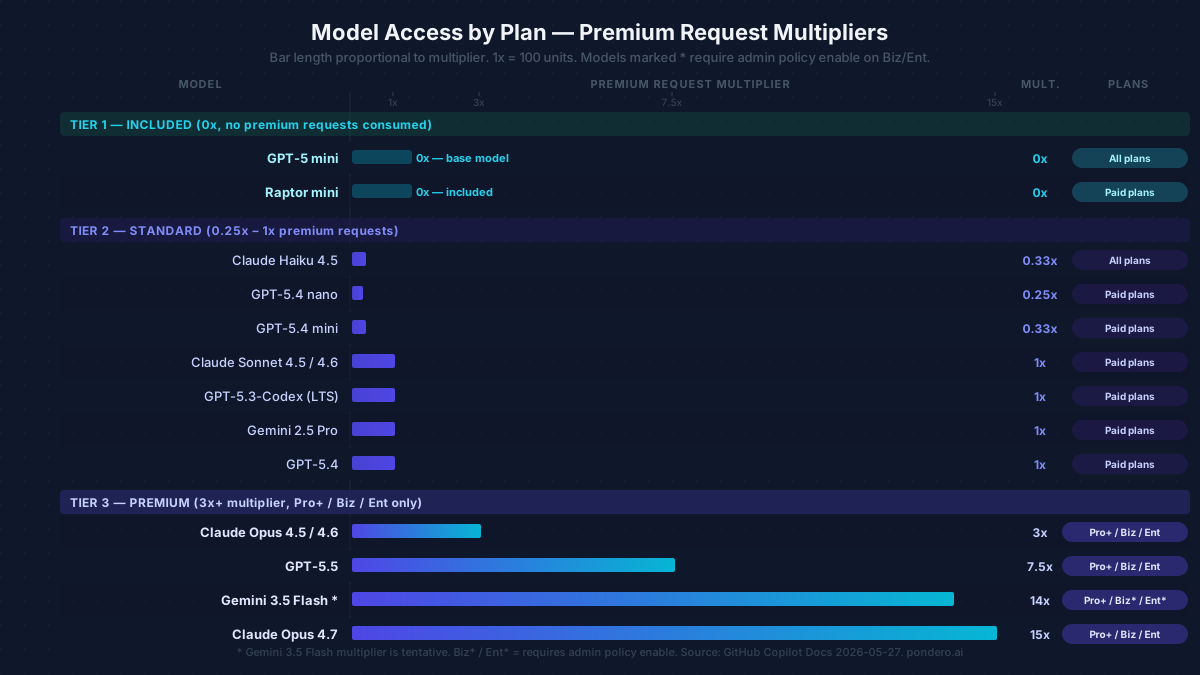
The following multipliers are sourced from the GitHub Copilot premium requests reference as of May 27, 2026. Models with a 0x multiplier (GPT-5 mini, Raptor mini) are included with paid plans and do not draw from the premium request quota.
| Model | Multiplier | Plans with access |
|---|---|---|
| GPT-5 mini | 0x (included) | All plans |
| Raptor mini | 0x (included) | Paid plans |
| Claude Haiku 4.5 | 0.33x | All plans |
| GPT-5.4 nano | 0.25x | Paid plans |
| GPT-5.4 mini | 0.33x | Paid plans |
| Claude Sonnet 4.5 | 1x | Paid plans |
| Claude Sonnet 4.6 | 1x | Paid plans |
| GPT-5.3-Codex | 1x | Paid plans (LTS: Business/Enterprise default) |
| Gemini 2.5 Pro | 1x | Paid plans |
| Gemini 3.1 Pro (preview) | 1x | Paid plans |
| GPT-5.4 | 1x | Paid plans |
| GPT-5.5 | 7.5x | Pro+, Business, Enterprise |
| Claude Opus 4.5 | 3x | Pro+, Business, Enterprise |
| Claude Opus 4.6 | 3x | Pro+, Business, Enterprise |
| Claude Opus 4.7 | 15x | Pro+, Business, Enterprise |
| Claude Opus 4.6 (fast mode) | 30x | Pro+, Business, Enterprise |
| Gemini 3 Flash (preview) | 0.33x | Paid plans |
| Gemini 3.5 Flash | 14x (tentative) | Pro, Pro+, Business*, Enterprise* |
*Business and Enterprise require admin policy enable for Gemini 3.5 Flash.
The Gemini 3.5 Flash 14x multiplier is marked "tentative and subject to change" in the May 19 changelog. Do not build budget projections around it until GitHub confirms a final rate.
What GPT-5.3-Codex LTS means for procurement
The LTS guarantee runs from launch (February 5, 2026) through February 4, 2027. For Business and Enterprise organizations that run a formal security review before adopting a new model, this window is long enough to complete that review and establish the model in policy without racing a deprecation clock. GPT-4.1, GPT-5.2, and GPT-5.2-Codex all deprecate June 1. GPT-5.3-Codex does not share that deadline.
Gemini 3.5 Flash at 14x: the actual cost across plans
At 14x (tentative), a single Gemini 3.5 Flash request consumes 14 premium requests. On Pro (300 requests/month), that is 21 sessions before you exhaust the premium budget on Gemini 3.5 Flash alone, leaving nothing for other premium models. On Pro+ (1,500 requests/month), you have room for roughly 107 Gemini 3.5 Flash sessions plus a full complement of 1x-tier usage.
On Enterprise (1,000 requests/user/month), 14x is more manageable but still meaningful for heavy users. This model is not a daily-driver choice at current multiplier rates, but it may be worth selecting for specific tasks where it outperforms the 1x tier.
June 1 billing change impact by plan
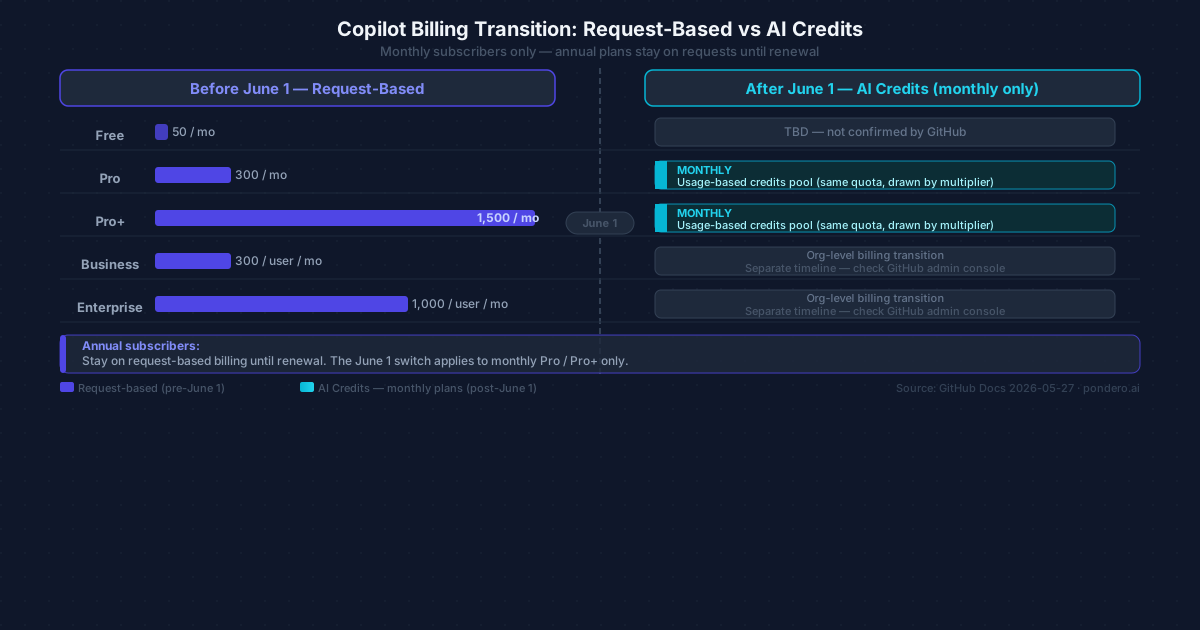
Starting June 1, GitHub moves Copilot from request-based billing to usage-based billing (AI Credits) for monthly subscribers on Pro and Pro+. The Free plan treatment after June 1 is not confirmed in current GitHub docs, so we are not speculating on it here. Check the GitHub Copilot plans page for the definitive answer before that date.
Annual plan subscribers: you stay on request-based billing until your annual renewal. The June 1 switch applies to monthly billing cycles only.
Business and Enterprise billing transitions follow a separate timeline and are managed at the organization level. The usage-based billing guide has the step-by-step prep checklist.
Under the new system, your monthly request allocation becomes a pool of AI Credits. The model multipliers determine how quickly you draw down that pool. A Claude Sonnet 4.6 request at 1x draws one credit. A Claude Opus 4.7 request at 15x draws fifteen. The math is the same as the current request system; the currency name changes.
GPT-4.1 (currently 0x, does not draw from your quota) deprecates June 1. After that date, every model in your workflow carries a multiplier. If you were relying on GPT-4.1 to handle routine tasks at no cost, you need a substitute. GPT-5 mini at 0x is the natural replacement. It is available across all paid plans.
When to choose Cursor instead
Copilot's case is strongest when your organization is already on GitHub and needs admin controls, policy management, and the GitHub-native automation layer. If those requirements are present, Copilot Business is the pick. The control plane is the product.
The case for switching flips on a specific profile: a solo developer or small team doing primarily IDE-based coding, not locked into a multi-IDE organization, and wanting a flat-rate cloud agent without per-token metering on routine tasks.
Cursor Pro ($20/month) bundles Cursor's Composer 2.5 multi-file agent, which handles multi-repo automations with a quality that the GitHub Copilot agent mode does not match at this point. For the setup and configuration details, see our Cursor v3.5 automations guide.
The billing structure is the concrete difference. Copilot Pro at $10/month plus overages at $0.04/request gives you 300 premium requests, then a usage-based tail starting June 1. Cursor Pro at $20/month gives you a flat rate for standard agent runs without per-token metering on typical sessions. For a developer who runs Composer heavily throughout the week, the Cursor billing model is predictable in a way that Copilot Pro will not be after June 1.
Where to stay on Copilot: your team uses JetBrains or Xcode alongside VS Code and needs one assistant across all of them. Your organization needs indemnification or audited automation. You are a Business or Enterprise customer with admin controls and the LTS procurement story matters. Those are the conditions where Copilot's breadth and control plane out-earn Cursor's depth.
For readers weighing the full field of coding agent options beyond Copilot and Cursor, the Grok Build vs Claude Code vs Cline comparison covers the terminal-focused agent category.
FAQ
Does auto model selection count against premium requests?
Yes. Auto selection draws from your premium request quota at the rate of whichever model it picks, with a 10% multiplier discount applied. If the router picks Claude Sonnet 4.6 (1x), you are charged 0.9x per request, not 1x. The discount does not apply to Free plan users.
Can you mix Copilot Free (for completions) with another tool for chat and agents?
Yes. Copilot Free's 2,000 monthly completions work in VS Code, JetBrains, Xcode, and other supported IDEs, and nothing stops you from running a separate chat tool alongside it. The practical limit is that the Free plan's 50 premium request ceiling means any meaningful chat or agent work will hit the ceiling quickly. For pure inline completion supplemented by a dedicated chat tool, the combination is workable.
What happens to request counts when the base model switched on May 17?
If your Business or Enterprise organization's default model changed from GPT-4.1 (0x) to GPT-5.3-Codex (1x) on May 17, your premium request consumption went up from that date forward. GPT-4.1 is still force-enabled at 0x temporarily, so explicitly selecting GPT-4.1 still costs nothing until June 1. After June 1, GPT-4.1 is gone.
Does Gemini 3.5 Flash work in all IDEs or just VS Code?
The May 19 changelog marks Gemini 3.5 Flash as generally available for GitHub Copilot, which covers the standard Copilot extension and its supported clients. The changelog does not restrict it to VS Code. Business and Enterprise admins must enable the Gemini 3.5 Flash policy before their users can access it.
Will GPT-4.1 stop working completely on June 1?
Yes. GPT-4.1, GPT-5.2, and GPT-5.2-Codex all deprecate June 1, per the supported models page. GPT-4.1 remains force-enabled at 0x until that date. After June 1, GPT-5 mini is the 0x-cost substitute on included models. GPT-5.3-Codex at 1x is the quality step-up and carries the LTS guarantee through February 4, 2027.