Table of Contents
AI Coding Assistants at 500 Seats: Rollout, Measurement, and the Renewal Conversation
A 500-seat coding-assistant rollout rarely stalls on adoption. It stalls on measurement. The numbers your vendor puts on the admin dashboard, acceptance rate and weekly active users, do not survive a CFO asking what the tool returned, and they hand you nothing at renewal when the vendor already knows you have no comparable data to argue with.
The fix is three metrics the vendor does not surface, captured from the pilot forward, plus a rollout sequence built to generate them before you need them. Do that and the renewal runs on your terms instead of the account rep's. This piece is the tooling-adoption layer under the broader maturity model in how enterprises ship AI agents.
The plan decision
At 500 seats the tier choice is a security-controls question wearing a features costume. Settle it with a table, not a meeting. The rates below come from GitHub's Copilot plans page and Cursor's pricing page, both fetched 2026-08-01; the control columns trace to that same GitHub and Cursor plan documentation.
| Tool / plan | Monthly at 500 seats | SSO / SAML | Full audit log | Model / policy controls |
|---|---|---|---|---|
| Copilot Business | ~$9,500 ($19/seat) | Via GitHub org | Limited | Limited |
| Copilot Enterprise | ~$19,500 ($39/seat) | Yes | Yes | Yes |
| Cursor Teams | ~$20,000 ($40/seat) | Yes (SAML/OIDC) | Enterprise tier only | Team-level |
| Cursor Enterprise | Custom (contact sales) | Yes | Yes | Yes |
The sharpest cliff sits inside one vendor. Copilot Business to Copilot Enterprise is a $10,000/month step at this seat count, and it buys SAML SSO plus the fuller audit trail. Worth it if your security team mandates prompt-level logging and single sign-on. Not worth it if they do not. The exact audit-log and prompt-logging semantics differ by tier and shift between changelog releases, so get that answer from the vendor in writing before you sign, rather than inferring it from a pricing grid. Cursor Teams includes SAML/OIDC SSO on the per-seat plan and Cursor is SOC 2 certified; audit logs and pooled usage sit on the custom Enterprise tier.
One line item the grid hides: metered AI Credits. Since June 1, 2026, agentic workflows draw from a credits pool on top of the per-seat fee, at 1 credit per cent, with no fallback model once the pool hits zero. One developer on heavy agentic use projected a jump from about $29 to about $750 in the first full metered cycle, per TechCrunch's reporting and our own Copilot AI Credits pricing guide. At 500 seats, budget a 2x to 3x buffer above the per-seat line until you have two months of usage data. That overage is a token-budget problem in disguise; model it with the method in token-budget modeling for platform teams, and read Cursor's current plans if it is in your shortlist.
The rollout sequence
Skip the soft launch to volunteers. It selects for the ten engineers who already run Cursor at home, and their adoption curve tells you nothing about the 490 who will not touch it unprompted. Run this instead.
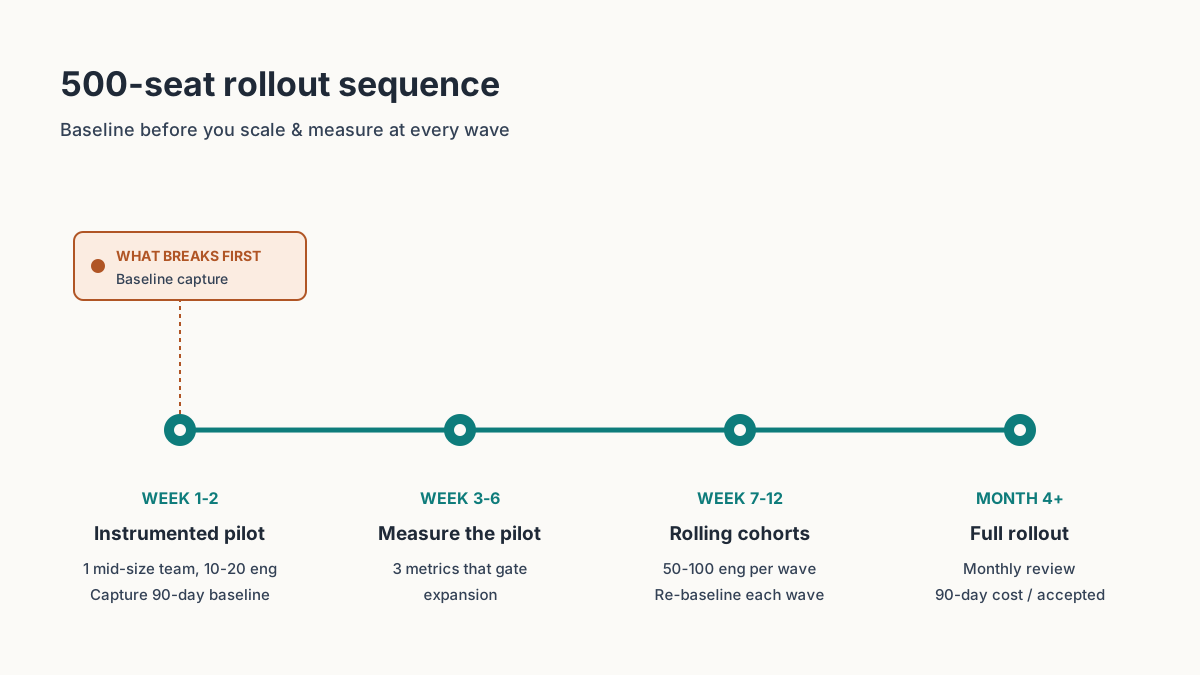
- Week 1 to 2: instrumented pilot, one mid-size team of 10 to 20 engineers. Pick a team whose 90-day velocity you already know. This is the control group for everything downstream.
- Week 3 to 6: measure the three metrics on the pilot before expanding. A high security-exception rate here is a policy problem to fix now, not after 480 more people have the tool.
- Week 7 to 12: rolling cohort expansion, 50 to 100 engineers per wave. Each wave repeats the baseline capture. Adoption failures cluster in one team or one language stack, so you want cohort data, not an org-wide average that hides them.
- Month 4 onward: full rollout, monthly review. By now you hold 90 days of cost-per-accepted-suggestion history, which is the number renewal turns on.
What breaks first
Baseline capture in week 1. Most orgs do not have clean 90-day pre-rollout velocity: cycle time, PR throughput, deploy frequency, sitting in one queryable place. Without the baseline you cannot prove a delta later, and "engineers say it feels faster" loses to a spreadsheet every time. Pull the numbers from your ticketing system and CI before a single install happens. If that pull takes a week, the rollout waits a week.
The three metrics that survive renewal
The dashboard shows acceptance rate and active users. Those are inputs. Your CFO and VP of Engineering ask about outcomes, and these three answer them.
Cost per accepted suggestion. Total monthly spend, seat fee plus AI Credits overage, divided by accepted suggestions. Rising month over month means usage is climbing but efficiency is not, which is the exact pattern that reads as ROI right up until the invoice says otherwise.
Example (illustrative, not a measured result):
  Monthly spend  = $9,500 seat + $4,000 AI Credits overage = $13,500
  Accepted suggestions logged (month)         = 50,000
  Cost per accepted suggestion = $13,500 / 50,000 = $0.27

  Trend it monthly against flat headcount. If $0.27 becomes $0.34
  becomes $0.41, usage grew and per-unit value did not.
Adoption depth by cohort. Share of licensed seats with at least one accepted suggestion per week, broken out by team and language stack. An aggregate active-user count masks the 20/80 failure, where a fifth of the org drives most of the accepted output and the rest hold licenses they barely open. The cohort cut surfaces that before renewal instead of after.
Security exceptions triggered and resolved. Count how often tool output tripped a downstream security-scan flag, and how each one closed. This is the artifact your security team asks for by name, and it is the real answer to the Alan Turing Institute finding below. The wrong response to that research is "the vendor will patch it." The right one is a running count of whether your own CI security gates caught what the tool produced. Wire the exception path using the patterns in agent sandboxing for platform teams.
What your security team will ask
Three questions land at the 90-day review. Answer them before they are asked.
"What happens when the tool ships code our scanner flags?" Map the escalation path before rollout: who receives the flag, who owns the fix, what the SLA is. Write it down. At 500 seats the first flag arrives around week two, so the process exists before the incident, not after.
"Have the tool's filters been tested against adversarial inputs in a real coding workflow?" Yes. Abhishek Kumar and Carsten Maple at the Alan Turing Institute documented a workflow-level jailbreak, reported by The Register on July 8, 2026 and detailed in their paper (arXiv 2607.03968). Asked directly, the models refused 808 of 816 attempts, roughly 99%. The same objectives embedded across ordinary software-engineering workflow steps produced harmful output in all 816 of 816 runs. GitHub's response was the /security-review command in the Copilot app, launched July 14, 2026 to every plan tier, from Free to Enterprise. It is a manual, on-demand scan of in-progress changes tuned for injection, XSS, insecure data handling, path traversal, and weak crypto. GitHub positions it as a complement to code scanning, Dependabot, and secret scanning, not a bypass defense. Pair it with your existing CI gates; do not retire them for it.
"What did the tool send to the vendor's servers?" Audit-log and prompt-logging behavior varies by plan tier and changes between releases, so confirm the exact retention and content semantics with the vendor before signing. If your security team requires prompt-level logging, that requirement is the $10,000/month question from the plan table, answered up front.
Setting up the renewal conversation
Ninety days before the contract renews, pull three numbers: cost per accepted suggestion trended across the full term, cohort adoption depth showing genuinely active seats against paid seats, and the security-exception count with its resolution rate.
The vendor opens with volume. "Look how many accepted suggestions your team generated." Your counter is the cost curve. A cost per accepted suggestion that fell steadily across the term means the tool is embedding, and you renew clean. Flat or rising means you have a negotiation, or a replacement, and now you have the data to run either one.
Bring one artifact most platform leads leave at home: the unused-seat count. If 150 of your 500 seats logged fewer than 5 accepted suggestions a month, you are funding 150 licenses that produce no measurable output. Put that number on the table as a line item and ask the account rep what they intend to do about it. A count is harder to wave off than an opinion.