
Table of Contents
The EU AI Act GPAI Obligations, Mapped to Your Agent Stack
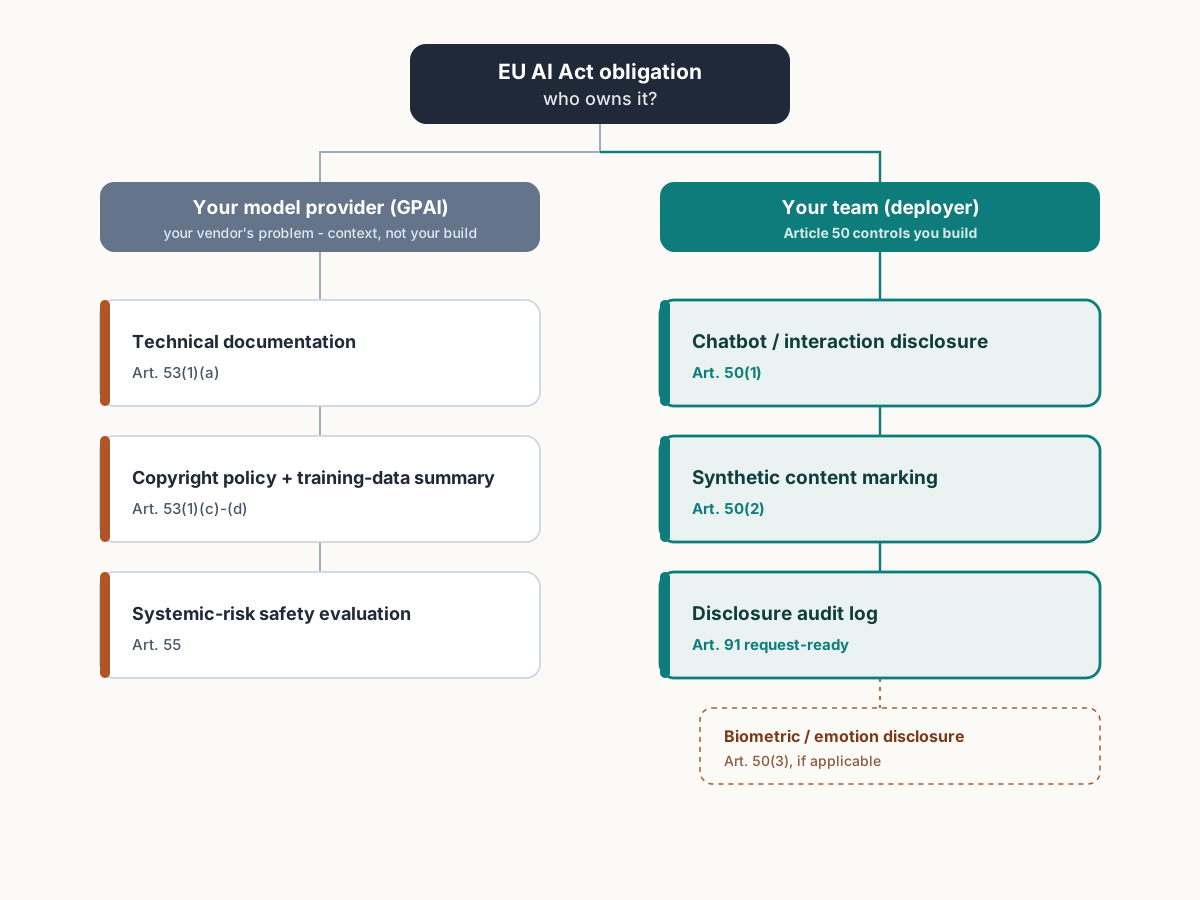
Four days ago the AI Office got enforcement teeth. Powers over general-purpose AI (GPAI) model providers became exercisable on August 2, 2026, and the Article 50 transparency rules apply from the same date (European Commission). Two rule sets, one date, two different owners. Most enterprise coverage merges them, and that merge produces two expensive mistakes: assuming your model vendor covers everything, or spending budget on obligations you never held. Here is the line. Your model provider owns the GPAI obligations. Your team owns Article 50. The gap between them is where most agent deployments carry an undocumented control.
What went live on August 2
Two things activated. The AI Office can now request documentation, run model evaluations, and demand corrective measures from GPAI providers, with fines up to 15 million euros or 3% of global annual turnover under Article 101 (EU AI Act, Art. 101). Separately, the transparency duties on AI systems that talk to people or generate content apply from the same day (our Article 50 coverage).
| Obligation | Who holds it | Article | Enforceable from |
|---|---|---|---|
| Technical documentation | Your model provider | Art. 53(1)(a) | Aug 2, 2026 |
| Copyright policy + training-data summary | Your model provider | Art. 53(1)(c)-(d) | Aug 2, 2026 |
| Systemic-risk safety evaluation | Providers of high-impact models | Art. 55 | Aug 2, 2026 |
| Chatbot / interaction disclosure | Your team | Art. 50(1) | Aug 2, 2026 |
| Synthetic content marking | Your team | Art. 50(2) | Aug 2, 2026 |
| Biometric / emotion disclosure | Your team (if applicable) | Art. 50(3) | Aug 2, 2026 |
Dates and article numbers per the EU AI Act text and the European Commission transparency fact page.
What your provider's Code status buys you
The GPAI Code of Practice was finalized July 10, 2025 (European Commission). Signing the full Code gives a provider a presumption of conformity with the matching GPAI obligations, which lowers its enforcement exposure. Amazon, Anthropic, Cohere, Google, IBM, Microsoft, Mistral AI, and OpenAI are on the full-Code signatory list (European Commission). xAI signed only the Safety and Security chapter and has to show transparency and copyright compliance by other means. Meta is absent from the list.
What breaks first: your vendor gets restricted mid-deployment
If the AI Office opens proceedings against a provider and restricts a model, every agent calling that model stops returning valid output. A provider without Code conformity carries higher odds of that, on a timeline you do not control. Code status is a procurement criterion now, not a legal footnote. Record which chapters your provider signed in the vendor file, next to uptime and data residency.
The three Article 50 controls your team builds
Article 50 does not pass through to your vendor. When your team ships the user-facing agent, your team is the provider of that system under 50(1) and 50(2) and the deployer under 50(3), so the work is yours either way (EU AI Act, Art. 50). Three controls close most of the gap. Each needs an owner, a CI test that fails on regression, and a documentation artifact.
Control 1: chatbot disclosure on every user-facing entry point
Article 50(1) requires that people know they are talking to an AI system (EU AI Act, Art. 50). Owner: the frontend or platform team that owns the interface layer. CI test: an integration test asserting the disclosure renders on every route that mounts the agent, failing the build when a new endpoint ships without it. Artifact: a route inventory listing each EU-facing entry point and its disclosure status. Where it breaks first is the internal tool that quietly gets a customer-facing route added in a sprint, with no review triggering a compliance check.
Control 2: synthetic content marking on generated output
Article 50(2) requires machine-readable marks on AI-generated text, image, audio, and video (EU AI Act, Art. 50). Purely assistive edits that do not substantially change the input sit outside scope. Owner: the service team that owns the output pipeline. CI test: a check that the mark survives serialization on each export path. Artifact: a marking policy naming which output types carry which mark. This breaks first in document-export flows that strip metadata on the way out, the default in most PDF and DOCX writers.
Control 3: a disclosure audit log
The regulation does not spell this one out. It is what the AI Office would request under its power to demand documentation from providers (EU AI Act, Art. 91). Owner: platform or data engineering. CI test: an assertion that each disclosure event writes a record. Artifact: a queryable log tying EU-user interactions to the disclosures they triggered. Six months out, an auditor asks you to prove disclosure showed on a given date, and without the log you cannot demonstrate it happened.
These controls sit next to the runtime guardrails in our agent sandboxing patterns and MCP tool-server governance guides.
What your security team will ask
Are our models classified as GPAI or high-risk?
The distinction sets your obligation set. High-risk systems under Annex III carry separate duties whose deadline moved to December 2, 2027 under the Digital Omnibus package the Council approved June 29, 2026 (Morgan Lewis). Classification is still required before that date, so the 2027 deadline is no reason to skip the inventory now.
What does our provider's Code status commit them to?
Point to the Commission signatory list and your provider's published Code summary (European Commission). Full-Code signatories committed to technical documentation, a copyright policy, and, for systemic-risk models, safety evaluation. Write down which chapters your provider actually signed rather than assuming full coverage.
If a model is restricted, what is the fallback?
GPAI enforcement makes this concrete for the first time (our enforcement coverage). Document a second model your agents can route to, the config change that switches them, and the person who owns that switch. Do it before a restriction, not during one.
The checklist
Three items, each assignable to one owner:
- Disclosure implemented and CI-tested on every EU-user-facing agent endpoint (Art. 50(1))
- Synthetic content marking policy documented and enforced on every export path (Art. 50(2))
- Vendor Code of Practice status confirmed and recorded, with a documented model-fallback plan