
Table of Contents
Best AI Search Visibility Tools in 2026: Bing Citation Share, Profound, Semrush, and the Firecrawl DIY Option
A ChatGPT citation you saw once tells you very little. In an October 2026 preprint, researchers at the National University of Singapore and Xi'an Jiaotong University ran 80 questions 20 times each through ChatGPT and found that 40.8% to 44.5% of the pages it retrieved for a question appeared in only one run, while Google results plus OpenAI's API recovered just 26.2% to 28.3% of the exact URLs it cited (per Search Engine Journal). Whichever tool you buy, read site-level trends across repeated runs, not a single page-level check.
On June 16, 2026, Bing Webmaster Tools shipped Citation Share, the first free publisher-side metric that tells you what fraction of an AI answer's citations point to your site (per Search Engine Land). A day later, Pew Research reported that 60% of U.S. adults now read AI-generated summaries at the top of search results, from a survey of 5,119 people (per Search Engine Land). More people now read AI answers, and publishers finally have one free way to see their share of them. This guide maps the six tools that close that visibility gap, with current pricing and a clear pick for each kind of buyer. For the long version of the Bing dashboard itself, see our full walkthrough; this piece is the landscape around it.
The urgency comes from a second number. Lily Ray's June 18 analysis of 100 B2B "best software" queries found that when Google's AI Overviews cited a brand's own listicle, the Overview recommended a competitor instead of that brand in 69% of the prompts she studied (per Search Engine Land). Being cited is not the same as being recommended, and being recommended for one query says nothing about the next one.
Why AI citation tracking is not rank tracking
Classic SEO measurement is positional and stable. A URL sits at position three for a keyword, position three predicts a click rate, and that position holds for days. AI citation has none of those properties. An answer engine retrieves whatever it judges useful for one specific prompt, drops those sources into a generated paragraph in no fixed order, and may pull an entirely different set for a near-identical question. There is no "position one" to track.
AI citation is also more volatile. Profound, the category's best-funded player, notes that up to 90% of the sources cited in AI answers can change over time (per Fortune). A page cited today for "best CRM for startups" can vanish from that answer next week because a competitor refreshed their page or the model updated. The click that used to confirm your reach is also gone: 68.01% of U.S. Google searches ended without any click in the first four months of 2026, up from 60.45% in 2024 (per SparkToro via Search Engine Land). Referral traffic is no longer a proxy for visibility. The citation itself is the unit you have to measure, and it moves.
What the October 2026 ChatGPT citation study changes
The paper, "Understanding ChatGPT Citations: Evidence from Production Web Search Across Model Generations," was posted to arXiv on October 11, 2026 and has not been peer reviewed (arXiv:2610.15382). The team recorded the data stream ChatGPT's web app sends a signed-in session, which exposes the searches ChatGPT ran and the pages it chose as sources, and had GPT-5.3 Instant and GPT-5.5 Instant each answer 80 questions 20 times, 1,600 runs per model (per Search Engine Journal). Then they checked how much of what ChatGPT cited two outside proxies could find: Google's top five pages of organic results, and OpenAI's Responses API with web search on.
| Proxy | Cited URLs it also found (GPT-5.3 / GPT-5.5) | Cited sites it also found (GPT-5.3 / GPT-5.5) | Source |
|---|---|---|---|
| Google organic, top five pages | 9.4% / 6.4% | 26.1% / 22.8% | Search Engine Journal |
| Responses API, full source list | 22.9% / 22.5% | about 38% for both | Search Engine Journal, Relevant Audience |
| Google and API combined | 28.3% / 26.2% | 50.3% / 48.7% | Search Engine Journal |
A page counts as cited if ChatGPT cited it in at least one of the 20 runs; figures average across the 80 questions (per Search Engine Journal).
In no visible GPT-5.3 or GPT-5.5 Instant run did ChatGPT search with the user's exact wording; it rewrites each question into its own queries (per Search Engine Journal). Retrieval churns as well. Only 9.4% (GPT-5.3) and 7.7% (GPT-5.5) of retrieved URLs appeared in at least 14 of 20 runs, and overlap between runs was higher for hostnames than for exact URLs (per Relevant Audience).
Read the scope carefully. The study tested no commercial tracker, Profound and Semrush included (per Relevant Audience). It measured a method, an API call or a Google ranking used as a stand-in for ChatGPT, and both of those vendors say they capture consumer-facing answers instead (see their sections). The variance applies to every tool, though: a product that samples each prompt once per period and reports page-level citations is reading one draw from a noisy distribution. All the settings tested predate GPT-5.6 and GPT-6, and the authors say monitoring should be re-checked whenever the model behind ChatGPT changes (per Search Engine Journal).
Two rules follow, and the rest of this guide applies them: report hostname presence as the stable signal and exact URLs as the volatile one, and rerun a prompt several times before calling a citation won or lost.
The six tools at a glance
Here is the landscape on the dimensions that decide which tool fits: a free tier, engine coverage, how fresh the data is, how the vendor says it collects answers, and the entry price.
| Tool | Free tier | Engines covered | Data cadence | Collection method | Entry price |
|---|---|---|---|---|---|
| Bing Webmaster Tools | Yes (full) | Bing / Copilot only | Near real-time | First-party engine data | $0 |
| Profound | No | ChatGPT, Google AI, Gemini, Perplexity | Daily | Browser capture, not model APIs (vendor-stated) | ~$99/mo (third-party), enterprise from there |
| Semrush AI Visibility Toolkit | No (add-on) | ChatGPT, Google AI, Gemini, Perplexity | Daily | Real requests, not LLM APIs (vendor-stated) | $99/mo per domain |
| BrightEdge | No | Multi-engine (enterprise) | Continuous | Not stated on its AI Catalyst page | Quote-only |
| Firecrawl DIY | Yes (1k credits) | Any engine you can scrape | Your schedule | Whatever answer page you scrape | $16/mo billed yearly (Hobby) |
| SparkToro | Yes (5 reports/mo) | Audience sources, not citations | On-demand | Not applicable | $50/mo |
Prices were pulled June 21, 2026 and are sourced per tool below; Firecrawl's was re-checked November 13, 2026. "Vendor-stated" means the method comes from the vendor's own documentation. One caveat the table cannot hold: Profound and Semrush track citations across the engines publishers care most about (ChatGPT, Perplexity, Google AI), while Bing covers only its own surfaces.
Bing Webmaster Tools: the free baseline everyone should turn on
What it measures: Citation Share reports what percentage of a given query's AI citations came from your site, alongside Total Citations, the pages driving them, and Grounding Queries (the retrieval phrases that triggered a citation). The June 16 update added Intents, Topics, and a Compare view to track change over a prior period (per Search Engine Land).
Who it suits: every team, full stop. Free, first-party, and it needs only a verified site. Do one thing after reading this: verify your site in Bing Webmaster Tools and open the AI Performance tab.
Pricing: free.
The limitation: scope. Citation Share covers Microsoft Copilot and Bing's AI surfaces and nothing else. It tells you nothing about Google AI Overviews, ChatGPT, or Perplexity, which is where most of your audience actually is. A strong Bing share confirms your content is structurally retrievable; it does not confirm anyone else is citing you. For the full dashboard walkthrough, including how to mine Grounding Queries for keyword data, see our Bing Citation Share guide.
Profound: the enterprise standard for multi-engine tracking
What it measures: how AI models describe and recommend your brand across ChatGPT, Gemini, Perplexity, and Google AI, run against millions of real prompts. It surfaces share of voice, which competitors win the prompts you lose, and the sentiment of how you are described (per Fortune).
Who it suits: agencies and larger brands that need defensible, board-ready numbers across every major engine. Profound raised $96 million in February 2026 at a $1 billion valuation and reports 700-plus enterprise customers including Target, Ramp, and Figma (per Fortune). This is the platform a CMO buys.
How it collects: Profound says it captures answers from the consumer browsing experience rather than from model APIs (per Profound), which puts it outside the proxy method the October study measured. Run-to-run churn still applies, so ask the account team how many times each prompt runs per reporting period and whether share of voice is counted by page or by domain.
Pricing: Profound does not publish a standard rate card. Third-party reviews in 2026 put an entry tier around $99/month (ChatGPT-only, a few dozen prompts) with most real deployments landing in the enterprise band and quoted on request (per Rankability). Treat any single figure as a starting point, not the number you will actually pay.
The limitation: cost and opacity. The published-price floor is low, but the configuration most brands need is enterprise-quoted, and there is no self-serve path to the full product. For a solo operator, it is overkill you cannot easily price in advance.
Semrush AI Visibility Toolkit: the pick if you already pay Semrush
What it measures: AI visibility for a domain across ChatGPT, Google AI, Gemini, and Perplexity, with 25 custom prompts tracked daily, AI competitor analysis, prompt research, and a site audit for AI readiness (per Semrush, via DemandSage).
Who it suits: teams already living inside Semrush for keyword and backlink work. The AI data lands next to the SEO data you already check, so there is no new login and no new vendor contract.
How it collects: Semrush's knowledge base says its prompt responses "are captured from real requests and not via any APIs of LLMs," with tracked prompts queried on the target platform daily (per Semrush).
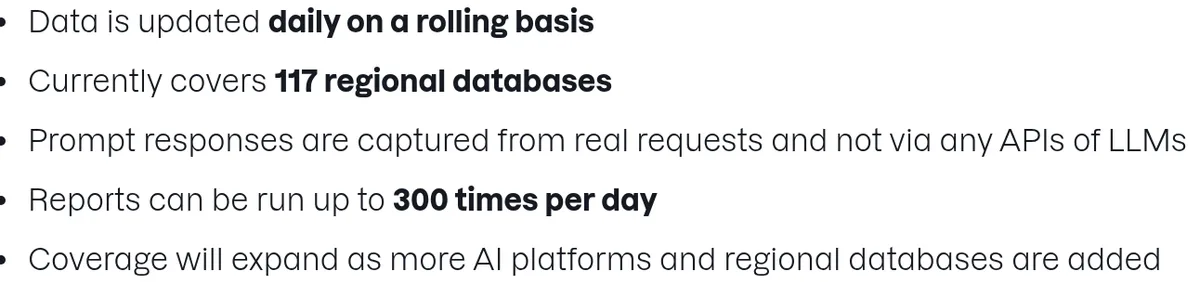 Source: semrush.com, captured November 13, 2026.
Even so, a daily check is one sample per prompt per day. Read the 25-prompt report as a weekly trend by domain rather than a daily verdict on one URL.
Pricing: the AI Visibility Toolkit is a $99/month add-on, billed per domain, and the same price whether you pay monthly or annually (per DemandSage). If you are not already a Semrush customer, the base Pro plan starts at $139.95/month billed monthly (per DemandSage), so the all-in cost to start from scratch is roughly $239/month.
The limitation: the 25-prompt cap and the per-domain, per-seat billing. Tracking two brands or giving a second teammate access each adds another $99 (per DemandSage). For a single domain you already monitor in Semrush, it is the cleanest add-on in the category; for multi-brand agencies it gets expensive fast.
BrightEdge: enterprise analytics most readers can skip
BrightEdge sells AI-citation and generative-search analytics folded into a broader enterprise SEO platform, with multi-engine coverage and continuous monitoring aimed at large content operations.
It suits enterprises already running BrightEdge for SEO that want AI visibility inside the same console. Nobody adopts it just for citation tracking.
Pricing: quote-only. BrightEdge does not publish public rates, and it sells annual enterprise contracts, not month-to-month plans. Budget accordingly and expect a sales cycle.
BrightEdge has no entry point for a small team. No free tier, no self-serve trial, no published price. We include it for completeness, because it will come up in any "AI search visibility platforms" list, but for the operators reading this it is the least relevant of the six.
Firecrawl DIY: build your own multi-engine tracker
Firecrawl measures anything you can point a scraper at. Firecrawl's /monitor runs scheduled checks on the pages you choose, returns a structured diff of what changed, and notifies you only when something meaningful moves (per Firecrawl). Aim it at the answer pages for your target queries across ChatGPT, Perplexity, and Google, and you have a custom, multi-engine citation tracker that no paid platform fully replicates.
Who it suits: solo operators, small teams, and builders who want granular multi-engine data without enterprise pricing, and who are comfortable writing a few lines of code.
Pricing: the Hobby plan is $16/month billed yearly ($190 a year) or $19 month to month, for 5,000 credits, and a monitor check costs 1 credit per page per check (per Firecrawl pricing, re-checked November 13, 2026). The free tier gives 1,000 credits a month to prototype with (per Firecrawl pricing). Tracking 25 queries across three engines once a day runs about 2,250 credits a month. With three runs per check every other day, the repeat-run habit the October study argues for, it comes to about 3,375 credits, still inside Hobby's 5,000. The structured-diff output uses up to 90% fewer LLM tokens than naive scraping, so if you pipe the diffs into a model, the downstream cost stays low (per Firecrawl).
The limitation: it is a kit, not a dashboard. You build the query list, you wire the scrape targets, and you compute citation share yourself. There is no share-of-voice chart waiting for you. A scraped answer page is also not the signed-in ChatGPT session the study recorded, so compare your numbers week to week rather than reading them as what every user sees. You can start building at Firecrawl.
SparkToro: research context, not a citation tracker
SparkToro shows where an audience actually spends attention, which podcasts, social accounts, publications, and search terms they use. That is audience intelligence, not AI-citation tracking, and it does not report your citation share in any engine.
Treat it as a research and strategy tool: find the sources your buyers trust, then target those for the co-mentions that influence what AI engines recommend. It informs the GEO strategy; it does not measure the GEO result.
Pricing: a free tier gives 5 reports a month, and the Personal plan is $50/month (per SparkToro pricing). Business and Agency tiers run $150 and $300.
Its weak spot for this job is that it answers a different question. SparkToro will not tell you whether ChatGPT is citing your domain. We include it because the audience-source data feeds the strategy upstream of the metric, and because it gets miscategorized as a tracking tool in roundups that have not read the product.
Which tool for which team
The right answer depends on budget and how many engines you need to cover. Mapped to the three personas most readers fall into:
| Persona | Constraints | Recommended tool | Why |
|---|---|---|---|
| Solo operator / creator | Tight budget, one or two domains, comfortable in a terminal | Bing (free) + Firecrawl Hobby ($16/mo billed yearly) | Free first-party baseline plus a DIY multi-engine tracker for the cost of a lunch |
| 10-person agency | Needs client-ready charts, multiple brands, already pays for SEO tools | Semrush AI Visibility Toolkit ($99/mo per domain) | Citation data next to the SEO data, no new vendor; scale cost is predictable per client |
| Enterprise brand | Board reporting, every engine, dedicated support | Profound | Multi-engine share of voice with the funding and customer base to back the numbers |
Start every team on Bing regardless of tier. It is free, it is first-party, and it is the only one of the six where the engine hands you its own citation data directly.
The Firecrawl DIY tracker in five steps
The DIY path is worth its own walkthrough, because it is the option that gives a small team enterprise-grade coverage at hobby-tier cost. The shape is: scrape the answer pages for your tracked queries on a schedule, diff each run against the last, and compute your own citation share from the results.
Step 1: list your tracked queries. Pull your highest-intent prompts from the Bing Grounding Queries tab and from your sales calls. Twenty to thirty is plenty to start.
Step 2: install the SDK and authenticate.
pip install firecrawl-py
export FIRECRAWL_API_KEY="<YOUR_API_KEY>"
Step 3: create a monitor that watches an answer-engine result page for one query and emails you the diff when the citation list changes.
from firecrawl import Firecrawl

firecrawl = Firecrawl(api_key="<YOUR_API_KEY>")

monitor = firecrawl.create_monitor(
    name="ai-citation-tracker: best crm for startups",
    schedule={"text": "daily at 9am", "timezone": "UTC"},
    goal=(
        "Track which sources are cited in the AI answer for this query. "
        "Alert when a new domain replaces a previously cited source. "
        "Ignore ads, timestamps, and UI changes outside the citation list."
    ),
    targets=[
        {
            "type": "scrape",
            "urls": [
                "https://www.perplexity.ai/search?q=best+crm+for+startups",
            ],
        }
    ],
    notification={
        "email": {
            "enabled": True,
            "recipients": ["[email protected]"],
            "includeDiffs": True,
        }
    },
)
Step 4: run one monitor per engine, then repeat it. Duplicate the block above with the answer URL for ChatGPT and Google AI so each engine's diff stays clean and interpretable. Then add repeat runs, for example three copies of each monitor at 9am, 1pm, and 5pm on an every-other-day schedule, which matches the credit math above. With 40.8% to 44.5% of retrieved pages appearing in only one of 20 runs in the October study (per Search Engine Journal), one diff showing a new domain is a candidate change; log it only when it holds across most of the day's runs.
Step 5: compute your share at two levels. Export the cited links from each diff into a spreadsheet and count them twice: by exact URL, and by hostname after stripping each link to its domain. Report the hostname share; in the study, the outside proxies found about half of the sites ChatGPT cited but only about a quarter of the exact pages (per Search Engine Journal). Where the engine shows which model answered, record it, since two of the study's sessions switched to another model partway through collection (per Search Engine Journal). Week one is a snapshot. Run it four weeks and you have a hostname-level trend you can act on. For the manual, audit-style version of this workflow over 30 days, see our co-mentions tracking guide, and if you are weighing scrapers, our Firecrawl vs Apify vs Browse AI comparison covers the tradeoffs.
The verdict, by persona
Solo operators and creators should run Bing Webmaster Tools for the free first-party baseline and build the Firecrawl DIY tracker on the $16-a-month Hobby plan (billed yearly) for multi-engine coverage, with repeat runs and hostname-level share built in from day one. That combination gives you more than most teams paying ten times as much, because you control exactly which queries and engines you watch.
If you run a 10-person agency, the Semrush AI Visibility Toolkit at $99/month per domain is the pick. The data lands beside the SEO work you already do for clients, the per-domain pricing scales predictably across accounts, and you can hand a client a chart without standing up your own pipeline.
For an enterprise brand reporting to a board, Profound is the pick. It covers every major engine, the $96M raise and 700-plus customer base mean it will not vanish, and the share-of-voice reporting is built for exactly the meeting you have to walk into.
BrightEdge is the pick only if you already run it for SEO and want AI data in the same console. SparkToro is not a tracker at all; keep it for finding the sources your buyers trust, and feed that into the strategy, not the scorecard.
Before you sign with a paid tracker, ask how many times each prompt runs per reporting period and whether citation share is counted by page or by domain. A single-run, page-level number is the least stable measurement in the October study (per Search Engine Journal).
Whatever you pick, turn on Bing today.
What changed
- November 13, 2026: Added the October 2026 NUS and Xi'an Jiaotong University ChatGPT citation study and what it means for each tracker, a collection-method column in the comparison table, a dated Semrush documentation screenshot, and repeat runs plus hostname-level share in the DIY steps. Re-checked Firecrawl pricing: Hobby is $16 a month billed yearly, $19 month to month. Other prices are unchanged from June.
- June 21, 2026: First published.