Table of Contents
Adobe's Local MCP Server for Creative Cloud: What's Open and What Isn't
Adobe just opened a second door into Photoshop, and the person who built it told TechCrunch the company hasn't decided how far it swings. That's the whole story worth knowing before you point ChatGPT or Gemini at your Creative Cloud apps: a working, documented MCP connector for Claude has existed since April. The thing announced at MAX this week is a different, newer, and far less finished piece of plumbing.
What shipped at MAX
At Adobe's MAX event in Miami on November 10, 2026, the company rolled new generative features into its flagship apps and, separately, released a local MCP server for Creative Cloud (per TechCrunch). Photoshop gets a relighting tool and prompt-based sliders for generative style. Premiere adds a professional color-grading system and an object-removal tool for video. Lightroom picks up blink correction and blemish removal. Firefly gets a prototyping tool called Builder (private beta, aimed squarely at Figma's turf), an on-brand graphic generator, a targeted image editor that changes one region without touching the rest, and a video-assembly tool that stitches clips, stills, and sound effects into a rough cut. Adobe is also making its Firefly agent "proactive and always on," per TechCrunch, so it stays present across a session instead of waiting for a prompt.
None of that matters much to anyone who builds on top of Adobe rather than clicking around inside it. What matters is the MCP server: a local process that exposes endpoints across Illustrator, Photoshop, After Effects, and Premiere so an outside AI assistant (ChatGPT, Claude, Gemini) can drive those apps directly. Adobe already had AI integrations in some of its apps, but this is the first time the surface is a standard protocol instead of a one-off plugin, and it runs locally, talking to the desktop apps on your machine rather than to copies of your files sitting in Adobe's cloud.
Two different doors, not one
Here's the part the MAX headlines blur together. Adobe did not just ship one MCP server this month; it now has two, and they are not the same thing.
The first is "Adobe for Claude" (listed on Claude's connector marketplace as "Adobe for creativity"), a hosted MCP server Adobe runs itself at adobe-creativity.adobe.io/mcp. We pulled the current listing: it has been live and Anthropic-verified since April 2026, requires an Adobe sign-in, and bundles 109 tools across Acrobat, Photoshop, Lightroom, Illustrator, Firefly, Premiere, Express, InDesign, and Stock. It works by acting on assets you've uploaded into Creative Cloud storage, and it only works inside Claude.
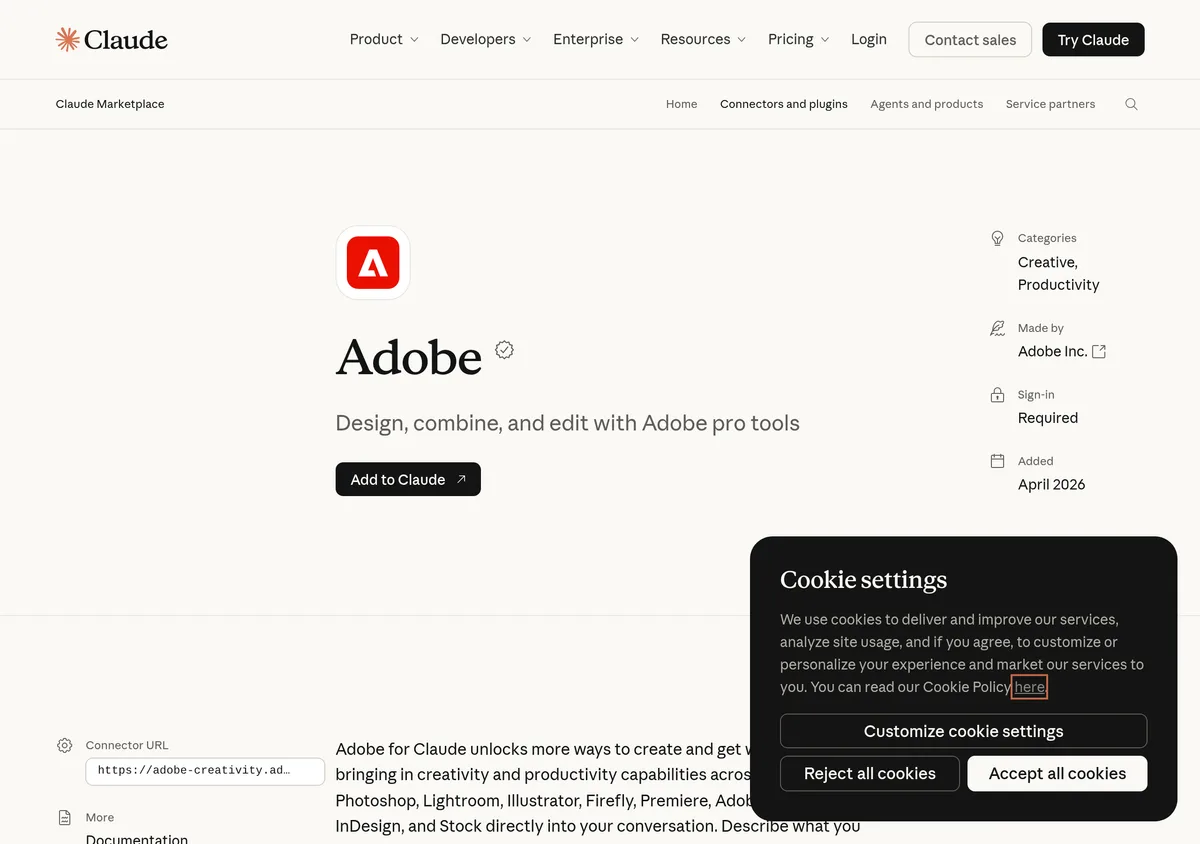
The second is the one TechCrunch covered this week: a local server exposing Illustrator, Photoshop, After Effects, and Premiere to any MCP client, not just Claude. It is new, it has no public endpoint URL or setup docs as of this writing, and Adobe VP Deepa Subramaniam told TechCrunch the company is "still figuring out where and when and how to draw the line" on what it exposes. That is not a minor caveat. It means the tool surface you'd connect to today could look different in three months, with no deprecation notice beyond "we're going to see how people use it."
| Surface | Status (Nov 11, 2026) | Apps covered | Clients | Where it runs |
|---|---|---|---|---|
| Adobe for Claude (hosted connector) | Live since April 2026, Anthropic-verified | Acrobat, Photoshop, Lightroom, Illustrator, Firefly, Premiere, Express, InDesign, Stock | Claude only | Adobe's cloud, on uploaded assets |
| New local MCP server | Announced at MAX, Nov 10 2026; scope undecided | Illustrator, Photoshop, After Effects, Premiere | ChatGPT, Claude, Gemini (per Adobe) | Your machine, talking to the desktop apps directly |
| adb-mcp (community project) | Open source, maintained since March 2025 | Photoshop (full), Premiere (limited) | Claude Desktop, OpenAI Agent SDK | Your machine, via a proxy socket and UXP plugin |
What it costs
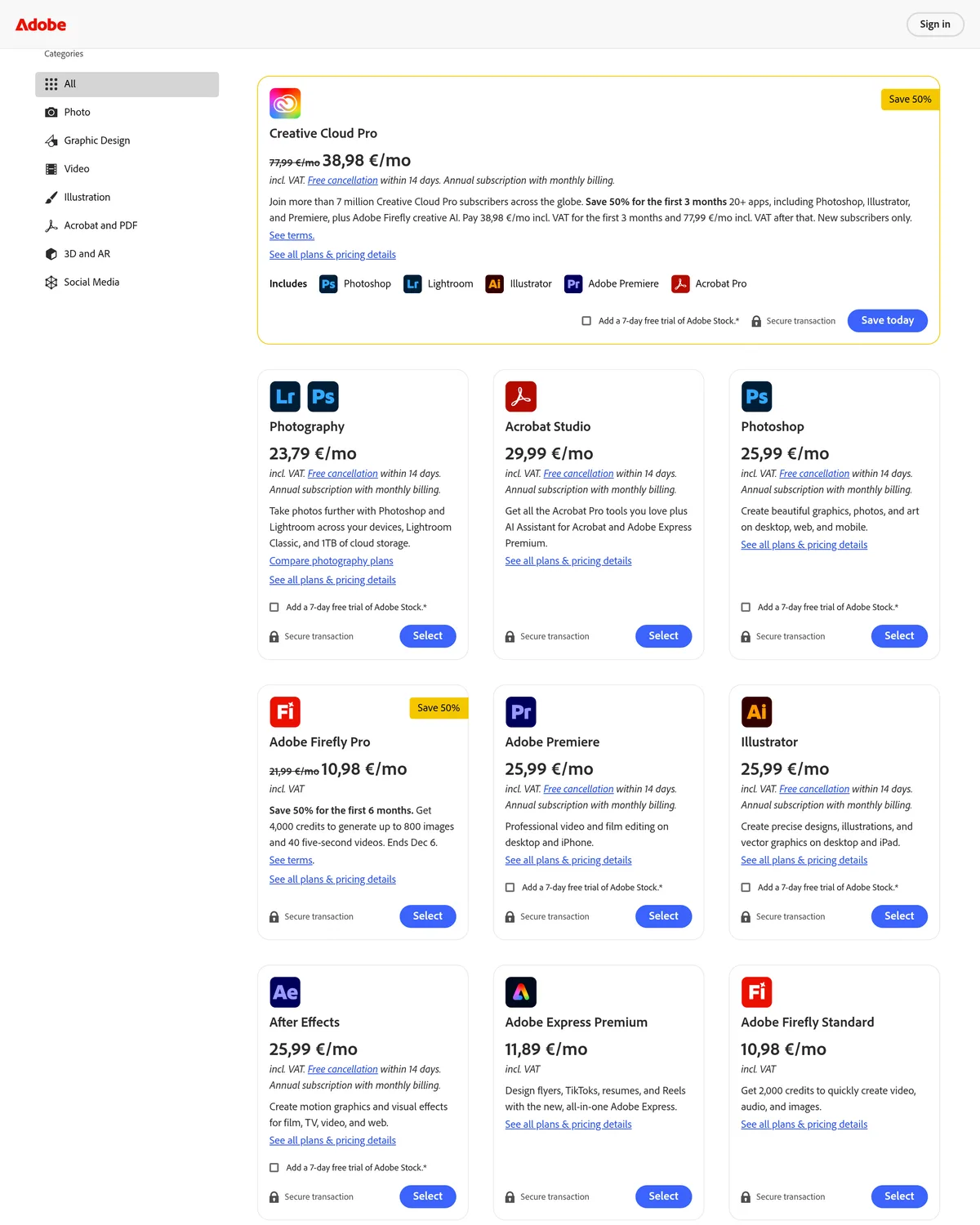
Nothing on top of your existing subscription, for either MCP surface. Creative Cloud itself is not free, though, and the MCP connections only reach apps you're already paying for. We pulled Adobe's current plans page: the Creative Cloud Pro bundle (20+ apps including Photoshop, Illustrator, and Premiere) lists at €77.99/month before a new-subscriber discount, and single-app plans like Photoshop, Premiere, or Illustrator run about €25 to €26/month each.
Sign-in to the hosted connector is free; some of its 109 tools need an eligible paid plan, per Adobe's own connector page. The new local server has no published pricing tier of its own; expect it to work against whatever apps your Creative Cloud login already unlocks, the same way the hosted connector does.
How to turn on what already works
If you want Claude editing Photoshop or Premiere files today, you don't need to wait on the MAX announcement. The hosted connector is live now:
- Open Claude's connector marketplace listing for Adobe and click "Add to Claude."
- Sign in with your Adobe account when prompted. A free account unlocks a subset of tools; a paid Creative Cloud plan unlocks the rest.
- Start a chat and ask Claude to find, edit, or summarize an asset in your Creative Cloud libraries, something concrete like "crop this photo to a square and remove the background."
- Check Claude's response against the source file in Photoshop or Lightroom before you treat the output as final. The connector acts on your actual Creative Cloud storage, so a bad edit is a real edit.
The new local server has no equivalent walkthrough yet. Adobe hasn't published an endpoint URL, an auth flow, or a capability list beyond "a number of endpoints and capabilities across Illustrator, Photoshop, After Effects, and Premiere," Subramaniam's own phrase. Treat anything you see claiming a finished setup guide for it with skepticism until Adobe's developer site actually ships one.
What Adobe hasn't decided
Subramaniam's full quote to TechCrunch is worth reading straight, because it is an unusually direct admission for a company announcing a product: "We are still figuring out where and when and how to draw the line. What we're putting out there is a number of endpoints and capabilities across Illustrator, Photoshop, After Effects, and Premiere. We're just going to see how people use it, what they're trying to do, and keep showing more. We don't have any need or desire to sort of limit what the MCP endpoint can expose."
Translate that past the optimism: nobody, including Adobe, can tell you today which Creative Cloud actions the local server will support next quarter, whether it will gate tools behind enterprise licensing, or how it will handle a shared team library where permissions matter. The hosted connector at least has a fixed, auditable tool list (the 109 names are public on Claude's listing). The local server's list is a moving target by Adobe's own admission.
There's also an outside critique worth weighing. Figma co-founder Dylan Field argued last month that MCP isn't a perfect standard and mostly benefits the frontier labs building the clients, not the vendors exposing the endpoints. Adobe shipping a wide-open, scope-undecided local server into that argument is either a bet that openness wins adoption, or a company moving faster than its own governance. Probably both.
One more practical note for anyone running agents with filesystem or app-control access already: a local MCP server that can drive Photoshop and After Effects is a new tool an agent can call, and new tools are new attack surface. If you're auditing what your agents can reach, our MCP tool poisoning checklist is the right next read before you wire this into anything automated.
If you don't want to wait
adb-mcp is an open-source project (MIT license, not endorsed by Adobe) that already does local MCP control of Photoshop, with more limited Premiere support. It's been maintained since March 2025, with commits as recent as July 2026, and the author documents it working with Claude Desktop on Mac and Windows plus the OpenAI Agent SDK. No After Effects, no Illustrator, and it's a side project with no SLA. But it's running today, and it doesn't come with a "we'll see" on scope.
What to do this week
If you already pay for Creative Cloud and use Claude, turn on the hosted connector. It's documented, it's scoped, and the worst case is you spend ten minutes finding out a tool doesn't do what you hoped. If you want local, desktop-level control over Photoshop specifically and you're comfortable running a community project, adb-mcp gets you there now. If what you actually want is the new local MCP server because it promises After Effects and broader client support, wait for Adobe to publish an endpoint and a tool list. Connecting an assistant to an undocumented surface that the vendor says might change shape next quarter is a fine thing to pilot on a throwaway file. It is not something to wire into a production workflow yet.
Related guides on Pondero
- What Is MCP? The Complete Guide to Model Context Protocol
- MCP Tool Poisoning: How to Audit the Servers Your Agents Call
- Jama Connect Ships an MCP Server
This post is part of Pondero's daily coverage of AI tool updates. See all MCP guides