OpenAI and Anthropic Turn to Mac Minis for Computer-Use Agent Reinforcement Learning
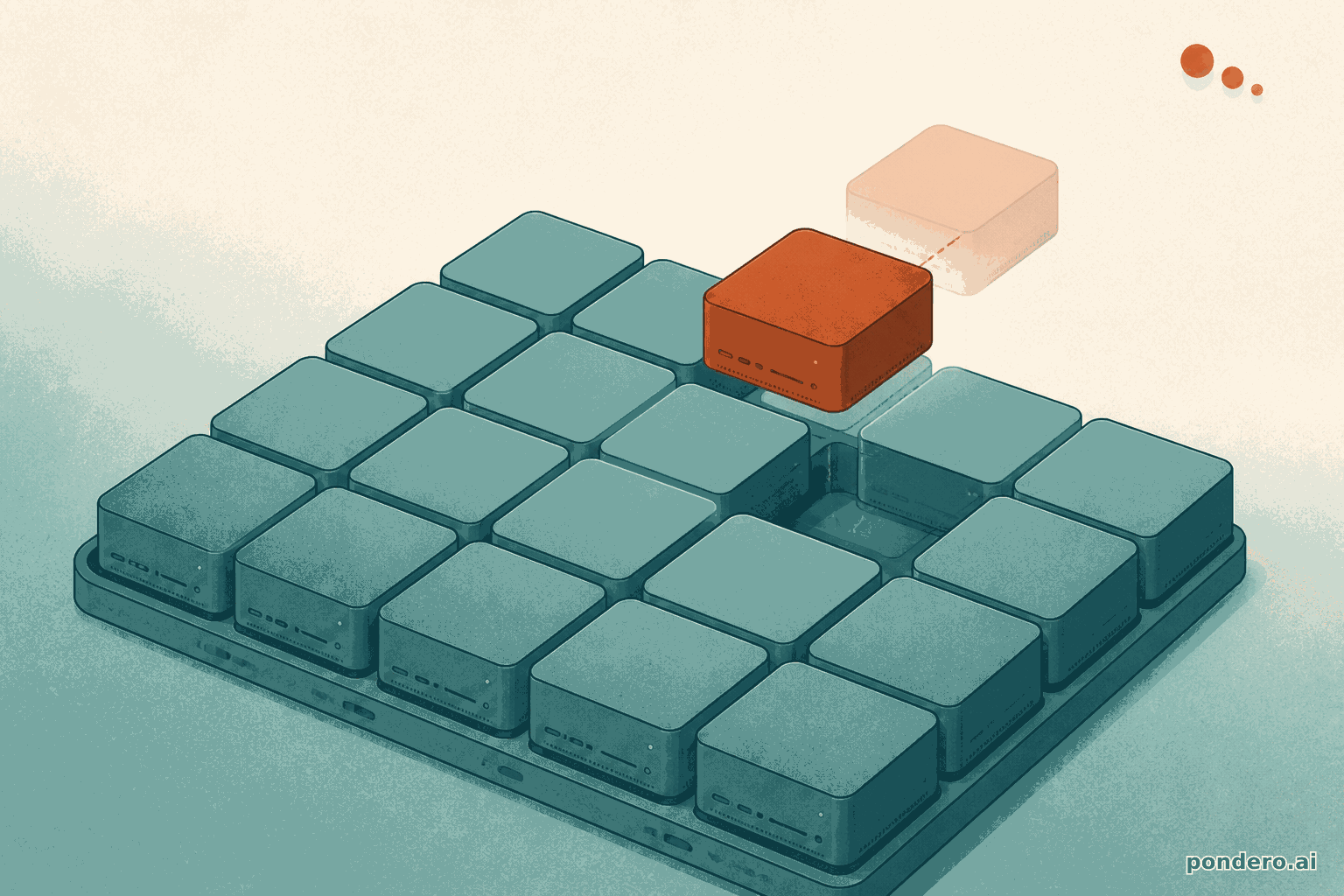
OpenAI purchased tens of thousands of Apple Mac minis and Mac Studios to run reinforcement learning for computer-use agents, while Anthropic rents the same hardware through Amazon Web Services, according to a report from The Information picked up by The Decoder on August 31, 2026. The scale of the purchase was large enough that the most powerful Mac Studio configurations had been sold out for months before Apple's August 25 M6 refresh.
What
Computer-use agents learn by observing a real screen, taking an action such as a mouse click or a keystroke, and receiving feedback on whether the outcome matched the goal. Running those observe-act-feedback cycles at the speed needed for reinforcement learning requires machines running a full operating system, not just a GPU compute cluster processing abstract token sequences.
Per The Decoder, OpenAI wants even more units but has been blocked by inventory shortages tied to memory chips. Anthropic's approach through AWS lets the company rent capacity rather than own hardware outright.
Apple announced the M6 Mac mini and M5 Ultra Mac Studio on August 25, 2026, per the Apple newsroom. The M6 carries a Dual 16-core Neural Engine that delivers up to 2x the peak AI compute of the prior generation and nearly 30% more peak GPU compute for AI tasks compared to the M5. Unified memory bandwidth reaches 170 GB/s with up to 32 GB of memory shared across CPU, GPU, and Neural Engine.
Why it matters
The choice of Mac hardware over GPU clusters is not arbitrary. Computer-use agent training is memory-bound: the agent state, screen buffers, and OS context all need to sit in fast, close-to-compute memory rather than passing through the PCIe bus between discrete GPU VRAM and system RAM. Apple's unified memory architecture addresses that constraint directly. The workload is also far less parallelizable than transformer pre-training, so hundreds of smaller, self-contained machines beat fewer large GPU nodes for this use case.
The practical implication for teams building computer-use agents: the same hardware that runs at a developer's desk also scales to production training with the right orchestration layer. Anthropic's AWS rental model shows one path for organizations that need the capability without capital hardware purchasing.
NVIDIA's DGX Spark targets the same compact form factor but uses discrete GPU architecture with CUDA and Tensor cores. Whether NVIDIA adjusts its positioning for agentic RL workloads will shape the hardware market for computer-use AI over the next 12 to 18 months.
What to watch next
Apple does not sell rack-mount hardware. If AI labs continue to scale Mac-based RL training, pressure for a datacenter-grade Apple silicon form factor grows. A rack-mount product would be a departure from Apple's current roadmap and has not been announced.
NVIDIA has not publicly addressed AI labs routing RL workloads away from GPU clusters. Any official response, whether through DGX product updates or new software targeting agentic RL, would be a meaningful signal about how the GPU market views the emerging computer-use training workload.
Sources
- Apple introduces M6 and M5 Ultra for a big leap in performance and AI compute: Apple Newsroom, August 25, 2026
- OpenAI and rival AI labs are buying tens of thousands of Mac minis to train computer-use agents: The Decoder, August 31, 2026