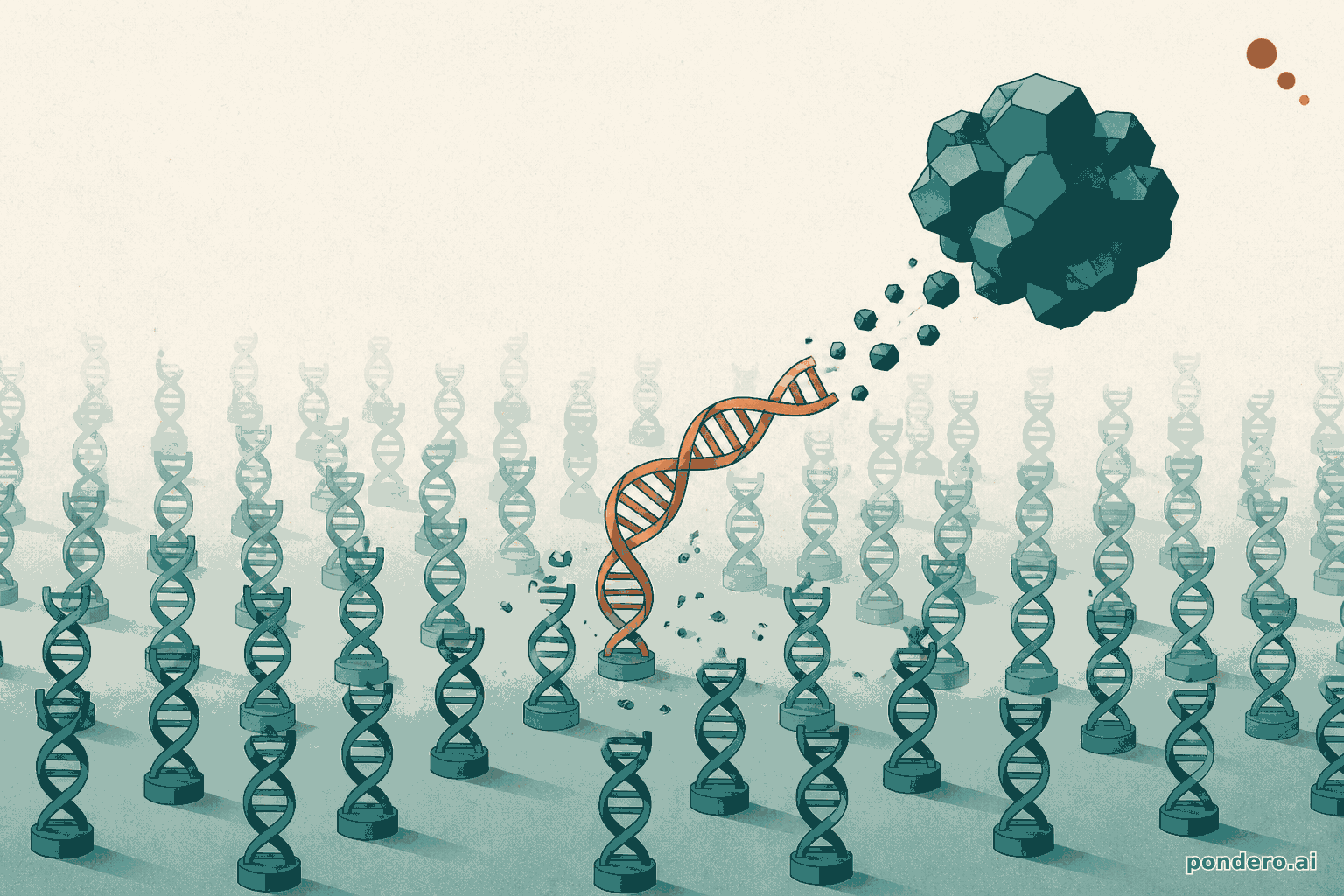
Claude Agents Discover Novel CRISPR-Like Enzyme System in Bacteriophages
For 21 hours, roughly 950 Claude agents autonomously searched a massive DNA database and identified a previously uncharacterized enzyme system with structural features resembling CRISPR arrays, per Anthropic's September 23, 2026 announcement. Feng Zhang, a pioneer of CRISPR genome editing and a professor at MIT and the Broad Institute, called the finding "genuinely intriguing." It is the first published result from a life sciences research group Anthropic formed in spring 2026 to test whether general AI models can systematize biological discovery.
What happened
A researcher gave Claude a single high-level prompt: search a large DNA sequence database for interesting new examples of reverse transcriptases (RTs). From that point, the agents worked without further human direction. Per Anthropic, the run consumed 210 million tokens across roughly 950 agents over 21 hours. The agents gathered more than 200,000 RTs from the database, identified 3,500 new candidate systems, and narrowed the list to 20 compelling candidates before generating short human-readable reports on each.
One agent spotted something prior studies had overlooked: a tandem repeat array of DNA sequences sitting next to an unusual RT gene in bacteriophage genomes. Bacteriophages are the viruses that infect bacteria. In its session log, the agent wrote: "[The DNA next to the RT] is spectacular: I can see by eye a tandem repeat array...that's a CRISPR-like...repeat array?!" It then counted the repeats, measured their spacing, compared the layout against known RT systems, and searched the existing literature before filing a report for human review.
Anthropic named the new system array-associated reverse transcriptases, or ART. ART has three components: the RT gene itself, a partner gene beside it, and a long array of evenly-spaced DNA repeat sequences. The underlying RT comes from a jumbo phage and had appeared in earlier published studies. What no one had previously documented was the accompanying repeat array and the accessory protein of unknown function. Those two features together give ART its CRISPR-like character. Initial lab experiments showed the ART array is transcribed into a set of distinct short RNA molecules, a pattern consistent with how CRISPR arrays produce the guide RNAs that make those systems programmable.
The primary biological function of ART has not been confirmed. Per Anthropic, further experiments are ongoing. The team deposited a pre-print rather than waiting for full characterization, specifically to give the broader research community early visibility.
AI-driven biology now has a reviewable finding
The result is the first concrete, externally reviewable output from an AI-autonomous biology discovery pipeline at a frontier lab. For three years, claims about AI-accelerated science have circulated largely as projections. ART is a specific finding, backed by a deposited pre-print and an on-record quote from a named expert.
Zhang's full comment: "This is an exciting example of how AI agents can contribute to biological discovery. The identification of RNA-repeat arrays associated with reverse transcriptases is genuinely intriguing and merits further investigation. I hope this work encourages more scientists to explore how AI can support their research."
For teams building or evaluating multi-agent research workflows, the run statistics are the most actionable data in the announcement. An expert human scientist conducting equivalent genome-mining analysis would typically spend weeks to months processing comparable data and narrowing candidate systems, per Anthropic. The 21-hour, 950-agent run compressed that phase. The 210 million token figure gives a rough compute budget for what a discovery-grade biology survey costs at current API pricing.
The tools used were Claude Science and Claude Code, both standard Anthropic products available through existing plans. The team also uses a custom parallel harness to coordinate many Claude sessions during high-volume surveys. The core tooling is off-the-shelf; the scale comes from orchestration on top of it.
Context
The CRISPR parallel Anthropic chose is deliberate. CRISPR entered science as an unexplained repeat sequence in bacterial DNA; researchers who dug into it eventually built a gene-editing platform now central to medicine and agriculture. Restriction enzymes and Taq polymerase followed a comparable path from curiosity to billion-dollar tool. Per Anthropic, ART has a combination of characteristics found together previously only in systems that turned out to be programmable tools for cutting, copying, and pasting DNA.
Whether ART follows that path depends on wet-lab results not yet available. Anthropic published the pre-print to share early findings and to demonstrate the discovery method, not to claim a working tool. No commercial applications have been announced.
Anthropic's life sciences organization spans the research group behind this result, teams working on drug discovery, and teams training Claude in biology and chemistry. The lab operates at biosafety levels BSL-1 and BSL-2 and does not handle human pathogens. All wet-lab work is performed by human scientists. The announcement notes that all research was conducted in Claude Science and Claude Code, the same tools available externally, with occasional use of the custom parallel harness for high-volume genomic surveys.
The broader framing traces back to a public essay by Anthropic CEO Dario Amodei on AI and biology. Per Anthropic's announcement, the life sciences group was created to test whether the kind of acceleration Amodei described is achievable in practice. ART is their first public answer.
What to watch next
Three questions will determine how significant this result proves to be. First, whether further lab experiments confirm ART has a programmable function analogous to CRISPR systems. Second, whether the pre-print survives peer review and whether independent labs can replicate the finding. Third, whether other frontier labs (Google DeepMind, OpenAI, and others building biology-adjacent research products) publish comparable AI-autonomous discovery results. A single result from a single lab establishes that the method is feasible. Multiple independent results would establish that it generalizes.
Anthropic is actively soliciting collaboration from external scientists on other genomics problems and other research domains.
Sources
- Claude discovers a novel enzyme system with CRISPR-like repeats: primary (Anthropic, September 23, 2026)
- Anthropic says its biology lab has already found something big: secondary (TechCrunch, September 23, 2026)