Table of Contents
Perplexity Patents and Comet Assistant's permission prompt, explained
Ask Comet to pull your Amazon order history and it will, right after a small blue prompt asks whether it can act on your behalf. Click Allow once and the agent logs in, scrapes the page, and hands you an answer. That click feels like permission. A federal judge disagreed with the part of that sentence that matters most: permission from you is not authorization from Amazon, and for five months in 2026 a court order said so. The ruling flipped again in August. We will get to the flip.
That fight is the clearest window into what Perplexity actually shipped last November: a free natural-language patent search agent (Perplexity Patents) and a rebuilt Comet Assistant with a permission system in front of every sensitive action. Both are now about a year old, both are still running, and most coverage of them got the date wrong by treating a one-year-old feature as this week's launch. Here's what each one does, how to turn them on, and the one thing the permission prompt cannot actually promise you.
What Perplexity Patents actually searches
Perplexity Patents is a natural-language research agent, not a new database. Type a plain question like "patents on AI for language learning" or "key quantum computing patents since 2024" into Perplexity's main search box, and the agent decomposes the query into parallel retrieval tasks against a dedicated patent index, built on top of Perplexity's own exabyte-scale search infrastructure rather than a licensed third-party patent dataset, per TestingCatalog. It expands your wording to related terms on its own: ask about "fitness trackers" and it also surfaces results indexed under "activity bands" and "health monitoring wearables," per dig.watch.
Answers cite the specific filings they draw from, and the agent will pull in non-patent literature too, academic papers and public code repositories, when that's where the relevant prior art actually lives, per YourStory. Perplexity hasn't published a formal technical spec. What it has shown is an enterprise "Patent Researcher" template inside its Spaces product that walks through the same workflow against USPTO, WIPO Patentscope, Espacenet, Google Patents, and The Lens, which is the closest thing to documentation the tool has per YourStory.
It launched October 30, 2025, in a free global beta, no waitlist, no region lock. Free-tier accounts get metered daily access; Pro and Max subscribers get higher usage quotas and more model configuration options, per TestingCatalog. A year later, Perplexity still hasn't announced an end date for the beta or posted what it will cost once that ends. Every outlet that covered the launch flagged the same gap, and nothing has filled it since.
What changed in Comet Assistant
The second piece of the November 2025 rollout was a rebuilt Comet Assistant, announced days after Patents. CEO Aravind Srinivas framed it around three things: multitasking across tabs, visible step-by-step reasoning in a sidecar panel, and a permission system gating anything the agent does inside a logged-in session, per The Hans India. Perplexity's own benchmark claims a 23% improvement in successful task completion on multi-step, multi-tab work, like comparing flight prices across several sites in parallel instead of serially, per AlternativeTo. That 23% figure is Perplexity's own internal number, not an independently reproduced benchmark, so read it as a vendor claim about Perplexity's prior release, not a third-party score.
The permission mechanic is the part that actually matters day to day. Before Comet clicks a link, fills a form, or extracts data from a page, it asks. You get three choices: handle the step yourself, let the agent do it once, or grant standing permission for the rest of the task, per The Hans India. High-risk steps, logging into an account or completing a purchase, always pause for an explicit yes regardless of what you granted earlier.
How to turn both on today
Neither tool needs a settings toggle buried three menus deep.
Perplexity Patents: Open Perplexity's standard search (web or app, no separate URL) and type a patent-shaped question directly. The agent recognizes the intent from the query itself and routes it through the Patents pipeline automatically. Standard accounts search for free with daily usage limits; Pro ($20/month, $17/month billed annually) and Max ($200/month, $167/month billed annually) unlock higher quotas, per Layer3Labs' pricing breakdown, updated November 1, 2026:
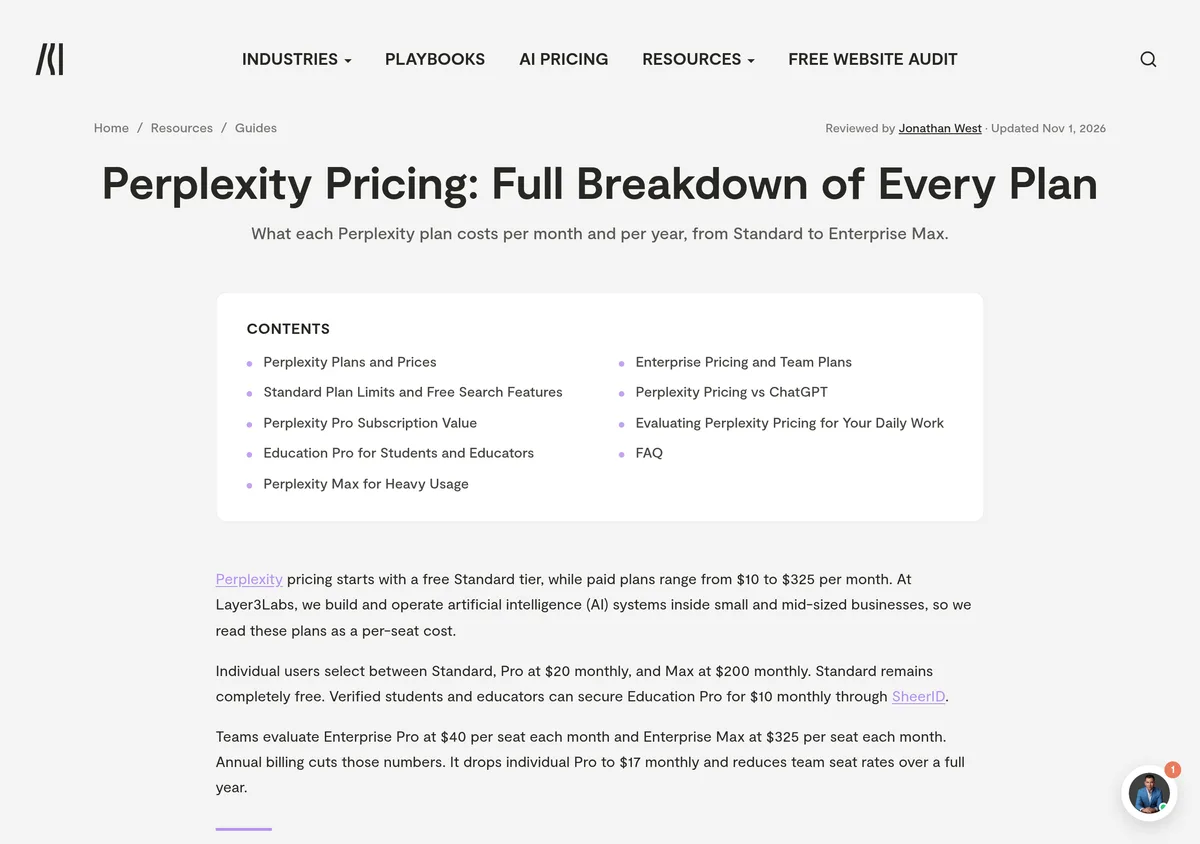 Source: layer3labs.io, captured November 7, 2026.
Comet Assistant: Download Comet at perplexity.ai/comet; it's free on Mac, Windows, Android, and iOS, with iPad support that shipped in a later April 28, 2026 update. Sign into any plan and the Assistant is on by default inside the omnibar. The permission dialog isn't something you enable. It appears the first time the agent needs to touch a page, and from then on it remembers whatever you granted for that specific task.
| Perplexity Patents | Comet Assistant | |
|---|---|---|
| Access | Type a patent question in main search | Built into Comet browser, on by default |
| Cost today | Free beta, all tiers | Free browser; Max Assistant needs Max plan |
| What gates it | Nothing, no confirmation step | Permission prompt before every sensitive action |
| Launched | Oct 30, 2025 | ~Nov 6-9, 2025 |
| Beta end date | Not announced as of Nov 2026 | N/A, shipped feature |
The permission click's real limit
Here's where the permission prompt runs into a wall it can't solve on its own. Amazon sued Perplexity in November 2025, arguing Comet was entering password-protected areas of Amazon's site, including customer account pages, to complete tasks on users' behalf, and doing it in a way designed to look like ordinary human browsing rather than bot traffic. On March 9, 2026, US District Judge Maxine Chesney granted Amazon a preliminary injunction, finding the retailer had presented "strong evidence" that Comet accessed accounts with the user's permission but without Amazon's authorization, then transmitted private account data back to Perplexity's own servers, per eWeek.
 Source: eweek.com, captured November 7, 2026.
That's the whole mechanism in one sentence: the court didn't say users lacked the right to delegate tasks to software. It said a user's Allow once click doesn't automatically carry Amazon's own sign-off, and those are legally separate gates even when they look like the same button to you. The order forced Perplexity to destroy any Amazon data it had collected and to certify compliance.
The story kept moving. Perplexity appealed, the Ninth Circuit granted an administrative stay, and on August 4, 2026, a three-judge panel reversed the injunction outright. Writing for the panel, Circuit Judge Milan Smith held that the Computer Fraud and Abuse Act treats a tool like Comet as exactly that, a tool, not a person capable of "accessing" a system on its own, which shifts the access question onto the individual user rather than Perplexity, per Bloomberg Law via AI Weekly. Amazon's trademark and state-law claims survived the ruling and the fight isn't over. But the practical upshot for anyone granting Comet standing permission on a logged-in account: liability for what the agent does there didn't disappear when Perplexity won on appeal. It moved onto you.
Alternatives worth knowing
Patent search has free, slower options if you don't need conversational query expansion. Google Patents indexes over 120 million patent publications alongside Google Scholar and the Prior Art Archive, no account required. USPTO's Patent Public Search and WIPO's PatentScope are the official government-run equivalents, also free, both keyword-and-classification driven rather than natural-language. The Lens stayed free for search and browsing after its June 2026 ownership change to a non-profit under SPIE, though fee-waived accounts narrowed to academic users, per casrai.org. On the paid end, PatSnap and similar enterprise platforms add prior-art scoring, landscape analysis, and competitor monitoring that a conversational agent isn't built for.
| Tool | Cost | Best for |
|---|---|---|
| Perplexity Patents | Free beta (higher quotas on Pro/Max) | Fast natural-language scoping before deeper review |
| Google Patents | Free | Keyword search, broad public coverage |
| USPTO Patent Public Search | Free | Official US filing records |
| WIPO PatentScope | Free | International filings |
| PatSnap | Paid, enterprise | Landscape analysis, FTO opinions, competitor tracking |
On the browser-agent side, the field thinned out fast. OpenAI's ChatGPT Atlas, Comet's closest rival on authenticated multi-step tasks, shut down entirely on August 9, 2026, less than a year after launch, with its features folded into the main ChatGPT desktop app, per eWeek. The Browser Company's Dia takes a different approach, scoping reusable "skills" to specific pages and tabs rather than granting broad session access, which sidesteps some of the authorization question Comet is still fighting in court, simply by asking for less.
Who should actually turn this on
If you're a founder, inventor, or engineer doing early prior-art scoping before you call a patent attorney, Perplexity Patents is worth the two minutes it takes to type a question. It's free, it cites its sources, and it catches conceptual matches a keyword search misses. Don't stop there for anything you'll file on. A real freedom-to-operate opinion needs a human patent attorney and probably a paid platform like PatSnap behind them.
For Comet Assistant, the permission prompt is genuinely useful for research tasks: summarizing a dozen open tabs, cross-referencing prices, compiling a report from public pages. Think twice before granting it standing permission on a logged-in, revenue-bearing account like a bank or a shopping site. Remember what the Amazon case above actually resolved and what it left open: the Ninth Circuit cleared Perplexity, but Amazon's trademark and state-law claims are still active, per AI Weekly's summary of the ruling. Your click buys convenience. It does not buy you a settled answer on who is liable if that access goes wrong.