Table of Contents
Woof: Underdog's on-device speech model, and its licensing catch
A text-to-speech model that fits in 31.7 MB sounds like a toy next to a 40 GB frontier voice model. On a 500-sentence benchmark full of phone numbers, dates, and codes, Underdog's own numbers put its small model within half a point of that 40 GB competitor's word-error rate (per Underdog). It downloads once, runs in a browser tab over WebGPU, and never makes a network call again. If you're wiring voice into an agent and the recurring API bill or the "did my transcript leave the device" question keeps coming up, that's worth five minutes of your attention. It's also licensed in a way that quietly rules out the use case most people reach for first.
What's actually running in your browser
Underdog, the on-device AI startup founded by Thiel Fellow Sigil Wen, released Woof on November 5, wrapped in a browser game: a retro room with a typewriter and a radio that read back whatever you type, built to show the model off (per TechCrunch). The game is at underdog.ai/escape; strip away the puzzle and what's underneath is the actual product. Underdog ships Woof in two sizes, both small enough to argue about in megabytes instead of gigabytes (per Underdog):
| Model | Download | Parameters | Word-error on hard sentences | Source |
|---|---|---|---|---|
| Woof, one voice | 31.7 MB | 30.7M | 2.06% | Underdog |
| Woof, two voices | 40.6 MB | 38.2M | 1.42% | Underdog |
| Fish Audio Drama 3 (comparison) | 41.5 GB | 35.9B | 1.89% | Underdog |
That word-error figure is Underdog's own test: 500 sentences stuffed with phone numbers, dates, prices, and codes, the kind of text that trips up a model trained mostly on clean prose. It's a self-reported benchmark, not an independently audited one, and it only measures whether the words came out right, not how natural the voice sounds. Treat the number as "this model doesn't garble the hard stuff," not as proof the voice is pleasant to listen to. The one-voice model is the one actually running inside the escape-room demo, generating audio about 18 times faster than real time on a single laptop CPU thread, per Underdog's own numbers on that page.
Your browser downloads the weight file once over WebGPU, the same API Chrome, Edge, and recent Safari builds use to run compute on your own GPU, and every generate call after that runs locally. No request leaves the tab, so there's no round trip to bill or to intercept.
Try it in the next five minutes
Open underdog.ai/escape in a recent Chrome, Edge, or Safari build (the page checks for WebGPU and tells you plainly if your browser doesn't have it). Type anything into the in-game typewriter and Woof reads it back, generated on your machine, with your Wi-Fi off after the initial load.
To actually build with it, skip the game and pull the weights directly. The two-voice model sits on Hugging Face at ConwayResearch/Underdog-Woof; a git clone or the huggingface_hub Python client gets you the 40.6 MB file. The one-voice model is the one embedded in the browser demo rather than published as a separate standalone download as of this writing, so if you want the smallest possible footprint, start by inspecting what the demo page loads.
The catch that didn't make the tweet
Underdog's own launch line was "31.7 MB, so small that it runs in your browser" (per Underdog's November 5 post on X). What it didn't say in the same breath: the weights ship under CC BY-NC 4.0, and Underdog spells out on its own product page that this is deliberately not Apache 2.0 (per Underdog).
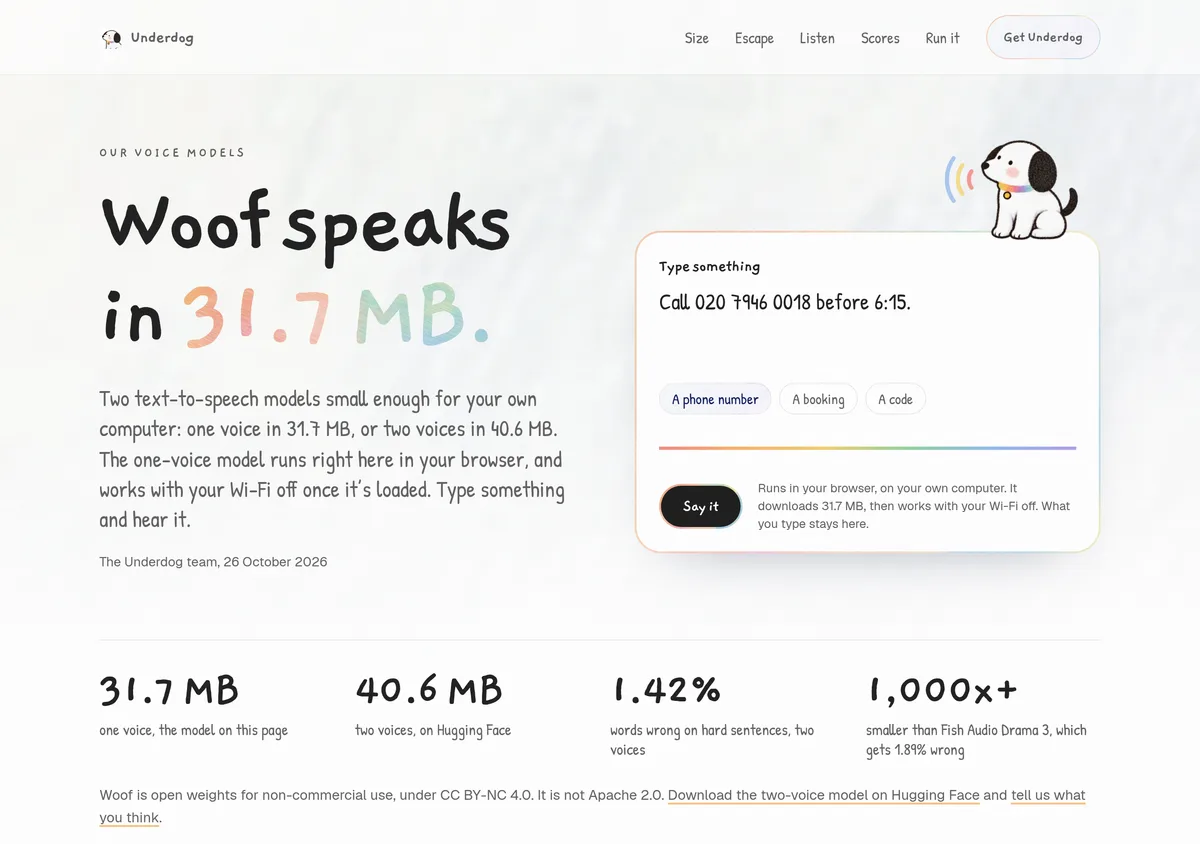 Source: underdog.ai/woof, captured November 9, 2026.
NC means non-commercial. You can prototype with Woof, demo it, run it in an internal tool, or ship it in a hobby project with no revenue attached. Bake it into a paid product and you're outside the license as written, full stop, with no published commercial tier to switch to yet. For a weekend project that's a footnote. For a team evaluating whether to build a voice feature on it, it's the first question to answer, before the second question about how the voice actually sounds.
The rest of the stack
Woof isn't Underdog's only small model. Weeks earlier the company shipped Bark, a 167 MB speech-to-text model built for on-device transcription and dictation, and separately a 27-billion-parameter model sized to run on a laptop, fine-tuned from Qwen3-8-27B, which founder Sigil Wen says compares favorably with Claude Opus 4.6 on some benchmarks (per TechCrunch). Wen's stated bet is bigger than any one model: "I think we will be able to run most capable models of today on the devices you already own within months," he told TechCrunch, adding that the goal is open, American-made models that don't force a privacy trade for capability (per TechCrunch).
All of this feeds Underdog's actual product: a locally-run AI assistant positioned against Meta's Muse and Google's Instinct, both of which have drawn their own privacy scrutiny over broad data access this year (per TechCrunch). That app is still invite-only; the signup page at underdog.ai/download puts you on a waitlist, not into the product. Woof and the Hugging Face weights are the only pieces of this you can actually take home today.
Woof versus a hosted TTS API
A hosted TTS endpoint like ElevenLabs or OpenAI's TTS API gets you a wider range of expressive, studio-quality voices, and somebody else's GPU does the work. The cost shows up per character or per request, the audio has to travel over the network both ways, and your text passes through a third party's servers before it becomes sound. If you want a deeper, pricing-level comparison of the hosted options, our ElevenLabs vs. OpenAI TTS vs. PlayHT breakdown covers that ground.
Woof flips every piece of that trade. Marginal cost per request is zero once the model is loaded, nothing about the input text crosses a network, and there's no API key to rotate or rate limit to hit. What you give up, based on what Underdog has published so far, is everything about voice quality that the word-error benchmark doesn't measure: emotional range, pacing, how it handles a sentence that isn't in the test set. A 31-million-parameter model wasn't going to out-act a frontier voice model, and Underdog isn't claiming it does.
Who should actually download this
If you're prototyping a voice feature for an agent or an internal tool, and cost, offline operation, or keeping text off a server matters more than a wide voice catalog, pull the two-voice weights from Hugging Face today and run your own scripts through it before you write a line of integration code. Five minutes with the escape-room demo will also tell you fast whether the voice clears your bar.
If you're building toward a paid, shipped feature this quarter, don't architect around the open weights yet. CC BY-NC 4.0 closes that door until Underdog publishes a commercial license or the waitlisted Underdog app itself ships with a production path. Watch two things from here: whether the 27B laptop model gets the same open-download treatment as Woof, and whether that waitlist actually opens. Until then, the smallest model in Underdog's lineup is also the only one you're free to build with outside a product.