Lindy Review 2026: The AI Agent That Manages Your Inbox and Meetings, Priced Clearly
Published June 28, 2026 · Updated June 28, 2026 · by Pondero Reviews
The short version
Lindy runs your inbox, calendar, and follow-ups from a text thread, now across four tiers. The decision turns on one feature gate: computer use. Current pricing, candid cons, and the per-persona pick.
Pros
- ✓One platform handles inbox drafting, meeting scheduling, notes, and follow-ups, run from an iMessage or SMS thread with roughly 60-second setup
- ✓The Plus tier at 49.99 USD a month covers the full personal-assistant job for a solo operator, with a 7-day trial that unlocks all Plus features
- ✓Computer use (Autopilot) lets an agent drive web dashboards that have no API, which is the capability most no-code tools cannot match
- ✓Enterprise carries SOC 2 Type II, HIPAA, GDPR, SSO, and SCIM, so the procurement conversation at a compliance-sensitive shop actually clears
- ✓Lindy Build ships a working full-stack web app from a prompt and tests its own UI, a separate product surface that comes bundled, not as an add-on bill
Cons
- ✕Computer use is gated to Pro at 99.99 USD a month, so the autonomous-against-any-dashboard workflows cost double the entry tier
- ✕Usage is sold as opaque tiers (standard, 3x, 7x) rather than a countable unit, so a long-running agent task is hard to budget before you hit a cap
- ✕There is no self-hosting, so the monthly bill never drops to near-zero the way an n8n box on a cheap VPS does
- ✕Lindy Build apps cover internal tools and intake forms, not complex application logic that still wants a developer
Lindy Review 2026: The AI Agent That Manages Your Inbox and Meetings, Priced Clearly
For a solo operator who lives in their inbox, Lindy on the Plus plan (49.99 USD a month, per Lindy's pricing page fetched June 28 2026) is the pick: it drafts your replies, schedules and reschedules your meetings, takes your call notes, and chases your follow-ups, all from a text thread, with setup that takes about a minute. For anyone who needs an agent to act inside a web app that has no API, the pick moves up to Pro at 99.99 USD a month, because one feature, computer use, is the line between an assistant that drafts and an assistant that does. That gate is the whole buying decision, and most reviews bury it.
Here is the one thing to leave with. Lindy is priced in four tiers now, and what moves you up a tier is capability. Plus gives you the drafting-and-scheduling assistant. Pro adds computer use and model choice. Max adds headroom. Enterprise adds the compliance and identity controls a regulated buyer needs. Figure out which capability you actually need, and the tier picks itself. We rate Lindy 4.5, up from the 4.3 on our May tool card, because the pricing is now legible, computer use is real, and the compliance story closed the gap for the buyers who could not consider it before.
A note on what this review is built from. The tool card we published in May predates the four-tier pricing, the Lindy Build launch, the named Enterprise tier, and the Parallel Web integration, so this is a fresh look sourced from Lindy's pricing page, product blog, and public changelog, each cited and dated inline.
What Lindy actually does
Strip away the category label and Lindy does three concrete jobs. Inbox first: it drafts replies in your writing style, triages threads by priority, and learns what to surface versus archive the more you use it (per Lindy's pricing FAQ, June 28 2026). Calendar second: it schedules and reschedules meetings, then generates prep briefs and follow-ups around them. Voice third: Lindy runs inbound and outbound phone agents for teams that need a number answered.
The setup is the part that sells it. You sign up, connect a phone number, and Lindy texts you. From then on the interaction is a message thread. You ask Lindy to handle an email, it drafts a reply, you approve, it sends. Nothing goes out without your sign-off by default (per Lindy's pricing FAQ, June 28 2026). The interface is optimized for iMessage on iOS, but any SMS-capable device works, so Android users text and get standard SMS back. It connects to Gmail, Outlook, Google Calendar, Slack, Notion, and a few hundred other apps.
That text-thread model is the reason Lindy reads as turnkey where competitors read as a project. You are not building a workflow on a canvas. You are texting an assistant.
Pricing by tier, and the one decision it forces
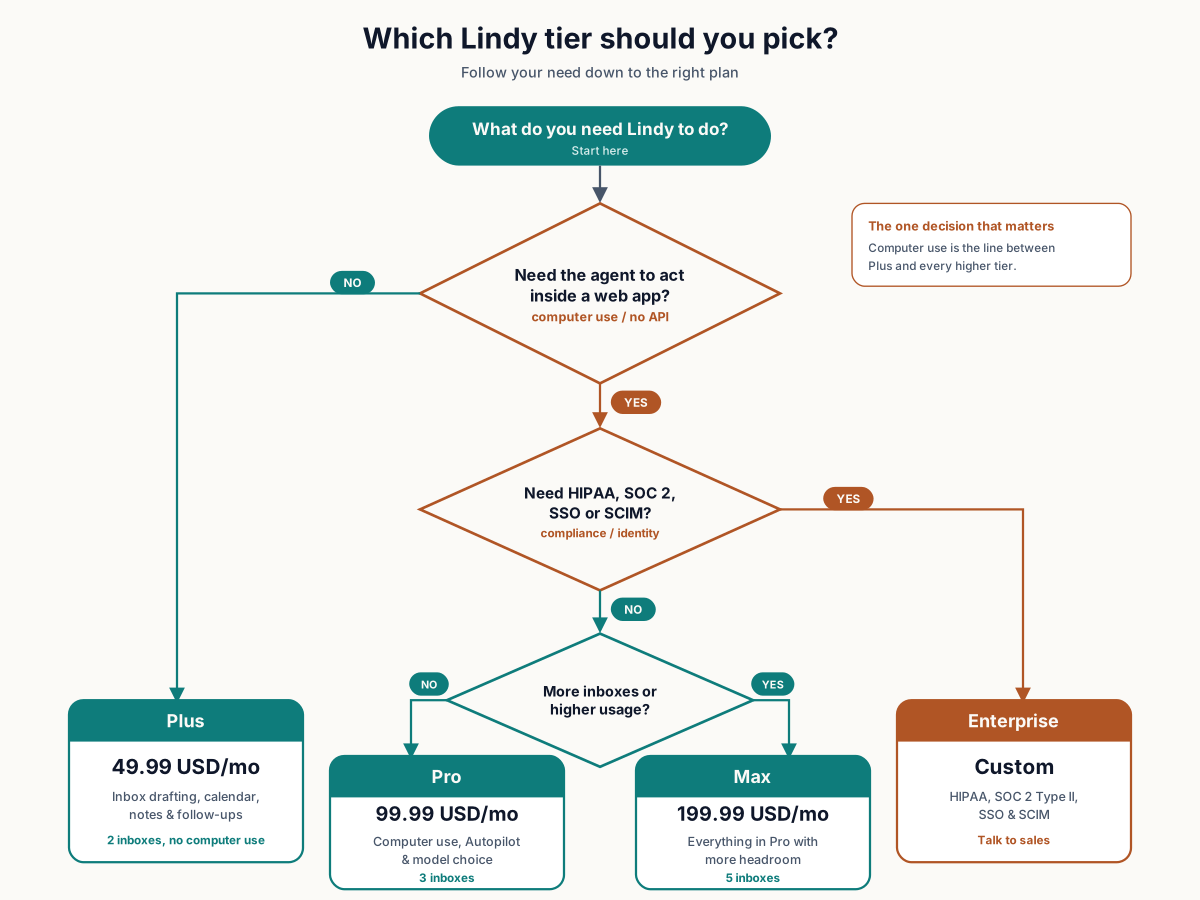
Here are the current tiers. The differences are not subtle, and they are not mostly about how much you use the thing.
| Tier | Price/mo | Inboxes | Computer use | Model choice |
|---|---|---|---|---|
| Plus | 49.99 USD | Up to 2 | No | Default only |
| Pro | 99.99 USD | Up to 3 | Yes | Yes |
| Max | 199.99 USD | Up to 5 | Yes | Yes |
| Enterprise | Custom | Custom | Yes | Yes |
All figures per Lindy's pricing page, fetched June 28 2026. Plus runs at standard usage with up to 2 inboxes, iMessage and SMS chat, email drafting, meeting scheduling and notes, prep and follow-up, and 100-plus integrations. Pro adds 3x the usage of Plus, a third inbox, computer use, your pick of the model Lindy runs on, and a live onboarding session. Max takes usage to 7x Plus and 5 inboxes. Enterprise builds on Max with a shared usage pool across the org plus the controls covered below.
Two decision points run through that table. The first decides Plus versus Pro: do your workflows need computer use? If Lindy only has to read and draft against tools it already integrates with (Gmail, Calendar, Slack, Notion), Plus is enough. If you need Lindy to log into a web dashboard that has no public API and click through it, you need Pro or higher, full stop. That is the feature that turns Lindy from a drafting assistant into an agent that acts. We will come back to why it matters and why the gate stings.
The second decision point is compliance, and it decides whether you are an Enterprise conversation at all. If you operate in healthcare or any environment that needs a signed BAA, SSO, and audit logs, you are talking to sales regardless of seat count. Everyone else can start on the free trial.
That trial is worth calling out because it is generous. The 7-day free trial gives full access to all Plus features, including inbox management, meeting scheduling and follow-up, meeting recording and notes, and the 24/7 text assistant (per Lindy's pricing FAQ, June 28 2026). There is no long-term contract on Plus, and you can cancel from account settings and keep access through the end of the billing period. So the entry risk is a week of your time, not a year of your budget.
Lindy Build is a different product, and you should know that going in
The biggest source of confusion about what a Lindy plan covers is Lindy Build, so let us draw the line clearly. Lindy Build is not the agent that runs your inbox. It is an AI app builder. You describe a web app in plain text, with whatever design guidelines, tone, and features you want, and Lindy Build generates it: front-end, back-end, database, and integrations, production-ready (per Lindy's Lindy Build post).
The feature Lindy leans on to differentiate it is QA. Where other app builders let you vibe-code and hand you the result, Lindy Build tests its own work. It clicks through the rendered UI, exercises forms and features, finds bugs, and attempts to fix them in the background, the way a developer would before shipping (per Lindy's Lindy Build post). It launched on August 28, 2025, per the Lindy changelog, and it is bundled with Lindy accounts rather than billed as a separate product.
Who is it for? A non-technical ops manager who needs a small internal tool. A status tracker, an intake form, a lightweight CRM, an internal dashboard. The kind of thing that historically meant a web agency or a developer sprint. What it is not for is complex application logic with real edge cases and a long-lived data model. For that, you still want a developer. Read Lindy Build as a way to ship the small internal thing without a build queue, not as a replacement for engineering.
Where Lindy beats the alternatives
Three things separate Lindy from the no-code automation crowd it gets compared to.
The first is that inbox and calendar are one platform with no build step. A solo operator running their email through Lindy is replacing what would otherwise be a triage tool, a scheduling tool, a notes tool, and a follow-up reminder, stitched together. Lindy collapses that into one text thread you set up in about a minute. Natural-language setup beats the canvas-and-modules model for the specific job of "manage my work life" because there is no workflow to design.
The second is computer use, branded Autopilot in Lindy's own material. The pitch is blunt: APIs are limiting, so with Autopilot your agent gets its own cloud computer and can navigate internal tools and dashboards the way you would (per the Lindy changelog). That is the capability that lets Lindy act against a vendor portal or an internal admin panel that never exposed an API. Make and Zapier route around missing APIs with HTTP modules and brittle scraping. Lindy drives the actual interface. For the long tail of business tools that never shipped an API, that is a real edge, and it is the reason the Pro tier exists.
The third is research inside the workflow. The Parallel Web integration, announced June 26 2026 per Lindy's integration post, puts live web retrieval and reasoning directly into agent steps through two nodes: Web Enrichment, which turns a set of inputs into structured data pulled fresh from the web, and Chat with Web, which answers questions against a live web index. You pick a Parallel processor by task complexity, from Lite for simple lookups up to Pro or Ultra when reasoning depth matters (per Lindy's integration post). For lead enrichment or competitive monitoring, that removes the need to bolt on a separate scraping API or a Firecrawl step.
And for the buyers who could not even consider Lindy before, the compliance story now clears. Enterprise ships with SOC 2 Type II, HIPAA, and GDPR compliance, plus SSO, SCIM provisioning, Evals for measuring agent quality, and audit logs that record every change, action, and integration (per Lindy's Enterprise announcement). The pricing page also carries GDPR, HIPAA, SOC 2, and PIPEDA badges (per Lindy's pricing page, June 28 2026). A healthcare ops lead who got a hard no from procurement on the old tool card has a different conversation now.
Where Lindy falls short
The candid cons are real, and the first one is the same feature we just praised. Computer use lives behind Pro at 99.99 USD a month. If the autonomous-against-any-dashboard behavior is the reason you want Lindy, the price of entry is double the Plus tier. There is no half-step. You are either on the drafting assistant at 49.99 USD or the acting agent at 99.99 USD, and a lot of buyers sit right on that line.
The second con is the usage model. Lindy sells usage as tiers, standard on Plus, 3x on Pro, 7x on Max (per Lindy's pricing page, June 28 2026), rather than as a countable unit like credits or tasks. That reads clean on the pricing page and gets murkier in practice. When an agent runs a long, multi-step task, especially one using computer use to grind through a slow web UI, there is no transparent meter that tells you how much of your monthly allowance that single run just consumed. You find the ceiling by hitting it. Make's credit model surprises you with arithmetic; Lindy's tier model surprises you with opacity. Pick your trade.
Third, there is no self-hosting. Lindy is a managed cloud product, so the bill never drops toward zero. A technical team that runs n8n on a small VPS can get per-execution cost to roughly the price of the box. Lindy will always be a monthly subscription. For a solo operator that is fine, the assistant is worth 49.99 USD. For a high-volume technical shop it is a structural cost ceiling.
Fourth, Lindy Build has a ceiling too. It ships internal tools, intake forms, and dashboards well. Hand it genuinely complex application logic and you are back to wanting a developer. Treat it as a fast path for the small thing, not a way to delete your engineering function.
Lindy vs Make vs n8n, in three lines each
This is not a full three-way review. The narrow question is when each tool wins.
Lindy wins when natural-language setup and no-code speed matter more than per-run cost control, and when you need an agent to act against tools that lack APIs. Because setup is a text thread rather than a canvas, it gets you to a working personal ops assistant with no build step. For the head-to-head against another agent platform, see Lindy vs Relevance AI.
Make wins for visual multi-step workflows and tighter per-execution cost at volume, with its AI Agents now generally available on a Core plan that starts well under Lindy's entry price. If your job is "wire many apps together with branch logic," the canvas is the better tool.
n8n wins if you can run Docker and want self-hosting to push per-execution cost to near zero. It is the technical team's pick when volume is high and someone owns the box. For the full breakdown across all three, see Make vs n8n vs Zapier.
A worked cost comparison
Here is the math that makes the tier decision concrete, using Lindy's own listed prices.
Example: a two-person ops team needs an assistant to triage two shared inboxes, schedule meetings, and write follow-ups, with no dashboard automation. That is the Plus job, at 49.99 USD a month, with both inboxes covered under the 2-inbox cap. Now the same team adds one requirement: Lindy must log into a supplier portal that has no API and pull order statuses every morning. That needs computer use, which moves them to Pro at 99.99 USD a month and doubles the bill. Before committing, confirm the portal genuinely has no API. A one-time integration on Plus is cheaper than a permanent doubling of the subscription. Map your must-have capabilities to the lowest tier that includes them, and do not pay for computer use you will not use.
The verdict, by who you are
Lindy earns a 4.5 in June 2026 because the buying decision is now legible, the headline capability is real, and the compliance gap closed. The cons are worth restating plainly: computer use doubles your entry price, the usage tiers are opaque, there is no self-host path, and Lindy Build stops short of complex logic. None of those flip the recommendation for the buyer Lindy is built for. They sharpen which buyer that is.
The picks, by situation:
- Solo operator or small team, inbox and calendar only. Plus at 49.99 USD a month. You get the full drafting-scheduling-notes-follow-up assistant from a text thread, with a 7-day trial that costs you nothing but a week of attention. This is the buyer the 4.5 is for.
- Anyone who needs an agent to act against a dashboard with no API. Pro at 99.99 USD a month. Computer use is the feature, and it is the only tier line that changes what Lindy can do rather than how much.
- HIPAA-covered or SSO-mandated organization. Enterprise. SOC 2 Type II, HIPAA, GDPR, SSO, SCIM, and audit logs are what get the contract past procurement, and pricing is a sales conversation.
- Pass on Lindy if you need deep multi-step workflow logic with code nodes (n8n is the pick) or high-volume agentic automation at tight per-run cost (Make or a self-hosted box wins).
If you fall in the first or second bucket, the lowest-risk move is to validate on the trial. You can start a Lindy trial on full Plus access, run your real inbox through it for a week, and only then decide whether the computer-use jump to Pro is a requirement or a nice-to-have.
Ready to try it?
Try lindy →