Table of Contents
Kimi K2.7 Code vs DeepSeek V4 vs Qwen3: Best Open-Weight Model for Your MCP Agent Stack (2026)
For MCP-heavy agent stacks, Kimi K2.7 Code is the right open-weight choice in June 2026. For high-volume code generation where raw correctness matters most, DeepSeek V4 Pro is ahead. Qwen3.5-397B fills the gap when multilingual support or licensing flexibility is the constraint. Here is the data behind each call.
Why "best open-weight coding model" depends on your workload
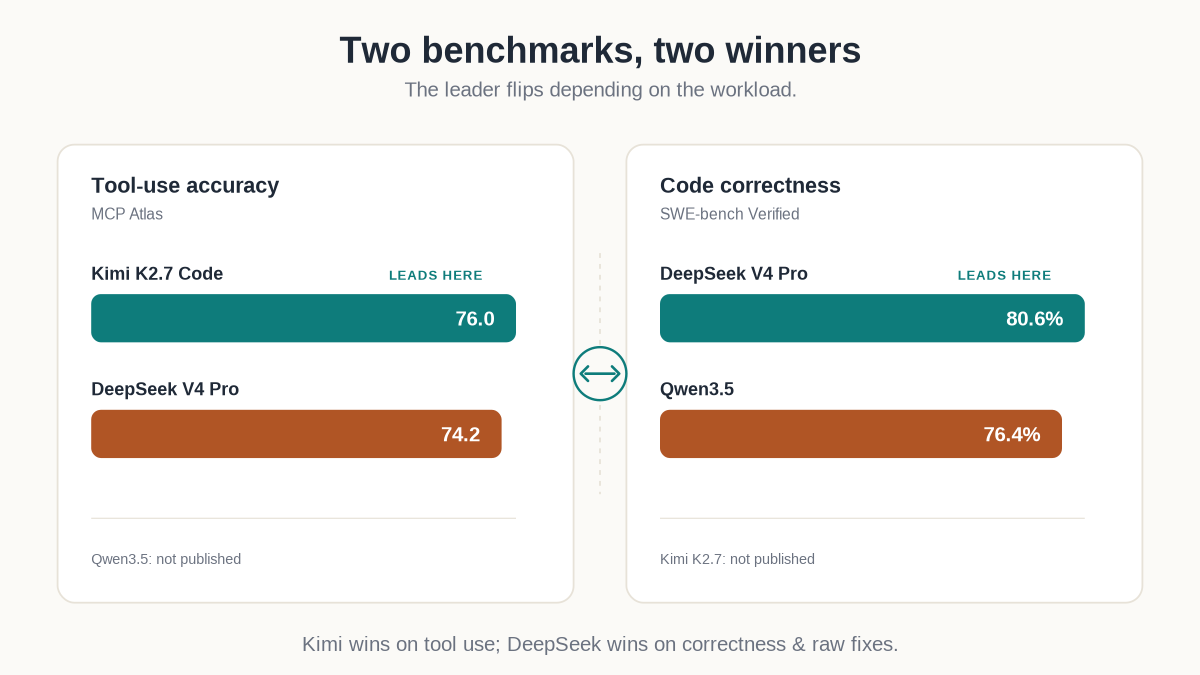
Two different rankings emerge from two different benchmarks. SWE-bench Verified measures whether a model can produce a correct code patch given a GitHub issue. MCP-specific benchmarks like MCP Atlas and MCP Mark Verified measure whether a model can orchestrate tool calls correctly across an agent loop. These two things are not the same skill, and the rankings flip depending on which one you care about. DeepSeek V4 Pro-Max scores 80.6% on SWE-bench Verified per the DeepSeek V4 HuggingFace model card. Kimi K2.7 Code scores 76.0 on MCP Atlas and 81.1 on MCP Mark Verified per Moonshot AI's release benchmarks. Pick based on your loop, not the headline number.
The three models: quick specs
| Model | Params (total/active) | Context | License | API price (input/output per 1M) | Self-host | Released |
|---|---|---|---|---|---|---|
| Kimi K2.7 Code | 1T / 32B | 256K | Modified MIT | ~$0.95 / ~$4.00 (per codersera) | vLLM, SGLang, KTransformers | June 12, 2026 |
| DeepSeek V4 Pro | 1.6T / 49B | 1M | MIT | $0.66 / $1.98 cache-miss, off-peak (DeepSeek docs) | vLLM, TensorRT-LLM, SGLang | June 2026 |
| Qwen3.5-397B-A17B | 397B / 17B | 262K (up to 1M) | Apache 2.0 | $0.60 / $3.60 (Together AI) | vLLM, SGLang | May 2026 |
Pricing: Kimi per codersera.com (June 2026); DeepSeek per official DeepSeek API docs; Qwen per Together AI pricing. DeepSeek now splits pricing into off-peak and peak hours (peak is Mon-Fri 01:00-04:00 and 06:00-10:00 UTC, excluding Chinese holidays, and costs double); off-peak is shown above.
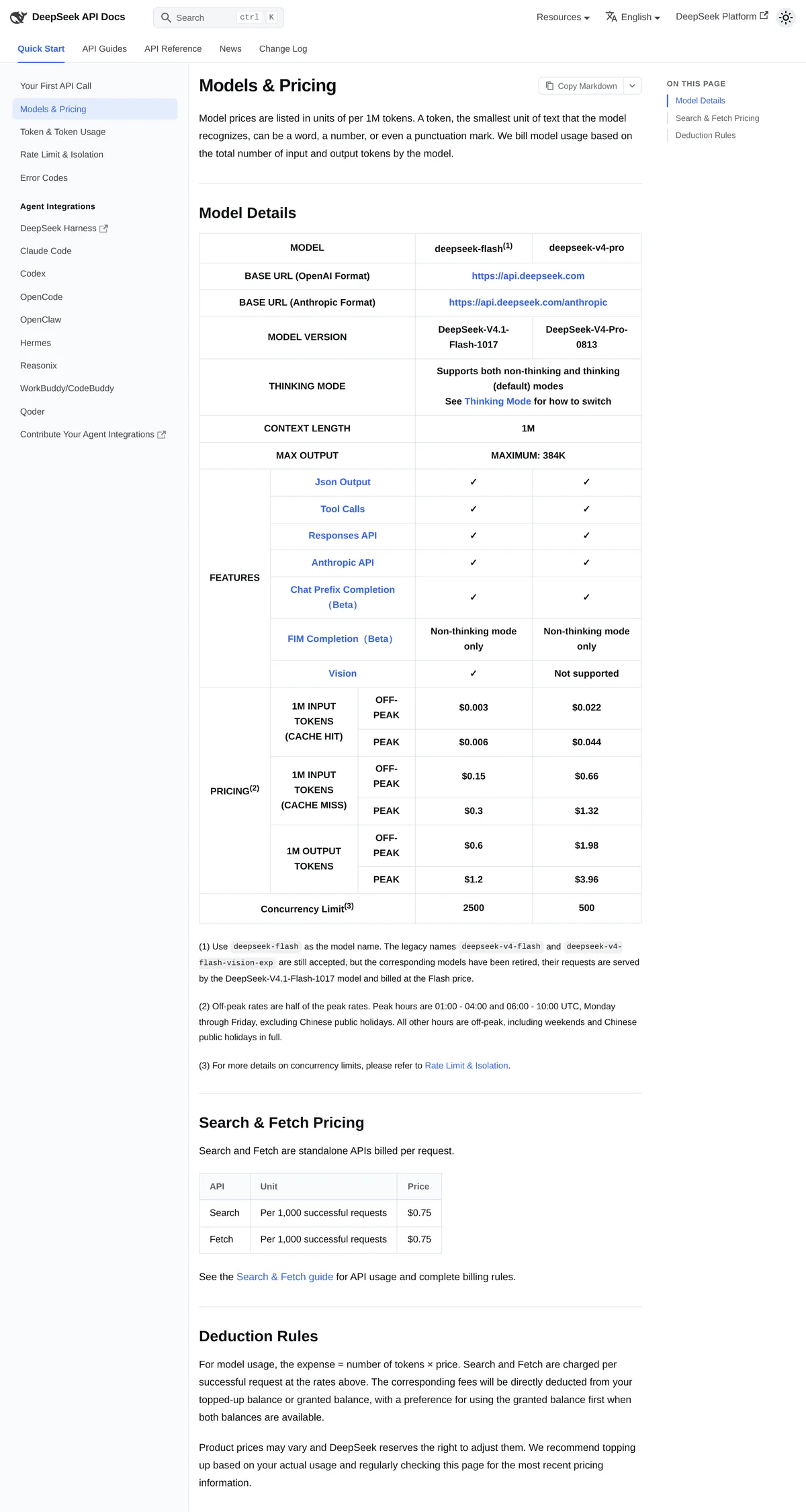 Source: api-docs.deepseek.com, captured November 5, 2026.
A note on architecture: none of these are dense models in the traditional sense. All three use Mixture-of-Experts. The "active" column is the parameter count actually touched per token, which is what determines inference cost and speed. "1T parameters" sounds expensive to run; 32B active is closer to a mid-size model per token.
MCP tool-use accuracy: where K2.7 leads
MCP Atlas and MCP Mark Verified were designed to measure exactly what standard benchmarks miss: can a model pick the right tool, call it with the right arguments, read the output correctly, and continue the task without drifting? These are the mechanics that fail in production agent loops, not the leetcode-style one-shot code gen that SWE-bench measures.
Per the Moonshot model card and MarkTechPost's June 12 coverage, K2.7 Code scores 76.0 on MCP Atlas (up from 69.4 on K2.6) and 81.1 on MCP Mark Verified (up from 72.8). For context, in the same benchmarks run by Moonshot, Claude Opus 4.8 scored 81.3 and 76.4 respectively. K2.7 Code actually edges out Opus 4.8 on MCP Mark Verified. DeepSeek V4 Pro-High scores 74.2 on MCP Atlas per the DeepSeek V4 model card, notably below K2.7's 76.0.
The mechanism behind K2.7's MCP strength: the model was explicitly trained for agentic tool-call loops, not just code generation. Moonshot also cut reasoning-token usage by roughly 30% versus K2.6, per aimlapi.com's complete guide to K2.7 (June 2026). Less overthinking on each step means an agent loop of 50 tool calls runs faster and cheaper than the same loop on a more verbose reasoning model.
Candid con on K2.7: as of June 24, 2026, every benchmark score in this section comes from Moonshot's own evaluation run. Independent third-party verification is pending, typically arriving 2-4 weeks post-release. If you're making a procurement decision purely on MCP Atlas vs MCP Atlas, wait for the independent runs. If you're making a decision on "does this model actually follow MCP tool schemas reliably," the early signal is strong.
Raw coding correctness: where DeepSeek V4 leads
SWE-bench Verified resolves GitHub issues against a real test suite. It's the closest public proxy for "does the patch actually work." DeepSeek V4 Pro-Max scores 80.6% on SWE-bench Verified per the official model card. Qwen3.5-397B-A17B scores 76.4% per its Hugging Face model card. K2.7 Code, at launch, has no independent SWE-bench Verified score published.
The K2.7 Code Bench v2 score of 62.0 (from 50.9 on K2.6) is Moonshot's internal benchmark. It is directionally useful but not directly comparable to SWE-bench Verified. Different scaffold, different tasks.
DeepSeek V4 Pro also supports a 1M-token context window natively, per the model card. That is meaningful for operators working with giant monorepos or needing to load an entire dependency graph before reviewing a patch. K2.7 Code tops out at 256K. For most agent workloads that's fine. For whole-codebase-at-once analysis, V4 Pro has a practical edge.
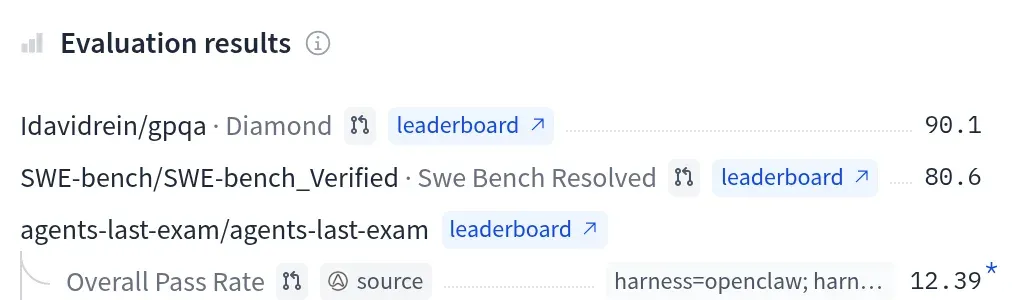 Source: huggingface.co, captured November 5, 2026.
The candid con on V4 Pro: DeepSeek's cheaper Flash tier just got a meaningful upgrade. The company shipped DeepSeek-V4.1-Flash-1017 on October 17, 2026, still priced at $0.15/M input (off-peak) against V4 Pro's $0.66/M off-peak, per DeepSeek's API docs (both run double during peak hours). It scores 77.0 pass@1 on DeepSeek's DeepSWE v1.1 benchmark (mini-swe-v2 harness), up from 74.2 for the prior Flash release, per the DeepSeek-V4.1-Flash-1017 model card. DeepSeek's own comparison table puts that ahead of the 74.0 it reports for Opus 5 on the same test. Treat that as directional, not a head-to-head win: these are vendor-run numbers, not independently verified, and DeepSWE v1.1 isn't the SWE-bench Verified test cited for V4 Pro-Max above. If your workload doesn't need Pro's extra capacity, Flash's economics just got harder to argue against.
DeepSeek also tuned this release for agentic project building rather than just patch generation. It added reinforcement learning with self-feedback for end-to-end builds like game creation, 3D modeling, and scene generation, and lists DeepSeek Harness, Tencent CodeBuddy, and WorkBuddy as the optimized integration points, per the release notes. Operators on DeepSeek Harness need v0.2.1-rc.1 or later to get the new model's full benefit.
Pricing and cost math at scale
Here is what a 100-call-per-day agent running on each model costs over a year, treating each call as roughly 4,000 input tokens and 2,000 output tokens (typical for a code review or patch generation task).
Example: 100 calls/day * 365 days = 36,500 calls/year

Kimi K2.7 (Kimi API native, cache-miss):
  Input:  36,500 * 4,000 tokens = 146M tokens * $0.95/M = $138.70
  Output: 36,500 * 2,000 tokens =  73M tokens * $4.00/M = $292.00
  Annual: ~$431

DeepSeek V4 Pro (cache-miss, off-peak):
  Input:  146M tokens * $0.66/M = $96.36
  Output:  73M tokens * $1.98/M = $144.54
  Annual: ~$241

Qwen3.5-397B (Together AI):
  Input:  146M tokens * $0.60/M = $87.60
  Output:  73M tokens * $3.60/M = $262.80
  Annual: ~$350
V4 Pro still wins this math at off-peak rates, by roughly 1.5-1.8x over K2.7 and Qwen3.5 (DeepSeek added a peak/off-peak pricing split since this piece was last updated, so the gap is narrower than the 3-4x it used to be). The flip condition is prompt caching. K2.7's cache-hit input rate is $0.19/M per codersera's pricing breakdown (cache-miss $0.95/M). Agents that re-read the same codebase context on every call (a very common pattern) see their effective input cost collapse. Run the math with your actual cache-hit ratio and your actual peak/off-peak call mix before assuming V4 Pro wins on price.
DeepSeek V4.1-Flash-1017 ($0.15/M input, $0.60/M output off-peak, per DeepSeek's API docs) is still below all three models above on both input and output, and it carries the same 1M-token context window as V4 Pro per the same pricing page. DeepSeek says the October 17, 2026 release completes tasks faster and produces shorter outputs than the Flash version it replaces, which lowers the effective per-task bill beyond the headline per-token rate, per the release notes. Worth evaluating first if your workload doesn't need V4 Pro's extra capacity.
The same October 17 release opened DeepSeek's Search and Fetch tool-calling APIs to every API user. Each is billed at $0.75 per 1,000 successful requests rather than by token, including calls made through server-side tool use in DeepSeek Harness, Claude Code, or Codex, per DeepSeek's Search & Fetch guide. The introductory free window DeepSeek offered through October 31, 2026 has ended; billing is active on every successful call now.
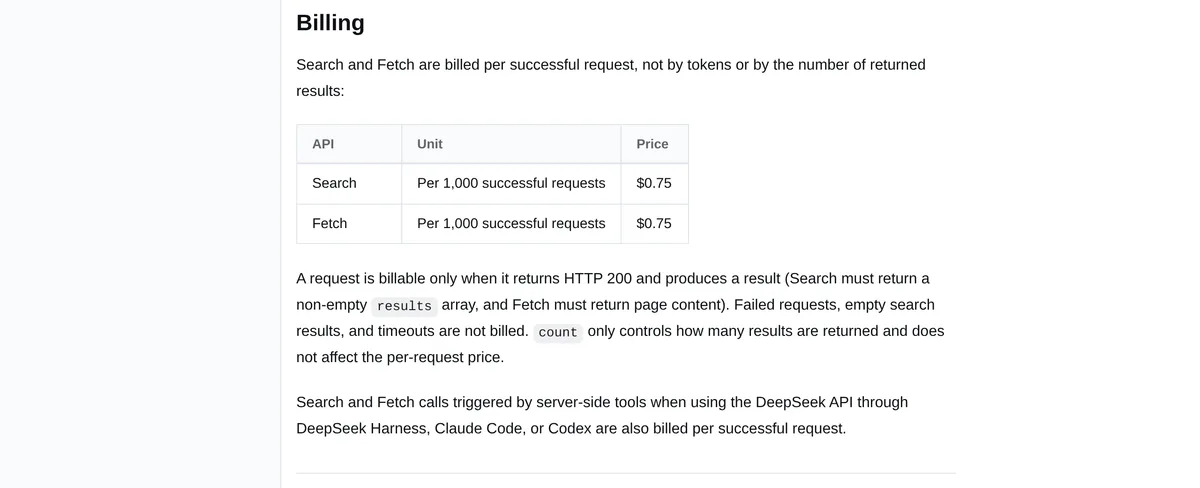 Source: api-docs.deepseek.com, captured November 5, 2026.
For an MCP stack that already pays per-call for a dedicated scraping tool, run the per-request rate above against what you're paying today.
Self-hosting: what it actually costs on GPU cloud
All three models ship open weights and support vLLM. None of them run on a laptop. The K2.7 Code weight checkpoint is approximately 595 GB per aimlapi.com's coverage. DeepSeek V4 Pro, at 1.6T parameters in FP4+FP8 mixed, is considerably larger. Qwen3.5-397B-A17B at 397B total lands between them.
Practical storage and hardware requirements:
- K2.7 Code: ~595 GB on-disk per aimlapi.com; vLLM + SGLang supported; KTransformers for quantized variants on fewer GPUs
- DeepSeek V4 Pro: 1.6T parameters in FP4+FP8 mixed per the model card; requires multi-node deployment; most production operators run FP4 or INT4 quantized variants from the community
- Qwen3.5-397B-A17B: 397B total at Apache 2.0; available via HuggingFace for self-deployment; Together AI's managed endpoint sidesteps the infrastructure entirely
Operators who want to self-host without owning the hardware should look at Cloudways for GPU cloud instances. Cloudways currently offers GPU-capable infrastructure with their promo code MIGRATE303, giving 30% off for 3 months plus free expert migration assistance. That promo expires June 30, 2026, so if you're planning Q3 deployments, starting the migration now captures the discount. DigitalOcean GPU Droplets are a lower-commitment entry point, with H100 instances available on an hourly basis for workloads where you don't need persistent endpoints.
The honest operational note on DeepSeek V4 Pro self-hosting: vLLM and SGLang have months of V4 optimizations behind them. The model is battle-tested in production. K2.7 Code weights arrived June 12; inference engine optimization typically lags a release by 2-4 weeks. If your timeline is July 2026 or later, K2.7 is fully in scope. If you need a stable self-hosted deployment today, V4 Pro is the lower-risk choice.
Workload decision matrix
| Workload | Pick | Why |
|---|---|---|
| MCP-orchestrated agent loop (tool-heavy) | Kimi K2.7 Code | 76.0 MCP Atlas, 81.1 MCP Mark Verified; purpose-trained for tool-call accuracy |
| Long-horizon code edits (SWE-style correctness) | DeepSeek V4 Pro | 80.6% SWE-bench Verified (Pro-Max); strong multi-language patch quality |
| Multilingual coding and instruction following | Qwen3.5-397B | 88.5% MMMLU; 201 languages; leads on IFBench and MultiChallenge |
| Cost-sensitive batch at scale | DeepSeek V4.1-Flash-1017 | $0.15/M input, off-peak (docs); best cost-per-token in this category, now paired with the strongest Flash-tier coding benchmarks DeepSeek has shipped, per the Oct 17, 2026 release |
| Research agent with web data layer | Kimi K2.7 + Firecrawl | K2.7 handles MCP tool calls; Firecrawl handles web data ingestion |
| Vision / screenshot-to-code tasks | Kimi K2.7 or DeepSeek V4 Pro | Both ship capable vision encoders; Qwen3.5-397B also supports vision |
| Apache-licensed compliance requirement | Qwen3.5-397B | Apache 2.0 is the most permissive of the three licenses |
For reference on the multilingual benchmarks: Qwen3.5-397B-A17B scores 88.5% on MMMLU (multilingual MMLU) and 76.5% on IFBench per the Qwen3.5 HuggingFace model card. The model supports 201 languages, which is the strongest multilingual footprint in this trio.
Connecting to your stack: API call pattern
All three models support an OpenAI-compatible API. Here is the Python pattern that works for K2.7 Code. Adapt base_url and model for the other two.
# Kimi K2.7 Code via the Kimi API (OpenAI-compatible)
# Requires: pip install openai
# API key from: platform.kimi.ai

from openai import OpenAI

client = OpenAI(
    api_key="<YOUR_KIMI_API_KEY>",
    base_url="https://api.moonshot.cn/v1",
)

response = client.chat.completions.create(
    model="kimi-k2.7-code",
    messages=[
        {
            "role": "user",
            "content": "Review this Python function for bugs and suggest a fix:\n\n```python\ndef divide(a, b):\n    return a / b\n```",
        }
    ],
    # Note: temperature, top_p, n, and penalties are locked in K2.7 Code.
    # Do not pass temperature=0 (the API will error on this override).
    max_tokens=2048,
)

print(response.choices[0].message.content)
For DeepSeek V4 Pro, swap base_url="https://api.deepseek.com/v1" and model="deepseek-v4-pro". For Qwen3.5-397B via Together AI, use base_url="https://api.together.xyz/v1" and model="Qwen/Qwen3.5-397B-A17B" with your Together AI key.
One critical K2.7 quirk to plan around: thinking mode is always on and cannot be disabled. The API errors if you try to set temperature=0, which is a common pattern for deterministic code generation. If your current agent code sets temperature explicitly, remove that override before pointing it at K2.7.
What changed
November 5, 2026: Added dated screenshots of DeepSeek's pricing page, its V4-Pro Hugging Face model card, and its Search & Fetch billing guide. DeepSeek has since split API pricing into off-peak and peak tiers; V4 Pro's cache-miss rate is now $0.66/M input and $1.98/M output off-peak (was $0.435/$0.87 flat), and V4.1-Flash-1017 is $0.15/M input and $0.60/M output off-peak (was $0.14/$0.28); the cost-math section and the "V4 Pro wins by 3-4x" claim were updated accordingly. The Search/Fetch free introductory window through October 31, 2026 has ended; billing is now active on every successful call. SWE-bench Verified for V4 Pro-Max is confirmed still 80.6% on the live model card.
October 19, 2026: Updated the DeepSeek side for DeepSeek-V4.1-Flash-1017, released October 17, 2026: new Flash-tier benchmarks and agentic tuning (see "Raw coding correctness" above) and the new Search/Fetch tool-calling API pricing (see "Pricing and cost math at scale" above). V4 Pro and its SWE-bench Verified score are unaffected by this release; the Kimi and Qwen3 comparisons below are unchanged from the June 2026 original.
The bottom line
For a solo dev building an MCP agent stack: K2.7 Code is the pick. The MCP tool-use scores are real and the Modified MIT license is clean enough for most solo projects. Get it via the Kimi API or OpenRouter while the inference ecosystem matures.
For a team shipping production code generation: DeepSeek V4 Pro. The SWE-bench Verified score is sourced from the official model card, the inference tooling is proven, and the API pricing is below K2.7 on a per-token basis at cache-miss rates. DeepSeek V4.1-Flash-1017, released October 17, 2026, deserves a look first if throughput matters more than absolute quality; it's meaningfully stronger on DeepSeek's own agentic coding benchmarks than the Flash release it replaces.
For multilingual teams or strictly licensed deployments: Qwen3.5-397B-A17B. Apache 2.0 is the most deployment-friendly license in this set, the multilingual instruction-following benchmarks are the strongest, and Together AI's managed endpoint removes the self-hosting complexity.
Where the pick flips: if you're running an MCP orchestration layer and you need the absolute best tool-call reliability today, K2.7 leads. DeepSeek's October update narrowed the price-to-capability gap at the Flash tier without touching V4 Pro's MCP or SWE-bench Verified numbers, so that flip still depends on independent MCP Atlas and MCP Mark Verified runs landing for K2.7 and V4 Pro alike.