Table of Contents
What 2026 Enterprise Agent Deployments Have in Common
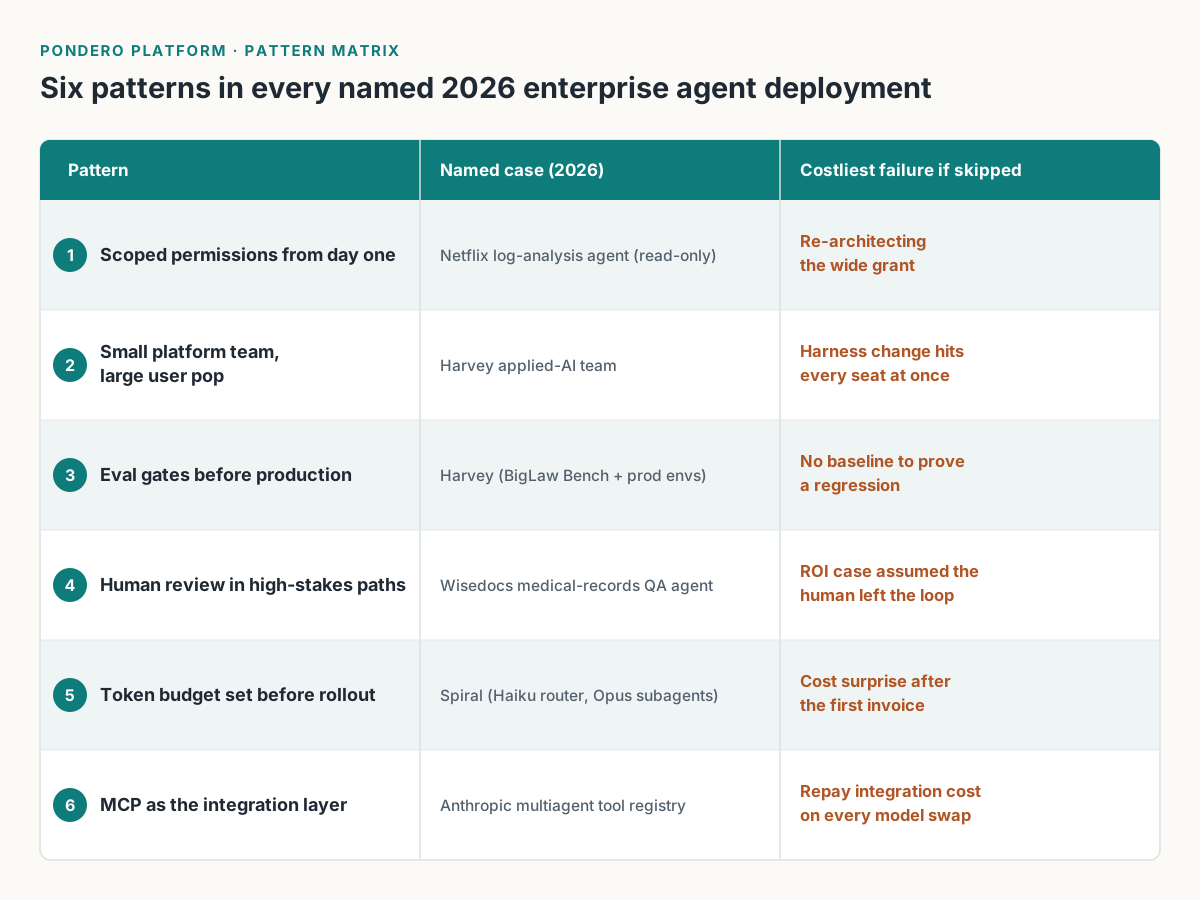
Read across every enterprise agent deployment that made it into the public record in 2026 and the same six structural choices keep showing up. Not the productivity numbers the vendor decks lead with, the plumbing underneath them: what the agent was allowed to touch, who owned the harness, what gate stood between a bad run and production. The record is thin, because most enterprise case studies are written by product marketing and strip the failure out. What escapes that filter, earnings-call mentions, named case studies with methodology, and vendor engineering posts, is worth more precisely because it was not written to sell you the tool. Here are the six, one named case each, and what they imply for a team designing now. This is pattern extraction, not a build guide; for the full path from shadow AI to a governed agent capability, see how enterprises ship AI agents.
1. Scoped permissions from day one
Every named deployment shipped with a deliberately narrow tool set. Netflix's platform team built an analysis agent that reads logs from hundreds of builds across deploy history, error logs, metrics, and support tickets, and its only output is a shortlist of the failure patterns that recur widely enough to act on (per Anthropic, May 19 2026). It surfaces; a human acts on what it surfaces. Teams that opened broad write access on day one are not in the record, because the ones that did it and got burned do not publish. Scope is the cheapest control to add up front and the most expensive to retrofit: narrowing an agent's reach after launch means re-architecting whatever already came to depend on the wide grant.
2. A small platform team, a large user population
The harness has one or two owners; the rest of the org consumes it. Harvey's applied-AI team, former Big Law attorneys sitting next to AI researchers, owns model selection and the eval process for a platform used by law firms and Fortune 500 legal departments, and rolled Claude across it in under a month (per Harvey's case study). With cross-session memory added, completion rates on their internal tasks rose roughly 6x in Harvey's own tests (per Anthropic, May 19 2026). A team this shape is not bottlenecked by engineering capacity but by eval iteration time, because one bad harness change reaches every seat at once. The July 2026 launch of Ode, a $1.5B Anthropic and Blackstone venture built to staff enterprise AI implementation, is the market pricing that same bottleneck (per BusinessWire, July 15 2026).
3. Eval gates before production, not after
Every team with a disclosed productivity number gated on evals before rollout, not after. Harvey tests every model through BigLaw Bench, real product environments, and blind assessment by both AI and legal researchers before it reaches a customer; the 6x is a figure from a population where that gate had already caught the bad runs (per Harvey). The runtime equivalent is a separate grader. Anthropic's outcomes loop scores each attempt in its own context window against defined criteria, and lifted task success by up to 10 points, with +8.4% on docx and +10.1% on pptx generation in its internal benchmarks (per Anthropic, May 19 2026). A gate you add after launch has no baseline to measure against, so the day something regresses in production you can argue about it but not prove it. For which harness fits your stack, see our eval-harness comparison.
4. Human review stays in every high-stakes path
None of the named deployments removed a human from the consequential decision in year one. Wisedocs put a QA agent in front of its medical-records pipeline to verify documents its insights engine generates, and reports the agent saves its Medical Quality Assurance team up to 50% of document review cycle time (per Wisedocs, May 6 2026). Read that carefully: the review still happens and the QA team still owns the standard. What the agent removed is preparation time, not sign-off. This is the most consistent pattern in the record and the one internal proposals most often get wrong, because the ROI case is easier to write if you assume the human comes out of the loop. The disclosed gains come from the prep step, not the approval step.
5. A token budget set before the rollout
The teams that reach an earnings call already have a per-task cost figure a CFO signed off on, and they get there by designing the model mix rather than discovering it. Spiral, the writing agent from Every, runs its lead agent on Haiku to field incoming requests and delegates the expensive drafting to subagents on Opus, so the cheap model handles routing and the costly one runs only on work that needs it (per Anthropic, May 19 2026). A cost surprise after launch is a bad time to learn your unit economics; model per-seat token spend before the rollout, not after the first invoice. Our token-budget model walks the math.
6. MCP (or an internal equivalent) as the integration layer
The deployments still running at the time of disclosure separated what the agent can do from how it does it. In Anthropic's multiagent setup a lead agent delegates to specialists that each carry their own model, prompt, and tools, and Netflix's agent reaches deploy history, logs, metrics, and tickets as distinct tool sources rather than calls hardwired into the agent code (per Anthropic, May 19 2026). That indirection is what makes a model swap a config change instead of a rewrite; wire direct API calls into agent code and you repay the integration cost every time a version ships. MCP is the emerging standard for that boundary. Governing those tool servers, who can register one and what it is allowed to reach, is its own problem; see our MCP governance guide.
What the patterns imply for a team starting now
If these six hold across every deployment willing to be named, a design missing them is a bet against the field. Two cost the most to add late: scoped permissions, because narrowing an agent's reach after launch means re-architecting whatever came to depend on the wide grant, and eval gates, because a gate installed after production has no baseline, so the day something regresses you can argue about it but not prove it. Start narrow on permissions and widen on evidence, and stand up the eval harness before the first production seat rather than after the first complaint. The next artifact worth building is a scorecard that turns these six into pass/fail criteria for a vendor RFP, which is where this desk goes next.
What the public record does not tell you
Every case here carries one bias: it is a team that shipped, kept the thing running, and was comfortable saying so. The failure modes that matter most, scope creep past the original grant, an eval that passed in staging and drifted in production, users who quietly stopped opening the tool, are absent from the case studies and have to be read out of the patterns themselves.