Table of Contents
How Enterprises Actually Ship AI Agents in 2026
Most enterprise agent programs do not fail in production. They fail in the gap between a pilot that impressed a director and the moment procurement, security review, and per-seat math all arrive in the same week. The pilot was measured in demos. Nobody built the eval that proves it still works after a model swap, nobody priced the token bill at 200 engineers, and nobody produced the artifact your security team asks for on day one. So the program stalls, the champion burns out, and the same engineers quietly go back to pasting code into a consumer chat window.
This is the map of that path, staged, with the trap at each transition named and priced. If you own the budget and the blame for an agent rollout, the useful question is not "which harness is best." It is "which stage am I actually in, what kills me next, and what artifact gets me to the stage after." Everything below is built to answer that. The one thing to leave with: your program dies between the funded pilot and the platform team far more often than it dies on a technical wall, and the fix is an eval harness plus a cost model, not a better demo.
The maturity model
Four stages. Each has a shape, a cost, the failure that ends it, and the one artifact whose absence is why teams get stuck. Read your own org against it before you spend another dollar.
| Stage | What it looks like | What it costs | The failure that ends it | Artifact that marks the exit |
|---|---|---|---|---|
| 1. Unsanctioned use | Devs expensing personal Copilot/Claude/ChatGPT; code pasted into web chat; no policy | Roughly $10 to $40/user/mo on personal cards (Copilot Pro runs $10, Pro+ $39), invisible to finance; the real cost is data exfiltration risk | A data incident, an audit finding source in a chat log, or a blanket security ban that kills the upside too | An approved-tools list plus a signed vendor DPA and a funded budget line |
| 2. Funded pilot | One team, one tool, a champion, a Slack channel of wins | Seats for one team plus the champion's time, usually under a discretionary line | Pilot success was measured in vibes and does not survive procurement, security review, and per-seat economics | A platform-team charter plus a security-approved reference architecture plus a real cost model |
| 3. Platform team owns a paved road | A small team ships a golden path: approved harness, curated tools, secrets broker, template repo, self-serve onboarding | 2-4 FTE plus infra; six figures fully loaded | No evals, so a model or prompt change silently regresses; no cost accounting, so spend balloons and finance freezes the program | An eval harness wired into CI plus per-team cost dashboards with budget ownership |
| 4. Governed capability | Evals gate changes, each team owns a budget, an audit trail maps to a framework, incident response exists | Ongoing platform cost plus eval maintenance plus governance overhead | Eval drift, governance theater, or calcification: teams route around a paved road that got slow | Not an exit. A steady state where a model swap ships behind a green gate without a war room |
Stage 1 to 2: someone has to own the risk
Shadow AI is not a discipline problem, it is a demand signal. Engineers reach for these tools because they work. The trap at this transition is the overcorrection: security discovers the exposure, cannot quantify it, and bans everything instead of funding a controlled pilot. That buys you a quarter of quiet and a year of the same shadow usage on personal devices where you have zero visibility.
The exit is cheap and boring. Publish an approved-tools list. Sign a data processing agreement with one vendor so the legal exposure is bounded. Put a real budget line behind one team. You are not solving governance yet. You are converting invisible risk into a funded experiment with a named owner.
Stage 2 to 3: the death valley
This is where most programs die, and it is worth being blunt about why. A pilot succeeds on a forgiving loop: one enthusiastic team, a champion who debugs every rough edge in person, usage low enough that nobody reads the token bill, and success defined as "people like it." None of those conditions survive scale.
Procurement wants a signed enterprise agreement, not a personal card. Security wants a threat model for a system that now executes code and touches internal tools. Finance wants to know what 200 seats plus token spend costs before it signs, not after. The champion who hand-held ten people cannot hand-hold two hundred. Every one of these is survivable. What kills the program is arriving at all four with nothing but a demo and a good feeling.
The artifact that gets you across is a charter for a platform team with actual headcount, a reference architecture your security team has already reviewed, and a cost model that survives contact with the CFO. Build those during the pilot, not after it succeeds. A pilot that produces only enthusiasm has produced nothing procurement can act on.
Stage 3 to 4: prove it works and prove what it costs
A platform team ships a paved road and, for a while, it looks done. Onboarding is self-serve, the harness is standardized, the wins keep coming. Then someone bumps the model version, or edits a system prompt, and three weeks later support tickets climb with no obvious cause. There was no eval gate, so nothing flagged the regression. Separately, one team's automated workflow starts looping, the token bill for the month lands at five times the last one, and finance freezes the whole program while it investigates.
Both failures share a root: you shipped capability without the instrumentation to prove it works or to attribute what it costs. The exit artifact is an eval harness in CI plus per-team cost accounting with budget ownership. Until a model change has to pass a green gate and every dollar of spend maps to a team that owns it, you do not have a governed capability. You have a paved road with no speed limit and no brakes.
The reference architecture
Six components. You can run a credible version of each on a small budget, and every one has a specific failure if you skip it. This is the golden path a stage 3 platform team maintains. Nothing here is exotic; the discipline is in wiring it together and drawing the trust boundary in the right place.
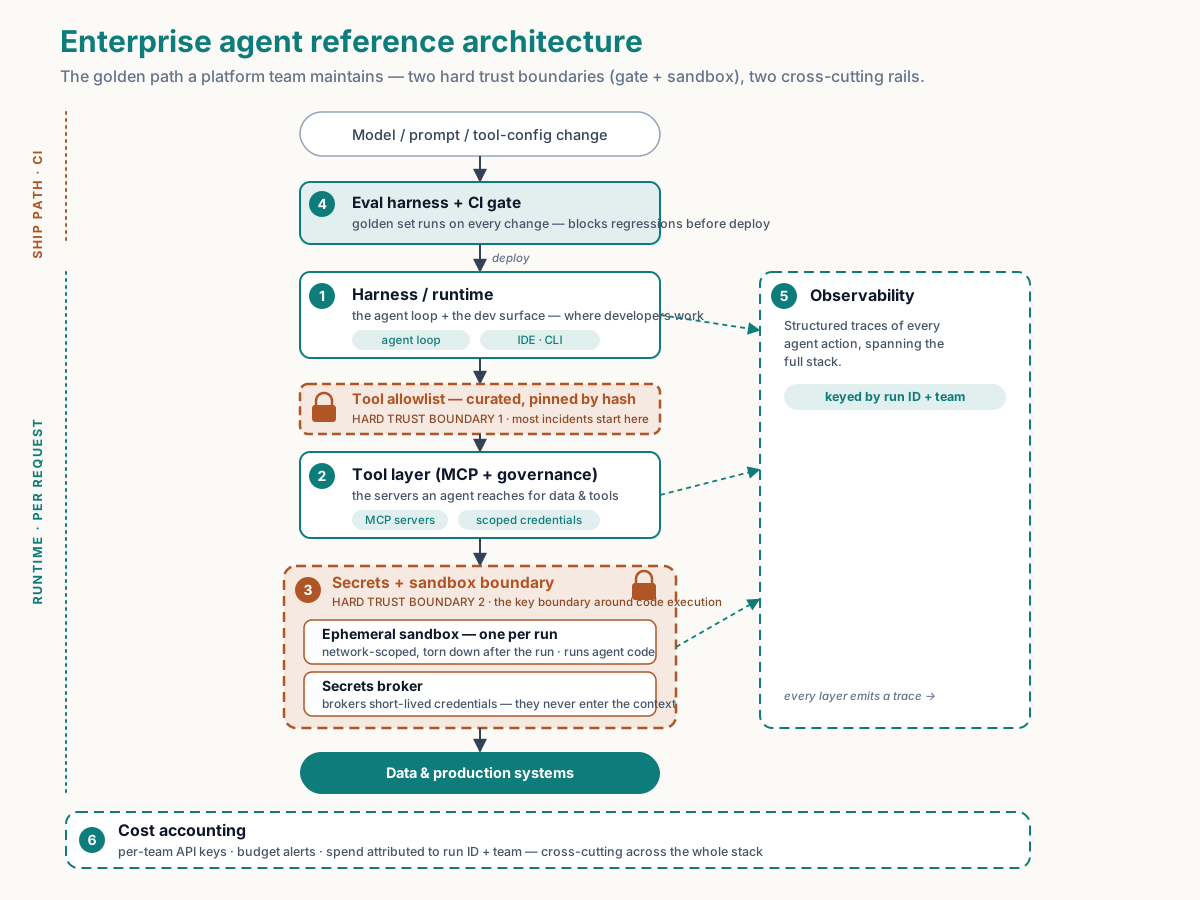
| Component | What it does | Minimum credible version | What breaks if you skip it |
|---|---|---|---|
| Harness / runtime | The agent loop plus the surface devs use (IDE, CLI) | Managed seats (Copilot, Cursor) or Claude Code on the API | You rebuild an agent loop badly and maintain it forever |
| Tool layer (MCP + governance) | How agents reach data, tools, and each other, with an allowlist | A curated allowlist of a few vetted MCP servers, pinned by hash | Prompt injection and tool poisoning: the agent takes actions no one asked for |
| Eval harness + CI gates | Proves a model or prompt change did not regress before it ships | A golden set of cases in promptfoo, run in CI on every change | Silent regressions ship; you learn from support tickets, not a gate |
| Observability | Structured trace of every agent action, prompt, and tool call | Structured logs plus traces keyed by run ID and team | No incident forensics, no cost attribution, no way to answer "what did it do" |
| Secrets + sandbox boundary | Keeps credentials out of context and code execution inside a box | A secrets broker plus an ephemeral sandbox per run | Sandbox escape to host code execution; credentials leaked into a log or a context window |
| Cost accounting | Attributes spend to a team and alerts before a budget blows | Per-team API keys plus a hard budget alert | Finance cannot attribute spend, so it freezes the entire program |
The tool layer is where most incidents start
The harness gets the attention, but the tool layer is where you get hurt. The moment an agent can call an MCP server, read a repository, or run a shell command, its instructions can come from anywhere its context touches: a poisoned tool description, a malicious file in a cloned repo, a comment in an issue it was told to triage. In July 2026, Noma Security disclosed a prompt injection in GitHub Agentic Workflows that could leak private repository data with no credentials involved (see our coverage of the GitLost disclosure). The defense is not a single filter. It is an allowlist of vetted tools pinned by hash, a scan of skill and config files before they run, and a human approval step on any action that writes or exfiltrates.
Pin the allowlist. Scan what agents load. We walk through the tool-side attacks and the concrete controls in the MCP tool-poisoning defense guide, the prompt-injection guide, and the skill-file security scanner. If you own one control at stage 3, own this one.
A minimal governance manifest for the tool layer looks like this. Every server is pinned, every write-capable tool needs approval, and anything not on the list is denied by default:
{
  "mcp_servers": {
    "github-readonly": {
      "source": "ghcr.io/acme/mcp-github@sha256:9f2b...c41a",
      "scopes": ["repo:read", "issues:read"],
      "approval": "auto"
    },
    "internal-jira": {
      "source": "ghcr.io/acme/mcp-jira@sha256:7a1e...b90d",
      "scopes": ["issues:read", "issues:write"],
      "approval": "human"
    }
  },
  "default_policy": "deny",
  "scan_on_load": ["CLAUDE.md", "AGENTS.md", ".mcp/*.json", "skills/**"]
}
Pin by digest, not by tag. A tag like latest is a supply-chain hole: the image behind it can change under you, and a changed tool description is a changed instruction to your agent.
The sandbox boundary is a real boundary, not a config flag
Agents run code. That is the point and the risk. In July 2026, Pillar Security published seven sandbox-escape vulnerabilities across Cursor, OpenAI Codex CLI, Google Gemini CLI, and Google Antigravity, using a pattern that never attacks the sandbox directly: write a file inside the trusted workspace, then let the host pick it up and run it outside the container (Pillar's disclosure series). One shared Docker-socket flaw (GHSA-v4xv-rqh3-w9mc) hit Codex CLI, Cursor, and Gemini CLI at once. We break down the pattern in the sandbox-escapes teardown and the related TrustFall one-click RCE.
The lesson for a platform lead: treat the sandbox as a boundary you own, not a checkbox in a vendor's settings. Run agent code in an ephemeral, network-scoped sandbox with no host daemon reachable, no long-lived credentials mounted, and a fresh environment per run. If you are choosing where that sandbox lives, the cloud sandbox comparison covers the tradeoffs across providers.
The eval harness is what lets you say yes to a model swap
Without evals, every change is a bet. New frontier models ship monthly now, and each one is a temptation and a landmine. The eval harness is a golden set of representative cases with graded expected behavior, run in CI, so a model or prompt change has to clear a bar before it merges. Here is the shape of a gate that fails a pull request when accuracy drops below threshold:
# .github/workflows/agent-eval.yml
name: agent-eval-gate
on: [pull_request]
jobs:
  eval:
    runs-on: ubuntu-latest
    steps:
      - uses: actions/checkout@v4
      - name: Run golden-set evals
        run: npx promptfoo eval -c evals/golden.yaml --fail-on-threshold 0.85
        env:
          ANTHROPIC_API_KEY: ${{ secrets.ANTHROPIC_API_KEY }}
Expect the gate to be noisy the first month. Your evals encode yesterday's spec, and the first real signal is often the eval being wrong, not the model. That is fine. A noisy gate you tune beats a silent regression you find in the support queue. The failure mode to watch is eval drift: a golden set that nobody updates slowly stops describing the job the agent actually does, and a green gate starts meaning nothing.
Who owns it
Three org designs work in 2026. Which one fits is a function of how many engineers you are supporting and how regulated you are, not of ambition. Picking the wrong one is expensive in a specific way: too little structure and the paved road never gets built; too much and you have a governance body issuing standards for a capability nobody has shipped yet.
| Design | Headcount | Fits | Breaks when |
|---|---|---|---|
| Embedded champion | 0.5-1 FTE | One team, the pilot stage | You try to serve a second team; the champion becomes a single point of failure |
| Platform team | 2-4 FTE | 3-10 teams, roughly 50-300 engineers | The team becomes the only path to change a tool, and turns into a bottleneck |
| Center of enablement | 4-8+ FTE | Enterprise scale, hundreds of engineers, regulated industries | It writes standards faster than teams adopt them, and becomes a compliance tax |
The embedded champion is how every program starts and where many should stay for a quarter longer than they do. One strong engineer, deep in one team's workflow, moves faster than any committee. The moment a second team wants in, that model breaks, because a champion does not scale and does not leave documentation.
The platform team is the workhorse design for most of the mid-market and for divisions of larger companies. Two to four people who own the golden path, the evals, the secrets broker, and the cost dashboards. The failure to watch is centralization: if changing an approved tool requires a ticket to the platform team and a two-week wait, teams route around you, and you are back at shadow AI with extra steps.
The center of enablement, note the word, enablement, not excellence, is for the scale where you have multiple business units, real regulatory exposure, and a need to federate rather than centralize. It sets standards, owns the audit trail, and runs the eval and cost frameworks, but it pushes execution out to platform teams inside each unit. The trap here is the older "center of excellence" model that hoards decisions: at enterprise scale, a body that must approve every change is a body every team learns to bypass.
The economics
Three ways to pay for agent capability, and the honest answer is that a real program uses all three for different workloads. The mistake is picking one on principle. Price your actual usage shape, because the crossover points are not close together.
All prices below are current as of the dates cited and pulled from vendor primary sources, not our own estimates.
Seat licensing
Predictable, capped, and the right default for interactive developer usage. GitHub Copilot Business runs $19 per granted seat per month and Copilot Enterprise runs $39 per seat per month, per GitHub's plans page (fetched 2026-07-25). Individual tiers sit at $10 (Pro), $39 (Pro+), and $100 (Max). We keep the current plan breakdown in the Copilot pricing guide and the Copilot vs Cursor pricing comparison.
Seats look flat until you read the metering underneath them. Copilot plans carry a monthly pool of premium requests, and heavy agentic use burns through it. Additional premium requests bill at $0.04 each once the allowance is gone, per GitHub's premium-request docs (fetched 2026-07-25). The sharp edge is the model multiplier: as of June 1, 2026, Copilot code review carries a multiplier of 13, meaning one review can draw 13 premium requests from the pool. A team that runs automated code review on every pull request can exhaust a seat's allowance in days, not weeks. Where teams get surprised is treating the seat price as the whole bill. It is the floor, not the ceiling. Cursor's plans meter usage in a similar shape; the Cursor pricing breakdown covers its request accounting.
Claude offers a two-tier seat model on its Team plan: a standard seat and a premium seat with roughly 5x the usage of a standard one, per Anthropic's pricing page (fetched 2026-07-25). The structure tells you the same thing the Copilot metering does: vendors price for the fact that a heavy agent user costs far more than a light one.
Token spend
Variable, and the right model for automated or bursty workloads where you can route cheap models for cheap tasks. Anthropic API pricing, per Anthropic's pricing docs (fetched 2026-07-25), runs $5 per million input tokens and $25 per million output on Claude Opus 4.8, $3 and $15 on Sonnet (with introductory pricing of $2 and $10 in effect through August 31, 2026), and $1 and $5 on Haiku 4.5. A cache hit costs 0.1x the base input rate, so a large reused system prompt can cut input cost by 90%.
The reason token spend is not automatically cheaper: a heavy agentic user can burn more than a seat costs, fast. Here is the arithmetic on one heavy user, illustrative but built on the cited unit prices:
Example: one heavy agent user, one working day, on Sonnet
  Input:  2,000,000 tokens/day, 50% served from cache
          1.0M @ $3.00/MTok  = $3.00
          1.0M @ $0.30/MTok  = $0.30   (cache hit, 0.1x)
  Output:   500,000 tokens/day
          0.5M @ $15.00/MTok = $7.50
  Per day  ~ $10.80
  Per month (21 working days) ~ $227

Same user on Opus 4.8 (no cache) is several times higher.
A $39 Copilot Enterprise seat is cheaper for this user.
A light user who sends a few prompts a day is far cheaper on tokens.
Read that as a shape, not a quote for your org. It says the obvious-once-you-see-it thing: flat seats subsidize heavy interactive users and overcharge light ones. Metered tokens do the reverse, and reward you for routing Haiku at cheap tasks and reserving Opus for the hard ones. Route by task, not by habit. The teams that control token spend are the ones that put a cheap model in front of an expensive one, the way Anthropic describes its own reference workloads doing.
Self-host
A fixed floor, and the wrong answer for almost everyone until sustained volume is high. Running an open-weight model on your own GPUs trades per-token markup for capital and, more importantly, for an ops burden. The line that decides it is not GPU rental, it is the loaded cost of the engineer who keeps the inference stack alive. Below a high, steady token volume, that fixed floor never amortizes and the API wins on both cost and reliability. Self-host earns its place at two edges: sustained heavy batch volume where per-token markup dominates, and hard data-residency requirements that forbid a vendor API at all.
What your CFO will ask
Three questions, and you want the artifacts ready before the meeting, not after. What is the fully loaded cost per active user, seats plus token spend plus the platform team's time? Which team owns each dollar, and can you show spend attributed per team? What is the cap, the hard budget alert that stops a looping workflow from turning into a five-figure surprise? If you cannot answer the third one, that is your next build, ahead of any new capability.
What breaks first
The signature question of this desk. Ranked by how early it tends to appear in a real rollout, here is what breaks, and the earliest symptom you can actually catch it by. Instrument for the symptom, not the disaster.
| Rank | Failure mode | Earliest symptom you can catch |
|---|---|---|
| 1 | Prompt injection / tool poisoning | An agent takes an action nobody requested: reads a repo it was not pointed at, runs an unexpected command, posts data outward |
| 2 | Cost blowup | One team's token or premium-request line jumps 5x month over month, or an overage charge appears for the first time |
| 3 | Sandbox escape | A file written in the workspace executes on the host, or an agent reaches a local daemon (Docker, a database) it should not see |
| 4 | Eval drift / silent regression | Support tickets climb after a model or prompt change that no gate flagged |
| 5 | Secret leakage | A credential shows up in a trace, a log line, or a model's context window |
| 6 | Governance gap | Security or legal asks for an artifact (model card, DPA, audit trail, training-data summary) you cannot produce |
| 7 | Calcification | Teams route around the platform team; shadow usage quietly returns, and you are back at stage 1 |
Prompt injection and tool poisoning break first because they need no privileged access. The attack rides in on data the agent was told to read. The earliest symptom is behavioral: an action out of scope. Log every tool call with its arguments and alert on write or network actions the user did not initiate, because you will see this before you see anything dramatic. Our prompt-injection guide and the GitHub Agentic Workflows security writeup cover the concrete controls.
Cost blowup is second because it is common and undramatic until the invoice lands. A single misconfigured loop or an aggressive automated-review policy (remember the 13x multiplier) can multiply a bill quietly. The symptom is a month-over-month jump in one team's line, which you only see if you attribute spend per team. Set a hard budget alert per team. It is a smaller build than it sounds and it is the difference between a bad Slack message and a frozen program.
Sandbox escape ranks third: less frequent than injection, more severe when it lands, and, as the 2026 disclosures showed, present in tools you already trust. The earliest symptom is code running where it should not. You catch it by owning the sandbox boundary and monitoring for host-level execution from an agent context, not by trusting a vendor's default.
The bottom three are slower failures with organizational roots. Eval drift and governance gaps show up when someone external asks a question you cannot answer with an artifact. Calcification is the quiet one: it looks like success right up until you notice the shadow usage came back, which means your paved road got slower than the workaround. All three are why stage 4 is a steady state you maintain, not a finish line you cross.
Governance without theater
Two frameworks anchor the paperwork your security and legal teams will ask for, and both are worth mapping to your stack before an auditor makes you. Neither is optional theater if you operate at any scale.
The NIST AI Risk Management Framework is a voluntary framework organized around four functions: Govern, Map, Measure, and Manage, per NIST. NIST is revising it; a second draft was out for public comment as of the page fetched 2026-07-25. For a platform lead, the value is the vocabulary: it gives your security team a structure to hang your reference architecture on, and it maps cleanly onto the components above. Observability is your Measure function. The eval harness is your Manage function. The tool allowlist and sandbox boundary are your Map and Govern functions made concrete.
The EU AI Act is the binding one if you touch the EU market. Obligations for providers of general-purpose AI models became applicable on 2 August 2025, and the Act's broader transparency rules take effect in August 2026, per the European Commission. Under Article 53, GPAI providers must keep technical documentation, supply information to downstream integrators, maintain a copyright-compliance policy, and publish a sufficiently detailed summary of training content, per the Act text. Most enterprises are deployers, not model providers, so the direct Article 53 burden sits with your vendor. Your job is to hold the artifacts that prove which model you used, under which terms, with what human oversight. That is exactly what your observability and audit trail are for.
What your security team will ask
Have these ready and stage 2 to 3 stops being a wall. First, a threat model for a system that executes code and reaches internal tools. Then the signed DPA with each model vendor, and the tool allowlist with proof of how it is pinned. Where does the sandbox boundary sit, and what would an escape reach? Can you produce an audit trail that answers "what did this agent do, on whose behalf, with what data" for any given run? Every one of these is a component from the reference architecture, written down. Build the architecture and you have written most of the answers already.
Where to start Monday
Find your stage honestly, then build only the next artifact. Stuck at stage 1? The move is not a platform team, it is an approved-tools list and one signed DPA so a pilot can start with bounded risk. Running a pilot that people love? Spend the back half of it building the three things procurement will demand, the charter, the reviewed architecture, and the cost model, because a pilot that produces only enthusiasm dies at the next budget review. A paved road with no eval gate and no per-team cost attribution is a road you cannot govern or price, so stop adding capability and build those two before anything else.
The programs that ship are the ones where someone owned the boring artifact at each transition, priced the risk in numbers, and instrumented the failure mode before it arrived. The harness you picked never decides it. Pick your stage, build the one artifact, and come back for the next.