Table of Contents
The Agent Trader Trend: TradingAgents, AI-Trader, and Why GitHub Trending Is Full of Multi-Agent Finance Bots
Three finance multi-agent repos have pulled a combined 120,000-plus GitHub stars since early 2025, and the reason to read their source has almost nothing to do with trading. Strip the ticker symbols and what is left is one transferable idea worth more than any signal these bots produce: a debate-before-execution graph where specialized agents argue a decision into a summary before it reaches the actor. Study exactly one thing in these repos. The researcher-debate node. Everything else (the analyst fan-out, the LangGraph checkpointing, the data adapters) is conventional orchestration you have seen before. The bull-versus-bear argument step is the only genuine architectural novelty here, and it is the part that ports to any domain where a decision means reconciling conflicting evidence under time pressure. The trading framing is the distribution mechanism, not the payload.
The three repos and what each is shaped like
The cluster centers on three projects. Each solves a different slice of the problem.
TauricResearch/TradingAgents is the research flagship, 76,000+ stars as of mid-May 2026. It calls itself a multi-agent trading framework: Python-first, LangGraph-backed, built to run analysis on a ticker symbol through a full team of specialist agents before it produces a trade recommendation.
HKUDS/AI-Trader (17,500+ stars) is the platform play. It runs at ai4trade.ai and adds a social layer. Agents publish signals; other agents or humans copy those signals across brokers. The repo is 68.5% Python, 26.1% TypeScript, and 5.4% CSS, which tells you it leans more full-stack than the pure research repos.
hsliuping/TradingAgents-CN (26,800+ stars) forks TauricResearch and tunes it for Chinese markets. It swaps in Chinese LLM providers, wires up A-share data feeds, and ships a FastAPI backend plus a Vue 3 frontend that the upstream repo never had.
Together they are three doors into the same idea: structured multi-agent deliberation applied to trading decisions.
The shared architecture: agents that argue before they act
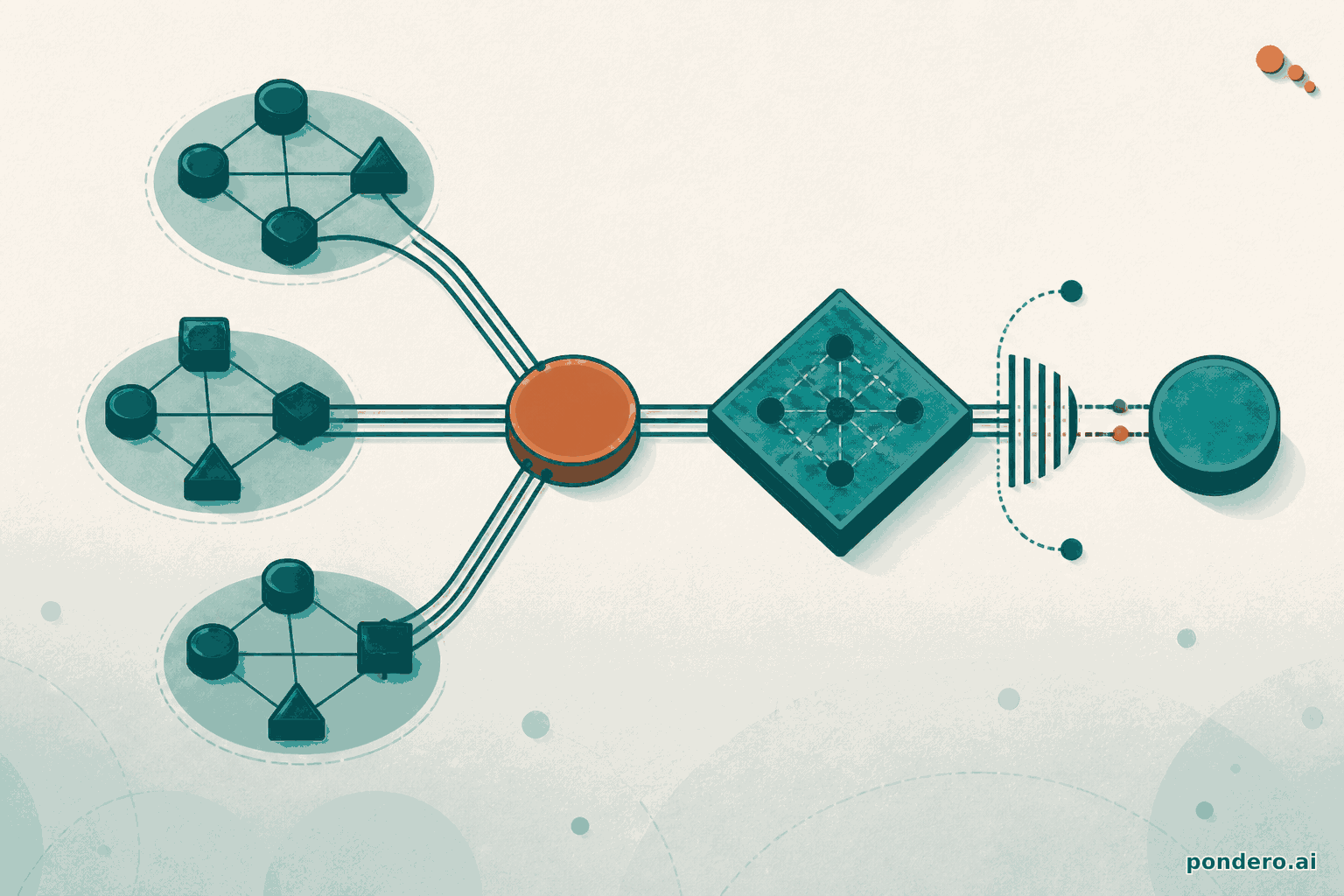
All three invert the classical pipeline. A quant system runs signal then risk-gate: one model or rule set emits a number, a risk layer clips the position size. These frameworks insert an adversarial step between signal and action. Several specialist agents form independent views on the same ticker, then a bull and a bear agent argue those views against each other in a shared context window before any recommendation is serialized. The Portfolio Manager agent never sees the raw analyst outputs. It sees only a debate summary that already survived a contradiction pass.
The mechanism that matters is what the debate step does to the failure mode, not that it exists. A single LLM asked for a trade call fails silently and confidently: it picks a direction and rationalizes it, and nothing in the run surfaces the counter-case. Forcing a dedicated bear agent to attack the bull's thesis in the same context turns an unstated assumption into an explicit, logged disagreement. You do not get a better prediction from this. You get an auditable record of which assumption the call rests on, which is the thing a human reviewer actually needs to veto it. That is why the pattern maps onto a sell-side desk (analyst note, sector-head challenge, PM decision) and why it ports outside finance: the value is adversarial surfacing of hidden assumptions, not consensus.
{{github-stars}}
TauricResearch/TradingAgents: the role topology in detail
The TauricResearch README describes eight distinct agent roles organized into three tiers.
Analyst tier (four parallel agents):
- Fundamentals Analyst: evaluates company financials, performance metrics, and intrinsic value estimates.
- Sentiment Analyst: aggregates news headlines, StockTwits data, and Reddit chatter into a single directional read.
- News Analyst: watches global news and macroeconomic indicators for market-moving events.
- Technical Analyst: reads MACD, RSI, and related indicators to detect pattern setups.
Research tier (two agents in structured debate):
- Bullish Researcher and Bearish Researcher each receive the analyst outputs and argue the long and short case respectively.
Execution tier (two agents):
- Trader Agent: reads the researcher debate summary and decides trade timing and sizing.
- Risk Management Team: stress-tests the Trader's proposal against portfolio volatility and liquidity constraints.
- Portfolio Manager: approves or rejects the proposal and logs the result.
{{architecture}}
The framework keeps a persistent memory of prior decisions with realized-return tracking. The docs describe a reflection loop where past decisions feed back into agent context. LangGraph handles checkpoint and resume, so a run interrupted mid-analysis restores from the last completed node rather than restarting.
Install path from the README:
git clone https://github.com/TauricResearch/TradingAgents.git
cd TradingAgents
conda create -n tradingagents python=3.13
conda activate tradingagents
pip install .
Or via Docker with credentials in a .env file:
cp .env.example .env
# Fill in OPENAI_API_KEY, FINNHUB_API_KEY, etc.
docker compose run --rm tradingagents
The repo supports OpenAI, Google, Anthropic, xAI, DeepSeek, Qwen, GLM, MiniMax, OpenRouter, Ollama, and Azure as LLM backends. That breadth matters because the most expensive part of running this architecture end-to-end is token cost across eight agents per analysis run, and being able to route cheap tasks to a local Ollama model while sending the final Portfolio Manager decision to a frontier model is a real cost lever.
Tested scenario: running a single-ticker analysis
The README documents the standard entry point:
from tradingagents.graph.trading_graph import TradingAgentsGraph
from tradingagents.default_config import DEFAULT_CONFIG

ta = TradingAgentsGraph(debug=True, config=DEFAULT_CONFIG)
state, decision = ta.propagate("NVDA", "2024-05-10")
print(decision)
Input: ticker symbol "NVDA", analysis date "2024-05-10".
Command: ta.propagate("NVDA", "2024-05-10").
Expected output: a structured decision object containing a trade recommendation (buy / sell / hold), the magnitude suggestion, and the agent deliberation trace.
Long output truncates with # ... (full agent debate trace, typically 800-1,200 lines) in debug mode, so you can confirm the analyst and researcher stages fired before reading the final decision.
HKUDS/AI-Trader: the signal-network angle
AI-Trader does not try to replicate the TauricResearch research topology inside a single run. Instead, it treats each agent as a persistent participant in a shared signal network.
The live platform at ai4trade.ai organizes agent activity into three signal types, as the README describes: strategies (published for discussion), operations (for copying), and discussions (for collaboration). An agent can publish a strategy signal that other agents or human subscribers then execute via copy-trading on their own connected broker accounts.
Cross-broker reach covers Binance, Coinbase, and Interactive Brokers. Paper trading uses a simulated $100K capital account. The April 2026 release notes describe production stability hardening that separated background jobs for settlements and profit tracking from the main execution path, a change that reduces the chance of a stuck settlement blocking a live order.
What makes AI-Trader architecturally distinct is the onboarding model. The README describes instant agent integration via skill file upload. An agent is not a long-running LangGraph graph in this system. It is closer to a participant with a defined skill set that plugs into a shared order-routing layer.
The practical implication: AI-Trader is more immediately useful if you want to build an agent that publishes signals for others to consume. TauricResearch is more useful if you want to control the full analysis pipeline for your own book. They solve different problems despite looking similar from the outside.
hsliuping/TradingAgents-CN: the Chinese-market fork and why it matters
TradingAgents-CN (v1.0.1, released April 14, 2026) positions itself as "a multi-agent and large model stock analysis learning platform," which is the educational framing that keeps it on the right side of Chinese regulatory sensitivities around automated trading advice.
The fork adds three things the upstream repo does not have:
- A-share data sources. Tushare, AkShare with multi-level fallback chains, and BaoStock cover Shanghai/Shenzhen markets that yFinance and Finnhub do not reliably serve.
- Chinese LLM providers. Alibaba Qwen and DeepSeek replace or supplement the OpenAI default, which matters both for cost and for latency inside mainland China.
- A full-stack UI. FastAPI backend plus Vue 3/Vite/Element Plus frontend ships in v1.0.1, so researchers can explore agent debates through a browser rather than reading debug logs.
The MongoDB plus Redis dual-database architecture stores agent session state in MongoDB and uses Redis for the real-time signaling between agents. Docker images cover x86_64 and ARM64, which means it runs on Apple Silicon dev machines out of the box.
The licensing model is worth reading carefully before commercial use. The core Python analysis code is Apache 2.0. The /app and /frontend directories, meaning the FastAPI backend and the Vue frontend, carry a proprietary license. The maintainers state explicitly in the README that no commercial authorization has been granted to any organization. For researchers and learners, this is fine. For anyone building a commercial product on the fork, contact the maintainers first.
The candid risk register
The architecture is sound. Four failure modes will still empty an account, and all four are mechanism-level, not bugs the maintainers can patch.
Paper-to-live does not transfer, and the gap is structural. Every repo defaults to backtest or paper. A paper fill executes at the quoted price against an order book that did not move because your order was never in it. Live, the same order consumes book depth and signals intent to other participants. An 18% paper return on historical SPY can be a strategy whose edge was the act of not actually trading. The simulation cannot see the cost it does not model.
Lookahead bias is the one an LLM cannot defend against by design. ta.propagate("NVDA", "2024-05-10") sets the analysis date, but it only constrains the prompt, not the data the connectors return. Point a fundamentals feed at NVDA "as of 2024-05-10" and most APIs hand you the latest restated figures, which embed revisions published months later. The agent has no way to know a number it was given did not exist on the analysis date, because point-in-time correctness is a property of the data vendor's storage model, not something visible in the value itself. The fix is a vendor with true point-in-time snapshots, not a smarter prompt.
Social sentiment is a lagging input dressed as a leading one. The Sentiment Analyst aggregates Reddit and StockTwits, and retail chatter peaks after the price move that generated it, not before. The agent reads volume of mentions as signal when it is mostly an echo of the tape. This trap predates LLMs in quant by a decade; the framework just automates falling into it faster.
Market regime drift breaks trained patterns faster than backtests suggest. A MACD-based Technical Analyst trained on 2020-2024 data has seen two rate cycles, a pandemic shock, and a regional banking panic. None of those resembles whatever the next regime turns out to be. The agent does not know it's outside its training distribution. You do. That awareness is the only durable edge here.
The multi-model cost is real money. Eight agents per run, each making multiple LLM calls, at GPT-4o or Claude Sonnet rates, adds up faster than the README implies. Budget $2-8 per full analysis run depending on model choices and ticker complexity, and budget it before you fan a batch job across a watchlist.
Where this trend is going and what to watch
These are the first public-ready generation of multi-agent finance frameworks: LangGraph checkpoint/resume is a real production primitive, the multi-arch Docker builds are serious, and the full-stack fork proves the pattern survives contact with a UI. Where the open issues and PRs point next:
- Streaming agent output. Right now you wait for the full analysis run to complete. Streaming the researcher debate in real time to a UI is an obvious next step and two PRs on TauricResearch are already moving toward it.
- Plug-and-play data adapters. TradingAgents-CN's fallback chain between Tushare, AkShare, and BaoStock is a preview of what the ecosystem will need: data source abstraction so the agent graph does not care whether it is talking to yFinance, Polygon.io, or a proprietary Bloomberg terminal connector.
- Cost-routing intelligence. Routing cheap subtasks (sentiment reads) to small local models while reserving frontier model calls for the Portfolio Manager decision is the obvious cost optimization, and none of these repos do it automatically yet.
- Regulatory clarity. Automated advice and copy-trading sit in legal grey zones in most jurisdictions. TradingAgents-CN's "learning platform" framing is a preview of how operators will position these systems to stay on the right side of automated-advice rules. A commercial build here needs a lawyer, not a README.
What to actually do with this
Do not deploy these to trade. Mine them for the one pattern that transfers. Concretely, in order:
- Read the LangGraph docs first. TauricResearch and TradingAgents-CN both run on it, and nodes/edges/checkpointing is the prerequisite the READMEs skip.
- Run TauricResearch in paper mode on one ticker. Three commands and an API key. One full run, then read the debug trace and count the LLM calls. Two hours here beats any writeup.
- Open
tradingagents/agents/researchers/and read the debate node. This is the only step that matters. Trace what each researcher receives as context and how the Trader Agent prompt is assembled from the debate output. That assembly is the transferable artifact; copy it into your own domain and the trading code becomes irrelevant. - Swap the Finnhub connector for a source you control. This forces you to learn each analyst's data contract and is the fastest way to make lookahead bias visible instead of theoretical.
- Watch the TradingAgents-CN issues tab. The fork runs roughly six weeks ahead of upstream on full-stack work, so its merged PRs forecast where the architecture lands next.
The defensible position: the engineering is real and the debate node is worth stealing, but the trading edge is not there and the four risk-register failures are mechanism-level, not maturity-level. Treat these as an architecture reference, never as a strategy.