
Table of Contents
Firecrawl Pricing 2026: Keyless, Free, Hobby, Standard. Which Plan Fits Your AI Agent Stack
Firecrawl shipped two back-to-back releases last week. Keyless landed June 16: 1,000 free credits a month, no account, no API key, no signup friction. Research Index arrived June 17: a specialized AI/ML literature layer with state-of-the-art recall on arXivQA benchmarks. Both sit on the same paid plan structure that has not changed. What has changed is that Firecrawl now has five access modes, and no single page explains how to pick between them for a specific workload.
This guide fills that gap. We pulled the current pricing (Firecrawl pricing page, June 18, 2026), verified the launch posts for both new features, and ran the credit math for the workloads that push readers from one tier to the next. If you already know what Firecrawl does, skip straight to the table below. If you want context on the API itself, our Firecrawl review covers the core feature set.
Plan comparison at a glance
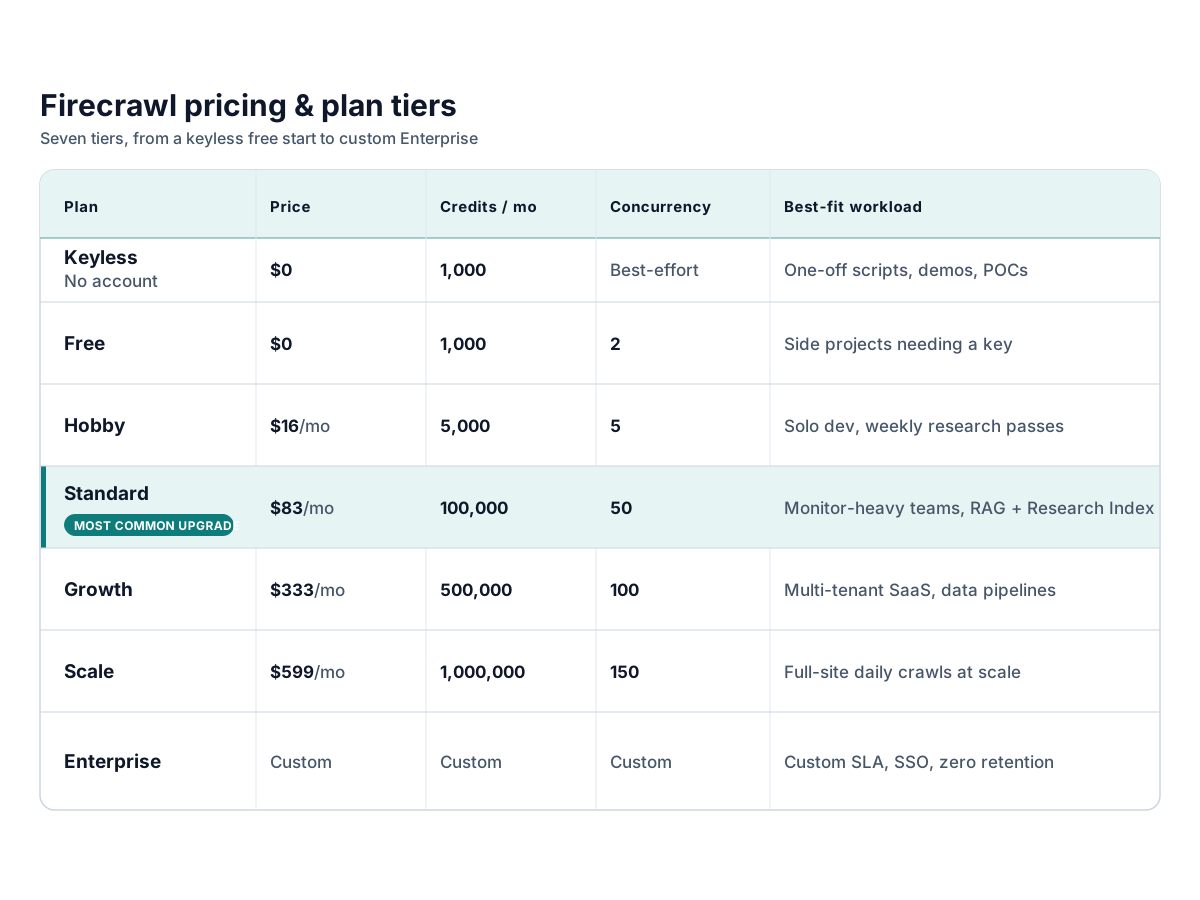
| Plan | Price | Credits/mo | Concurrency | Breaks at |
|---|---|---|---|---|
| Keyless | $0, no account | 1,000 | Unmetered, best-effort | More than ~40 pages/day average, or you need a key |
| Free | $0, account required | 1,000 | 2 concurrent | You need an API key or usage dashboard |
| Hobby | $16/mo | 5,000 | 5 concurrent | More than ~167 pages/day, or a 2-person team |
| Standard | $83/mo | 100,000 | 50 concurrent | More than ~3,300 pages/day, or Research Index power users |
| Growth | $333/mo | 500,000 | 100 concurrent | More than ~16,600 pages/day, or multi-tenant pipelines |
| Scale | $599/mo | 1,000,000 | 150 concurrent | True data pipeline scale |
| Enterprise | Custom | Custom | Custom | Custom SLA, SSO, zero data retention |
Credit rates per the pricing page: Scrape, Crawl, Map, and Monitor each cost 1 credit per page. Search costs 2 credits per 10 results. Interact costs 2 credits per browser minute. Monitor is 1 credit per page per check.
Keyless: the new entry point
Keyless is the most significant change to Firecrawl's free tier since launch. Before June 16, getting started meant a signup form, an API key, and an env file edit. Now you skip all of that.
Point Claude Code, Cursor, or any MCP-compatible agent at the Firecrawl MCP server and it starts scraping right away:
# Add Firecrawl MCP to Claude Code (no API key required)
claude mcp add --transport http firecrawl https://mcp.firecrawl.dev/v2/mcp
Or use the CLI directly:
npx firecrawl-cli@latest scrape https://example.comNo Authorization header. No account. The 1,000 monthly credits reset on a calendar basis (Firecrawl Keyless launch post, June 16, 2026).
Where Keyless fits: one-off scripts, demos, proof-of-concept agents, hackathon builds, anything that runs occasionally. Where it falls short: if you need to track usage across projects, rotate keys for security, or you're running a schedule that will burn 1,000 pages in the first week of a month, you need an account.
There's also a key-management gap. Keyless is authentication-free, which is great for setup but means you can't revoke or rotate credentials if a config file leaks. For anything you're shipping to other people, move to a keyed plan.
Free plan: when Keyless isn't enough
The Free plan has the same 1,000 monthly credits and the same $0 price (Firecrawl pricing page). What it adds is an API key, a usage dashboard, and rate-limit clarity. Two concurrent requests, clearly documented.
Upgrade from Keyless when any of these apply:
- You're building something that runs on a schedule (a cron, a webhook handler, an automated agent)
- You need usage tracking across multiple projects in one dashboard
- You're building something other developers will use, where key management matters
It's the stable foundation for a side project. No cost, 1,000 pages a month, enough for a solo developer running weekly research passes or a small competitor-monitoring script that refreshes a few times a week.
The ceiling is real, though: 1,000 credits/month at 2 concurrent requests. Any workload that routinely needs more than 33 pages per day will start to feel tight by mid-month.
Hobby: the 5,000-credit math
Hobby gives you 5x the credits at $16/mo on the yearly plan (Firecrawl pricing page). The concurrency jump from 2 to 5 parallel requests is the other meaningful upgrade; batch crawls over a URL list finish noticeably faster.
Who fits here: a solo developer or a 2-person team running weekly research passes, competitive intelligence runs, or pre-meeting company briefs. The Firecrawl Workflows guide covers per-skill credit costs in detail; most of the useful skills (deep research, company brief, lead research) run in the 50-200 credit range per invocation. At 5,000 credits a month you have room for roughly 25-100 meaningful skill runs before you need to be selective.
The break point is twofold. First: any workload routinely exceeding 5,000 page fetches a month. Second: concurrency. Five parallel requests means batch crawls of 50+ URLs take a while. If you're crawling a site list larger than a few dozen pages and care about wall-clock time, you'll hit the concurrency ceiling before you hit the credit ceiling.
Start on the Hobby plan once you're past the proof-of-concept stage and building something you'll run weekly.
Standard: the production threshold
Standard is where the math changes for teams running real agent pipelines. At $83/mo on the yearly plan (Firecrawl pricing page), you get 100,000 credits a month and 50 concurrent requests. That works out to 3,300 pages a day, which is enough for a competitive-intelligence workflow checking 20 URLs hourly (20 x 24 x 30 = 14,400 credits/month, well inside Standard).
Two workloads push readers to Standard from Hobby.
Monitor-heavy setups. The Firecrawl /monitor guide covers the credit math in full, but the short version: monitoring costs 1 credit per page per check. Watch 50 competitor pages hourly and that's 50 x 24 x 30 = 36,000 credits a month. Seven times Hobby's limit. Standard handles it with room to spare.
Research Index users. Standard is the natural entry point when Research Index becomes a core part of a RAG pipeline. The index launched June 17, 2026 and covers the full 3M+ arXiv paper catalog plus GitHub artifacts from top research repos, refreshed daily (Firecrawl Research Index launch post, June 17, 2026). On arXivQA, it hits 53.3% recall at $0.32 per task, 18% above the next best provider at similar cost, with an MRR of 0.750 (the correct paper lands in the top two results). You reach it via the /search/research endpoint, or through the MCP and CLI on any plan.
# Search the Research Index via the REST API
curl -X POST https://api.firecrawl.dev/v1/search/research \
  -H "Authorization: Bearer <YOUR_FIRECRAWL_API_KEY>" \
  -H "Content-Type: application/json" \
  -d '{
    "query": "attention mechanisms in transformer architectures",
    "limit": 10
  }'
The Research Index works on any plan. The math favors Standard because a literature-grounded agent that runs 10 research queries a day (10 results each) burns 600 credits/month on search alone, before any page fetches for claim verification. Add those fetches and you're looking at several thousand credits a month for a serious RAG pipeline. Hobby's 5,000 covers a light use case; Standard's 100,000 gives you room to actually iterate.
Move to Standard when your monitor checks or Research Index queries break 5,000 credits a month, or when you need 50 concurrent requests for batch pipeline work.
Growth, Scale, and Enterprise
Most agent builders stop at Standard. Growth, Scale, and Enterprise are for teams where Firecrawl is production data infrastructure, not a tool in an agent's toolbox.
Growth ($333/mo) gives you 500,000 credits and 100 concurrent requests (Firecrawl pricing page). The reader who needs this is running a multi-tenant SaaS where end users trigger crawls, or a data pipeline processing hundreds of URLs per batch. At 100 concurrent requests, a 10,000-page crawl completes in roughly 100 batches instead of 2,000.
Scale ($599/mo) is 1 million credits and 150 concurrent requests, billed yearly per the Firecrawl pricing page. This tier fits teams running full-site crawls on a daily schedule or continuous monitoring at real volume. Credits do not roll over month-to-month on standard plans (the FAQ on the pricing page is explicit), so the right question is whether your monthly burn genuinely reaches 500,000+ pages.
Enterprise is custom credits, custom concurrency, a dedicated SLA, SSO, advanced security, and zero data retention. Contact Firecrawl's sales team when your requirements go there.
Self-audit: two questions
Pick your plan in under two minutes.
Question 1: How many pages will you fetch per month?
Multiply your expected daily page count by 30, then add 20% for surprise runs. Check the result against the table above.
Some reference points, drawn from the Firecrawl Workflows guide:
- A weekly competitive intelligence run on 10 companies: roughly 50-500 credits per run, 200-2,000 credits/month. Fits Free or Hobby.
- A daily monitor on 20 competitor pages checked every 6 hours: 20 x 4 x 30 = 2,400 credits/month. Fits Hobby.
- An hourly monitor on 50 pages plus a daily research pass pulling 50 search results: (50 x 24 x 30) + (50/10 x 2 x 30) = 36,000 + 300 = 36,300 credits/month. Fits Standard.
Question 2: Do you need event-driven monitoring or batch crawls?
Monitoring is billed at 1 credit per page per check. It runs on Firecrawl's schedule, so you're not paying for a separate orchestrator. The constraint is pages-watched times check-frequency. Batch crawls are different: the constraint is concurrency and wall-clock time. Five concurrent requests on Hobby means a 500-URL batch takes 100 sequential rounds. Fifty concurrent requests on Standard cuts that to 10 rounds.
Your answers to both questions will land you on a tier.
Where each type of builder lands
For most AI agent builders, the path runs in sequence: start Keyless for prototyping, move to Free when you need a key and usage tracking, step up to Hobby ($16/mo) once you're running things on a schedule, jump to Standard ($83/mo) when your monitor workload or Research Index usage breaks 5,000 credits a month (Firecrawl pricing page).
A few specific cases:
- Solo developer, occasional research runs. Keyless or Free. No reason to pay yet.
- Solo developer with a weekly automation that crawls 20-30 URLs. Hobby. The key, dashboard, and 5,000 credits cover it.
- Small team (2-5 people) running daily competitive monitoring on 15+ pages. Standard. The hourly-check math exhausts Hobby inside a month.
- Team building RAG pipelines with Research Index as a primary retrieval layer. Standard. You'll want 50 concurrent requests and 100,000 credits to iterate without hitting ceilings mid-project.
- SaaS product where end users trigger crawls. Growth or Scale, depending on user count.
Sign up for Firecrawl and new users get 10% off the first purchase.