
Table of Contents
Best AI Penetration Testing Tools: XBOW vs Horizon3.ai vs Pentera vs MindFort, and Where GPT-6 Cyber Fits
OpenAI's GPT-6 Cyber built working privilege-escalation exploits for 948 Linux kernel bugs in a single run, at $1,279 in API credits per exploit, per OpenAI's write-up of the pipeline. Your security team almost certainly can't use it. The model ships only to approved customers in Daybreak Red, OpenAI's most restricted cyber tier, per OpenAI's November 5 launch post. What you can buy this quarter is a commercial agentic pentesting platform, and the four platforms compared here (XBOW, Horizon3.ai NodeZero, Pentera and MindFort) divide along one line: which part of your attack surface they go after.
Pick along that line. A SaaS company whose risk lives in web apps and APIs should put XBOW in front of its AppSec team first, or MindFort if it wants a published price and a small first commitment. An enterprise whose risk lives in Active Directory, internal networks and cloud identity should start with Horizon3.ai NodeZero, and bring Pentera into the bake-off if remediation workflow and the widest coverage on one contract matter more than a price list. Apply for GPT-6 Cyber only if you run a vulnerability research team or a bug bounty program. For everyone else, the model's existence is a planning input: assume automated probing of your own perimeter gets better and cheaper this year.
A gated research model on top, buyable platforms underneath
A scanner reports that a weakness might exist. The tools in this guide try the exploit, chain one weakness into the next, and return evidence that the attack worked. Hadrian's 2026 market roundup describes the category the same way, using Gartner's markers: autonomous reconnaissance, exploitation and validation, exposure chaining, multiagent orchestration and proof of exploitability, per Hadrian. Hadrian sells a competing product, Nova, so we used its roundup for capability descriptions only.
The top tier is a frontier-lab model. GPT-6 Cyber is available through the API and Codex to "a select group of approved Daybreak Red customers," and Daybreak Red API access requires IP allowlisting by default, per OpenAI. You get a model and build the harness, scope rules and triage yourself. The commercial tier ships as products, with an agent fleet or attack engine, scope controls, an evidence trail and a retest button, and you get in through a sales contract.
What GPT-6 Cyber changed, in three numbers
On ExploitGym, its benchmark for exploiting a specified vulnerability in a remote target, GPT-6 Cyber scores 48.5% against 32.1% for GPT-5.6 Cyber. On a new web penetration testing evaluation, where the model probes applications without their source code, it recalled 40.3% of vulnerabilities against 32.0% for GPT-6 Astra. On scope discipline, the number to read first if you would ever run it near production, it avoided out-of-scope services in 99.93% of runs without its deployment prompt and 100% with it, up from 94.49% for GPT-5.6 Cyber. All three figures are OpenAI's own, and the same post rates the model Critical for cybersecurity under OpenAI's Preparedness Framework, a step above the High rating on GPT-5.6 Cyber.
OpenAI says the model also produced reproducible evidence for 81 previously unknown Firefox bugs that Mozilla classed as high severity, per OpenAI; our news story on the launch covers both campaigns. The pipeline write-up is the document to read for budgeting: the Linux run cost $1,213,430 in API credits in total, and OpenAI calls its reported costs "more an upper bound" because better harness engineering could cut them, per OpenAI.
Is Daybreak Red access worth it?
For most teams, no. Getting value from GPT-6 Cyber means rebuilding what OpenAI built around it: an audit stage that narrows the code to review, analyst agents that propose findings, a triage agent that runs each proof of concept in an isolated VM, and a disclosure process, per OpenAI's pipeline post. Apply if you run vulnerability research, ship a large codebase of your own, or triage bug bounty reports at volume. OpenAI names Cisco, Calif and CodeRabbit as security teams already using it, per its launch post.
Most buyers will meet the model through a vendor. In customer quotes on OpenAI's launch page, Palo Alto Networks says it is bringing the same capability to customers through Unit 42 Continuous Frontier AI Defense, and CodeRabbit says the model found 66% more high and medium severity issues than its production model on an internal benchmark.
The access gate barely slows attackers
Gating protects the top model. Cheap offensive capability stays easy to get. XBOW's fall 2026 model evaluation found that at low budgets the open-weight DeepSeek 4.2 Flash outperformed models that are both more expensive and more tightly controlled, and concluded that "access control to models is not enough to keep the world safe," per XBOW's November 6 research post. TechCrunch reported that a hobbyist found a severe Ubuntu flaw in about two hours with GPT-5.6 Sol through the less restricted Daybreak Blue tier, having spent about $5,000 on subscriptions and tokens across several finds, per TechCrunch.
Criminal operators already run this class of tool. In October, one operator pointed the open-source Cairn pentest agent at more than 1,200 company sites and reached sites belonging to more than 100 companies, per The Hacker News (our report). Censys has since counted about 815 internet-exposed consoles of Artex, another open-source AI pentesting framework tied to real breaches, per Censys (our report). Read GPT-6 Cyber, and GPT-6 Astra before it, as a timing signal. Agents will probe your attack surface whether or not you ever get Daybreak access. Point your own agents at it first.
The four buyable platforms, side by side
Prices and terms are as published on each vendor's site on November 10, 2026, and every capability is vendor-stated unless the Source column points elsewhere.
| Tool | What it attacks | How a finding is proven | How it deploys | Pricing model | Source |
|---|---|---|---|---|---|
| XBOW | Web applications and APIs | Working exploit with request, response and reproduction steps; findings in generally available classes are confirmed by a deterministic check, preview classes are labeled | SaaS agent fleet; customer sets scope, protected URLs, rate limits and testing windows | Quote only, usage-based; also sold through AWS, Google, Oracle and Microsoft marketplaces | XBOW, XBOW pricing |
| Horizon3.ai NodeZero | Internal and external networks, cloud, Kubernetes, Active Directory; web apps added more recently | Proof of exploit, diagrammed attack paths, one-click retest of fixes | No endpoint agents; internal tests run from a customer-hosted Docker host or virtual appliance, external tests from Horizon3's cloud | Public list price: $15 per asset per test (Flex), or $50, $65 or $85 per asset per year with unlimited tests (Core, Pro, Elite) | Horizon3.ai pricing, NodeZero |
| Pentera | Internal, external, cloud and hybrid networks, Kubernetes, Active Directory, identities, APIs and web apps | A deterministic attack engine executes; AI layers on top; Pentera Resolve retests fixes | Customer guardrails include throttling, impact limits, emergency stop, read-only modes and full audit logging | No public price list; demo request | Pentera Core, Hadrian |
| MindFort | Live web applications and APIs; black-box by default, source code optional | Working exploit plus reproduction steps; opens a patch pull request, then reruns the original attack | SaaS agent swarms; starts from CI/CD, drives through an API and MCP server | Starter from $499 a month, Scale from $999 a month, Enterprise custom; first assessment complimentary | MindFort pricing, MindFort |
Two of the four publish prices, in different units: Horizon3.ai charges per asset, which fits infrastructure, and MindFort charges per assessment through credits, which fits applications. XBOW and Pentera want a scoping call first.
XBOW: application depth, quote-only pricing
XBOW's architecture, as Hadrian describes it, puts a coordinator in charge of where to spend effort while many specialized agents probe the application in parallel, and separate validators reproduce each successful attack before it reaches you, per Hadrian. XBOW says every finding ships with the working exploit, the request, the response and the steps to reproduce it, and that retests after a fix are free and unlimited, per xbow.com. Its own scale claim: a Fortune 50 organization assessed 180 applications in a month and received 1,216 validated findings, per XBOW.
On vendor stability, XBOW's Series C reached $155 million this year at a valuation above $1 billion, per GeekWire. Microsoft shops get a Sentinel connector plus two Security Copilot agents, one to launch pentests and one to analyze results, in public preview per XBOW's docs.
Candid cons: there is no public price, and XBOW stays centered on applications and APIs. If your main worry is Active Directory or lateral movement inside the network, Hadrian flags the same gap.
Horizon3.ai NodeZero: infrastructure and identity, with a price list
NodeZero pivots through a network, chains credentials, misconfigurations and vulnerabilities into attack paths, and shows you the exploit as it runs, per Horizon3.ai. Internal tests start from a free Docker host or virtual appliance you set up yourself; there are no endpoint agents to roll out. Daily scheduling turns the yearly pentest into a standing fix-and-retest loop.
NodeZero is the one infrastructure tool here you can budget before a sales call. An asset is any server, workstation, network device, cloud resource or internet-facing service, and a machine that appears under several names counts once, per Horizon3.ai's pricing page. At the Core list price of $50 per asset per year, 500 assets come to $25,000 a year with unlimited tests; the same 500 assets on Flex at $15 per test cost $7,500 per full run, so Core wins at four or more runs a year. Both figures are list prices before any negotiated discount.
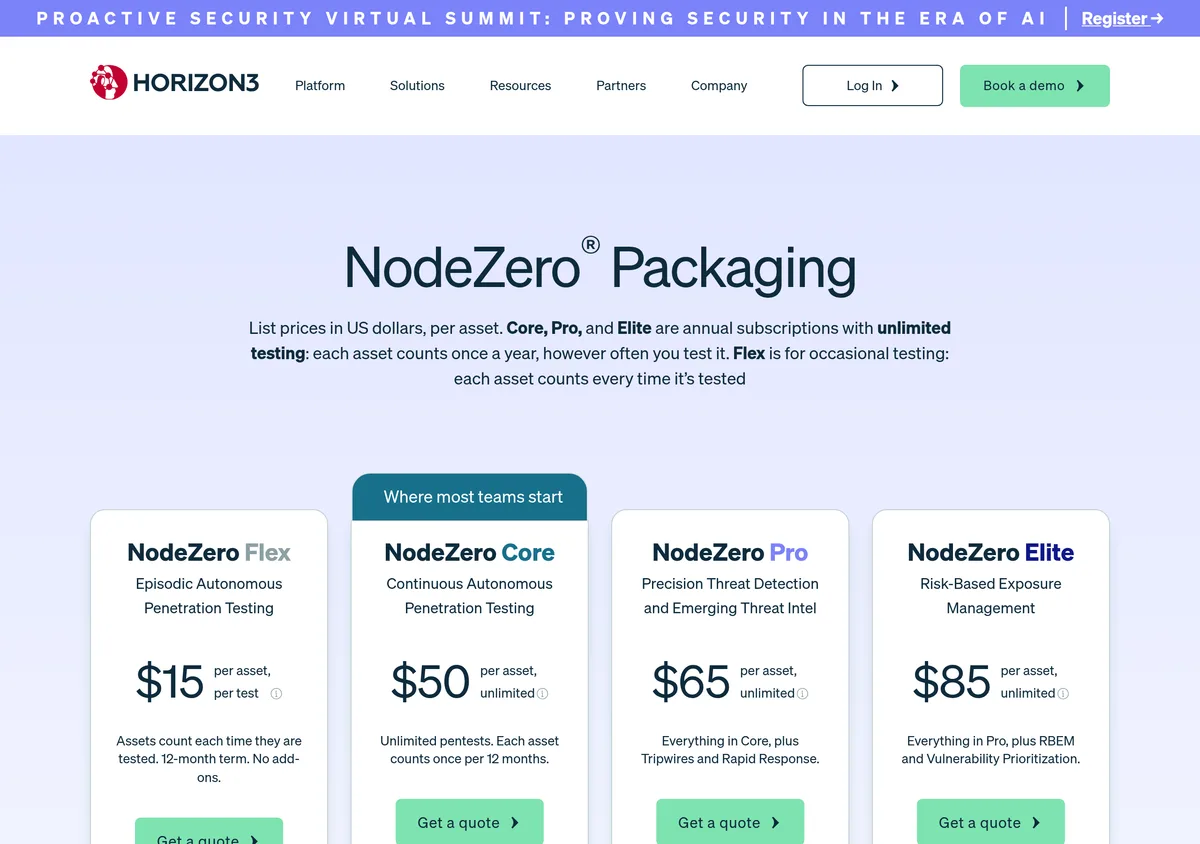 Source: horizon3.ai, captured November 10, 2026.
Where it hurts: per-asset pricing scales with a flat network. A 10,000-asset estate on the $85 Elite tier lists at $850,000 a year, per the same Horizon3.ai price list, so scope the first contract to the segments you most need tested.
Pentera: broad coverage on a deterministic engine
Pentera lists the longest set of covered environments of the four, from internal networks and Active Directory to cloud, Kubernetes, identities, APIs and web apps, per Hadrian's comparison. The architectural difference matters for change-control boards. A deterministic attack engine controls execution while AI handles selection and natural-language control, including through an MCP server, so the language model never gets unrestricted control over execution, per the same Hadrian write-up. Pentera says every attack technique is built by its research team and tested for no customer impact, and that tests run under customer-set guardrails including throttling, emergency stop and read-only modes, per Pentera. On the remediation side, Pentera Resolve assigns owners, routes tickets, tracks SLAs and retests fixes.
You will not see a Pentera price until after a demo. And because every technique comes from Pentera's research team, the AI chooses among moves Pentera has already built and tested. Change-control boards like that; the trade is less of the open-ended improvisation the LLM-driven tools are built around.
MindFort: published pricing for application testing
MindFort, backed by Y Combinator, runs swarms of agents against live applications, proves each finding with a working exploit, and can open a patch pull request against the repository and branch you choose, then repeat the attack after deployment, per MindFort. Connecting the repo is optional; when you do, agents trace each finding back to the code that caused it.
Starter lists at $499 a month with 250 credits and one target; Scale lists at $999 a month with 800 credits, unlimited targets and five concurrent assessments, per MindFort's pricing page. A Balanced assessment costs 200 credits and runs about six hours, a Deep one 400 credits, an Ultra pass 800 credits and about twelve hours, per the same pricing page. Starter therefore buys one Balanced pentest a month; Scale buys four, or one Ultra run before a release.
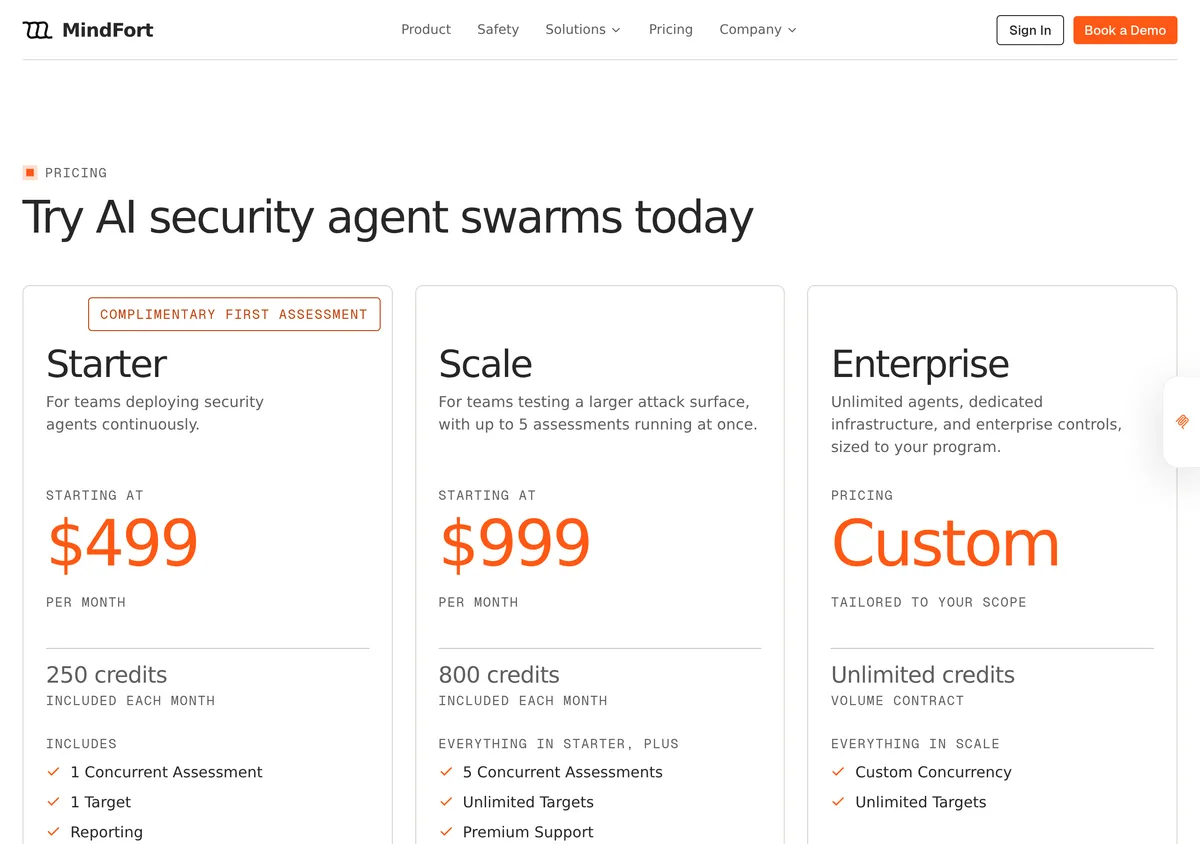 Source: mindfort.ai, captured November 10, 2026.
Watch the meter: if you switch on usage-based billing, assessments keep running after prepaid credits hit zero and the overage is billed immediately at standard credit cost, per MindFort. And like XBOW, it tests applications, not your internal network.
Which one to evaluate first
| Team shape | Evaluate first | Add to the bake-off | What decides it |
|---|---|---|---|
| SaaS company, risk in web apps and APIs, AppSec team in place | XBOW | MindFort | Depth of exploit evidence and how retests fit your release cadence |
| Startup or small team with no dedicated security staff, a handful of apps | MindFort | XBOW | A published monthly price and a complimentary first assessment |
| Infrastructure-heavy enterprise: Active Directory, hybrid cloud, flat internal networks | Horizon3.ai NodeZero | Pentera | Per-asset list pricing lets you budget before the first call |
| Continuous validation tied to remediation SLAs and audit evidence | Pentera | Horizon3.ai NodeZero | Ticketing, ownership and retest workflow, plus predictable execution |
| Vulnerability research team or high-volume bug bounty program | Daybreak Red application | XBOW | Whether you want to own the harness or buy one |
Run the bake-off the way XBOW suggests on its homepage: point the candidate at the same scope as your last manual pentest and compare what each one proved, per XBOW. All four vendors claim to attach a working exploit to every finding, so make that the acceptance test and reject anything that arrives without one.
What to do before your next pentest renewal
- Price an autonomous run against last year's scope. Before renewing a manual engagement, get one autonomous result on the same assets. Horizon3.ai's Flex tier lists at $15 per asset per test, per Horizon3.ai, and MindFort's first assessment is complimentary, per MindFort, so the comparison costs little.
- Shorten the patch window on anything internet-facing. In the Cairn campaign, sites that fell took just under 23 hours on average to compromise, per CyberSecurityNews. Our guide on AI agents and the disclosure embargo covers what to change in your release process.
- Check your bug bounty scope and triage capacity. Model-found reports arrive in volume and with proofs of concept attached. Decide which assets are in scope and who triages them before the queue backs up.
- Lock down the agents you run yourself. An offensive agent holding production credentials is a target in its own right, as the exposed Artex consoles show. Start with agent sandboxing patterns, then agent skill security review, prompt injection defense in production and MCP tool poisoning defense.
Pondero has no affiliate relationship with OpenAI, XBOW, Horizon3.ai, Pentera, MindFort or Hadrian, and no link on this page earns a commission.