Table of Contents
Make vs n8n: Which Fits Your Team (April 2026)
Published April 30, 2026 by Pondero Editorial
The short version
These two compete on team shape, not features. On a feature sheet they are twins: both branch, both loop, both run AI steps, both undercut Zapier on high-volume cost. Pick on the only axis that actually differs. Make is hosted SaaS with governance in the box; n8n is open source with a genuinely good self-hosted story. The decision is not "which has better nodes." It is whether your team should run its own infrastructure, and the operational gap between the two is concrete, not philosophical, as the next section shows.
The decision in one paragraph
If you want a hosted platform with enterprise governance baked in, pick Make. If you have an engineering function that can run a Docker container responsibly and you have residency, privacy, or cost reasons to self-host, pick n8n self-hosted, or run n8n Cloud if the residency case isn't decisive. If you're a Zapier customer evaluating switching, see our Zapier vs Make comparison first; the Make-vs-n8n decision is downstream.
Side-by-side
| Dimension | Make | n8n Self-hosted | n8n Cloud |
|---|---|---|---|
| Hosting | Vendor SaaS | You operate it | Vendor SaaS |
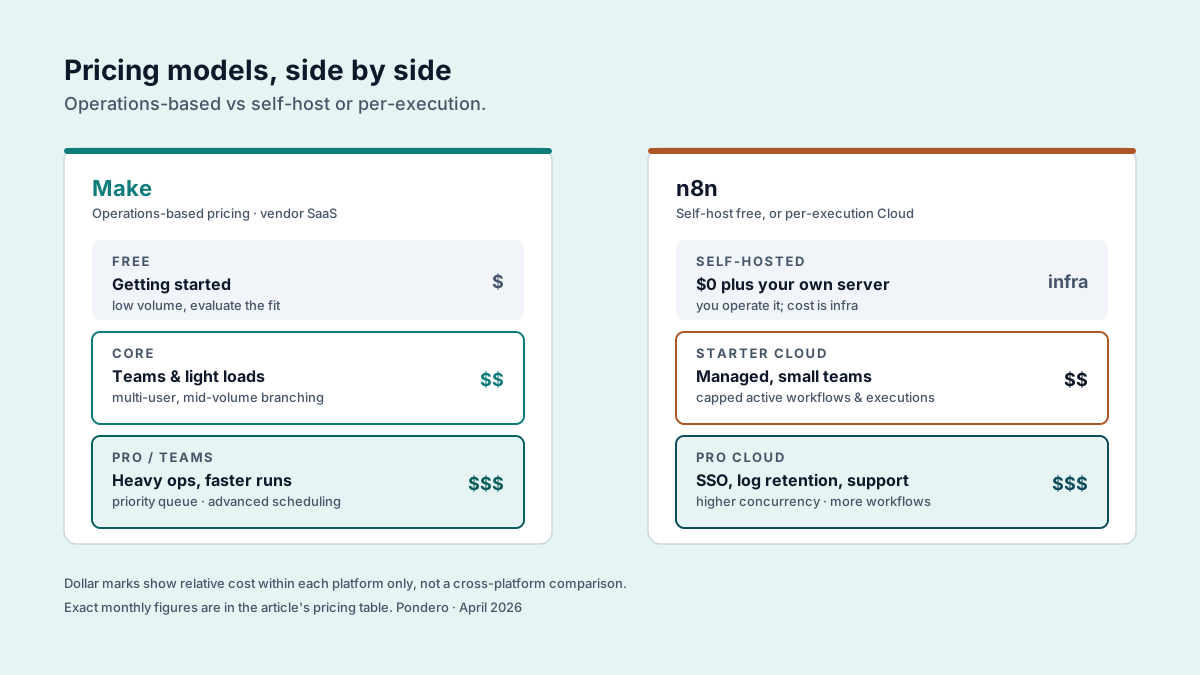
| Pricing model | Operations-based | OSS + your infra | Workflow execution-based |
| Visual workflow editor | Mature, polished | Mature; less polished | Same as self-hosted |
| Branching / looping | Native, mature | Native | Native |
| AI steps | Production-ready | Production-ready | Production-ready |
| SSO / SAML | Enterprise tier | Self-managed | Cloud enterprise tier |
| Audit log | Vendor-managed | Self-managed | Vendor-managed |
| Data residency | Region selection | You control fully | Region selection |
| Custom code steps | JS sandbox | Full Node.js | JS sandbox |
| Source-control integration | Improving | Native (Git) | Improving |
| Best for | Mid-market ops teams | Eng-led / privacy-led teams | n8n fans w/o ops capacity |
What the structural split looks like in practice
The "hosted vs self-hosted" line is not abstract. It is the difference between these two day-one experiences.
Standing up n8n self-hosted is one container and a database:
docker run -d --name n8n \
  -p 5678:5678 \
  -e N8N_HOST=n8n.yourco.com \
  -e WEBHOOK_URL=https://n8n.yourco.com/ \
  -e DB_TYPE=postgresdb \
  -e DB_POSTGRESDB_HOST=<YOUR_PG_HOST> \
  -v n8n_data:/home/node/.n8n \
  docker.n8n.io/n8nio/n8n
That command is also the bill. There is no per-execution line; you pay for the box, the Postgres instance, and whoever keeps both patched. n8n's custom-code steps run full Node.js, so a private-network call is a normal fetch in a Code node:
// n8n Code node: reach an internal service no public connector exists for
const res = await fetch('http://billing.internal:8080/v1/invoice/' + $json.invoiceId, {
  headers: { authorization: 'Bearer ' + $env.BILLING_TOKEN }
});
return [{ json: await res.json() }];
Make's equivalent path is the April 2026 CLI: scenarios become exportable JSON blueprints you can version and review, but the runtime stays Make's:
make scenario export --id 482193 > scenarios/lead-router.blueprint.json
# Commit, open a PR, then on merge:
make scenario import --id 482193 --file scenarios/lead-router.blueprint.json
Tested scenario, the decision in one shape: take a workflow that calls one internal-only service plus two SaaS APIs at 200k executions/month. On n8n self-hosted the internal call is the fetch above and the cost is flat infra. On Make the internal call needs a public-facing shim or a connector that may not exist, and 200k executions of a multi-module scenario is where operations-based billing climbs. The platform did not change; the team's perimeter and volume did. That is the entire comparison.
The four questions that decide
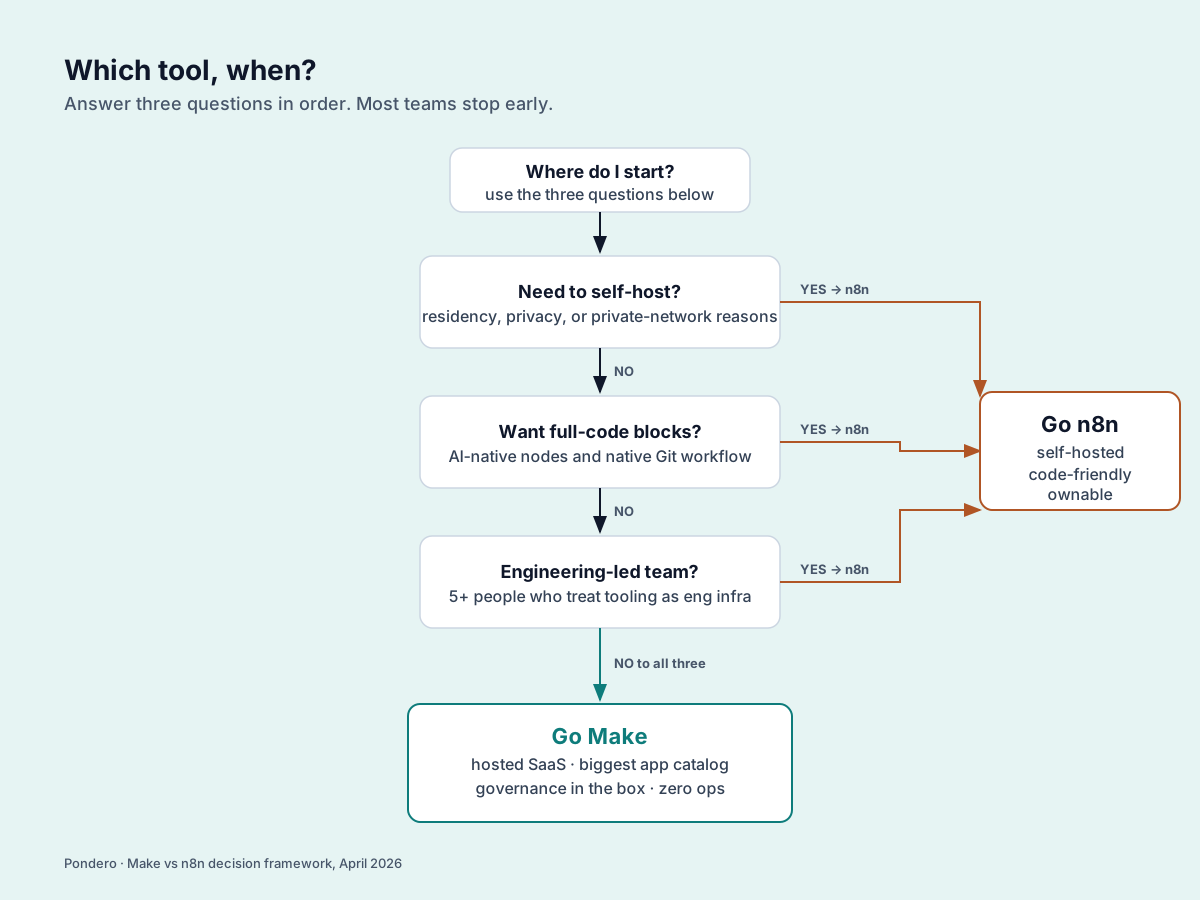
Before anyone argues nodes, answer these four. They settle most of it.
- Can someone on your team run a containerized service responsibly? If no, you are choosing between Make and n8n Cloud. If yes, n8n self-hosted is on the table.
- Do you have residency, compliance, or private-network reasons to self-host? A yes here points straight at n8n self-hosted. A no means hosted is fine and you can stop worrying about it.
- What is the volume and shape of your workflows? Low-to-mid volume with simple branching keeps Make's pricing friendly. High volume with heavy branching is where n8n's per-execution model usually wins.
- Where should governance live? Want audit log, SSO, and RBAC to ship with the product? Make. Want to own all of it yourself, governance included? n8n self-hosted.
Where Make wins outright
- Hosted ops without an engineering function. Make is the right answer for a marketing-or-ops team with no dedicated platform engineer.
- Approval-flow shops. Make's approval workflow on edits is now competitive enough that procurement teams who would have picked Zapier purely on this dimension can credibly evaluate Make. See our Make enterprise governance update.
- Mid-volume branching workloads. Operations-based pricing scales gracefully for the median ops team's actual workflow shape.
- Procurement-friendly governance. SSO, RBAC, audit log, dev/staging environments: all production-ready on Make.
Where n8n self-hosted wins outright
- Residency / privacy / compliance constraints. Self-hosted means data never leaves your perimeter. The full read on this trade-off lives in our n8n self-hosted vs Cloud April calculus.
- Engineering-led teams. Full Node.js in custom steps is a real productivity gain vs. sandboxed JS. Native Git workflow integration matches how engineering teams operate.
- High-volume cost-sensitive workloads. At sufficient volume, infrastructure cost beats per-execution pricing, sometimes by a lot.
- Private-network integrations. If your workflow needs to talk to internal services that aren't exposed to the public internet, self-hosting is the path of least resistance.
When neither answer is clean
Two real edge cases worth naming:
- Mid-market team with engineering capacity but no platform-eng dedication. Both Make and n8n Cloud are credible. The deciding factor is usually whether your team will treat workflow tooling as ops infrastructure (favor Make) or as engineering infrastructure (favor n8n Cloud, with self-hosting on the roadmap).
- Heavy branching workflows on a budget. n8n self-hosted is the cost-optimum but adds operational burden. Make's operations-based pricing is fine until your branching factor blows the operations budget. Run the math on a representative workflow before committing.
What we'd ignore in this comparison
- Visual-editor polish debates. Both are mature. If you have a strong preference after a 30-minute trial of each, that preference is real, but neither editor is the deciding factor for any team we've worked with.
- "AI steps are better on X" claims. Both ship serviceable LLM steps. AI step quality is now a baseline across the category, not a differentiator.
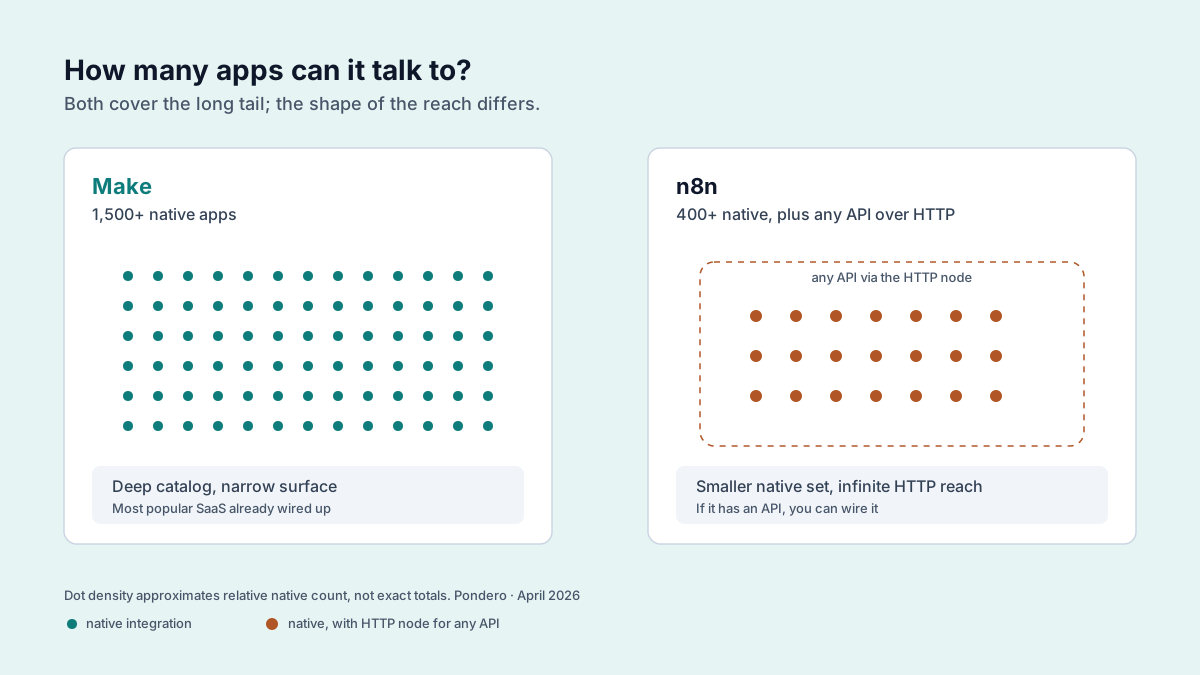
- App-coverage breadth comparisons. Both cover the long tail well enough for the median ops team. If you have a specific obscure integration need, check the directory; otherwise this isn't the deciding factor.
What we'd actually do this period
- Make-curious team: Run a 14-day trial. Build the most complex workflow you'd realistically deploy. If the pricing math holds and governance fits, commit.
- n8n-curious team with eng capacity: Stand up a self-hosted instance on a small VPS. Migrate one production workflow. If your team is comfortable operating it after 30 days, commit.
- Existing Zapier shop evaluating both: Read the Zapier vs Make comparison first. The Make-vs-n8n choice is the second question, not the first.
Verdict
Make for an ops-led team that wants governance in the box. n8n self-hosted for an engineering-led team with a residency, privacy, or cost reason to run its own boxes. The call inverts on exactly one input: if you have no platform-engineering capacity, n8n self-hosted is off the table no matter how good the cost math looks, because the half-engineer of permanent operations burden is the cost, and an unstaffed self-hosted instance is a future incident, not a saving. In that case it is Make or n8n Cloud, and the four questions above pick between them in ten minutes. For where Zapier lands in the wider field, see our best AI automation tools for ops leads guide.
Related: Zapier vs Make April 2026 update · n8n self-hosted vs Cloud April 2026 calculus · Best AI automation tools for ops leads