GitHub Copilot Review (2026): Copilot Fusion, Projects, and Code Review Max
Published June 27, 2026 · Updated November 19, 2026 · by Jonathan Hildebrandt
The short version
Copilot Fusion now picks the model for you on every plan, code review added Max and Adaptive effort levels, Projects runs agents across repos, and three more model waves retire through December 18. What changed since October, which settings to change before the November 30 Fusion discount ends, and why the 4.5 rating holds.
Pros
- ✓Copilot Fusion is generally available on all Copilot plans: pick it in the model picker and it routes each prompt to one model or a draft-and-review combination, billed per model with no separate Fusion charge (per GitHub Docs, Copilot Fusion, pulled Nov 19 2026)
- ✓Code review now spans four effort settings: an ensemble-based Lite, the default Balanced, a multi-provider Max in public preview, and an Adaptive mode in public preview that picks the level per pull request (per GitHub changelog, Sept 11, Oct 28 and Nov 17 2026)
- ✓Copilot approvals are generally available, so a Copilot review can count toward required approvals on the file paths an admin allows (per GitHub changelog, Oct 28 2026)
- ✓GitHub Enterprise customers working with an account team can get Copilot included for every licensed user and pay only for AI usage, without buying Copilot Business or Enterprise seats (per GitHub changelog, Oct 28 2026)
- ✓Local sandboxing stays free on every plan, and the picker keeps current models from four labs, including GPT-6.2 Sol, Claude Fable 5.2, Gemini 4 Carbon and MAI Code 2 (per GitHub changelog, Oct 7, Nov 9, Nov 10 and Nov 17 2026)
Cons
- ✕Fusion High and Fusion Max are limited to Pro+, Max, Business and Enterprise; Free, Student and Pro get Fusion Standard only (per GitHub Docs, Copilot Fusion, pulled Nov 19 2026)
- ✕Model churn keeps coming: three models retired November 16, six more go December 14 (including Gemini 3.8 Flash and Kimi K3), and MAI-Code-1.1-Flash goes December 18 (per GitHub changelog, Nov 13, Nov 16 and Nov 17 2026)
- ✕Copilot projects, code review Max, Adaptive review effort and computer use are all public previews (per GitHub changelog, Oct 28 and Nov 17 2026)
- ✕If Fusion discards a draft, file edits that draft already made stay in your workspace, so you review the diff yourself before committing (per GitHub Docs, Copilot Fusion, pulled Nov 19 2026)
- ✕Agent mode still trails Cursor Composer on whole-repo multi-file refactors, the gap carried from prior reviews
GitHub Copilot Review (2026): Copilot Fusion, Projects, and Code Review Max
Our September and October versions of this review gave the same instruction: route models deliberately, or the credit meter surprises you. On October 28 GitHub shipped the feature that does the routing for you. Copilot Fusion is generally available on every Copilot plan, and per GitHub's own Universe 2026 recap, "Fusion Max scored within two points of Opus 5.5 Max at half the cost and 40% less time per task" on the Artificial Analysis Coding Agent Index. That is a vendor benchmark, not a measurement of your repo. It is still the first credible answer to the problem this review has warned about since June.
The re-call: 4.5 out of 5, held. For a solo developer, Pro+ at $39 is the tier to hold, because it is the cheapest plan with Fusion High and Fusion Max (Fusion docs, pulled 2026-11-19). For a Business team, make Fusion Standard the everyday default and put code review on Adaptive. For an enterprise on GitHub Enterprise Cloud, ask about Copilot-included licensing before you renew seats. One dated action item: paid plans get 30% off model costs when using Fusion through November 30 (Fusion docs), so the next 11 days are the cheap window to find out whether it suits your task mix.
What changed since October 8
Newest first. Note the status on each, because four of the headline features are still previews.
- Gemini 4 Neon, GA (Nov 18). Google's lower-cost sibling to Gemini 4 Carbon, on Pro+ and up (GitHub changelog, Nov 18). Team customizations also reached GA for Business and Enterprise, letting team maintainers set approved Agent Plugins as defaults (GitHub changelog, Nov 18).
- Ignite releases (Nov 17). Fusion reached github.com, Visual Studio and the GitHub Mobile betas, and added models to each tier (Fusion update). GPT-6.2 Astra and GPT-6.2 Sol went GA on Pro+ and up (GPT-6.2 changelog). MAI Code 2 arrived from Pro up and MAI Code 2 Flash on every plan including Free (MAI Code 2 changelog). Code review gained Adaptive effort, secret detection, and cross-repository context, all public preview (code review changelog, Nov 17). Browser use and Azure DevOps repositories came to the Copilot app as previews (app changelog, Nov 17).
- Weekly release, week of Nov 9 (published Nov 16). Claude Fable 5.2 and Gemini 4 Carbon joined the picker on Pro+ and up. GitHub Enterprise Server repositories, issues, and pull requests work inside the Copilot app (GA, cloud sessions excluded). A cloud session can move to your phone through an Open in menu with a QR code, and the app can sign you back into an MCP server like Slack without leaving the conversation (GitHub changelog, Nov 16).
- Three models retired (Nov 16). Claude Opus 4.8, Claude Opus 5, and GPT-5.6 Terra (GitHub changelog, Nov 16).
- Six more retirements scheduled for Dec 14 (Nov 13). See the retirement table (GitHub changelog, Nov 13).
- Weekly release, week of Nov 2 (published Nov 6). Copilot came to JetBrains Air and, in public preview, to Xcode 27.3 beta. Agent Merge can be set up straight from a pull request and stays on while required checks are pending. When a conversation hits its context limit, you can compact it from the error instead of starting over (GitHub changelog, Nov 6).
- Universe 2026 (Oct 28). Fusion, projects, code review Max, approvals, and the Enterprise packaging each get a section below. Not covered elsewhere: automations can now propose improvements to their own prompts for you to approve (Universe recap). Our Fusion launch brief and Enterprise bundle brief cover the day itself.
- GPT-6.1 Terra, GA (Oct 26). OpenAI's lower-cost everyday agentic model, from Pro up (GitHub changelog, Oct 26).
- Six models retired (Oct 19). The wave our October version previewed has landed, with different replacements than first announced; details below (GitHub changelog, Oct 19).
One September item our last two versions missed: since September 11, Lite code reviews run an ensemble of agents instead of one. GitHub reports 47% more addressed high-severity comments per review, 31% more medium, and 11% more low, at about 8% lower review cost (GitHub changelog, Sept 11). The same update auto-resolves a Copilot comment once a later push addresses it.
Fusion takes over the routing job
Fusion is a model picker entry that is not a model. Select it, choose an effort level, and for each prompt it picks an execution pattern and the models that run it (Fusion docs, pulled 2026-11-19). There are three patterns. Single sends the task to one model. Cascade has an efficient model draft and a judge decide whether to accept the draft or escalate to a stronger model. Critique has one model draft while several others critique it in parallel, then the drafting model revises. Different prompts in one session can use different patterns, and hovering over the effort label under a response shows which models ran.
On cost, GitHub bills each model Fusion uses at that model's standard rate, with no Fusion surcharge (Fusion docs). Cascade and critique add model calls, so a Fusion High or Max task can cost more credits than the same prompt on Fusion Standard. The docs also say Fusion keeps the main conversation on one model where it can, to protect cached tokens. Through November 30, paid plans get the 30% discount on Fusion model costs; the plans page carried the same offer as a banner on November 19.
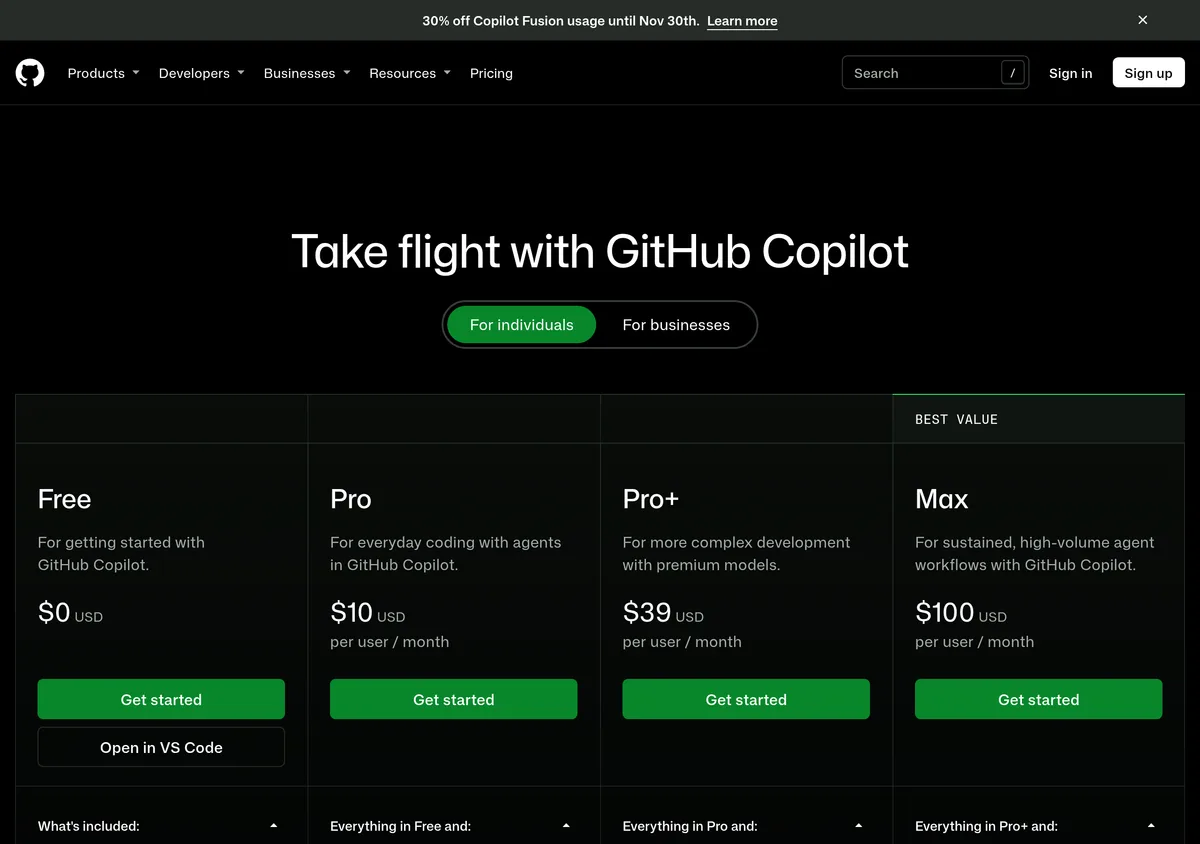 Source: github.com, captured November 19, 2026.
The plan split is where Fusion changes the buying decision. Every plan gets Fusion Standard, which picks one model per task. Fusion High and Fusion Max, the levels that run cascade and critique, start at Pro+.
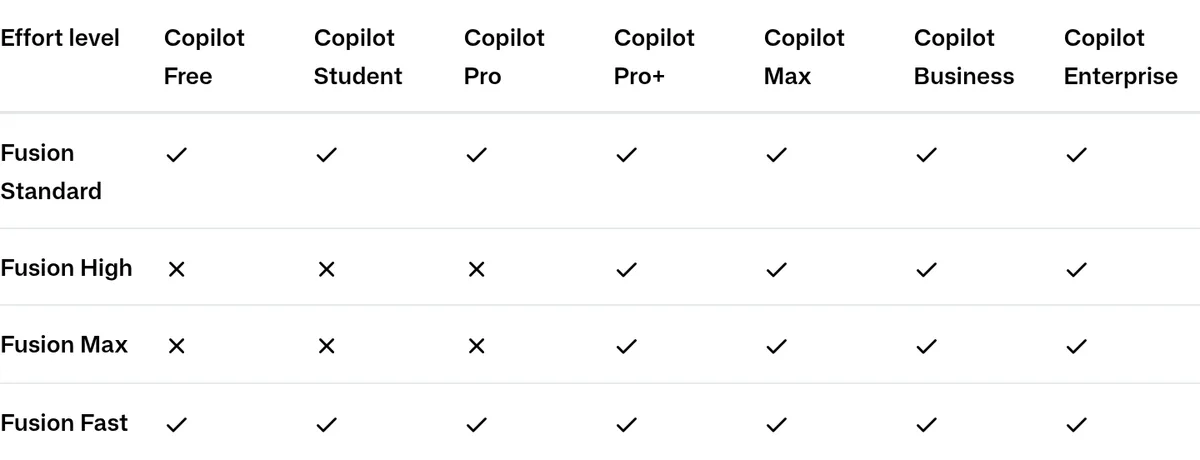 Source: docs.github.com, captured November 19, 2026.
| Fusion level | What it does | Plans | Source |
|---|---|---|---|
| Fusion Standard | Picks one model per task, balancing cost, quality, and latency | Free, Student, Pro, Pro+, Max, Business, Enterprise | Fusion docs |
| Fusion High | Adds model calls when a substantial, well-scoped task warrants them | Pro+, Max, Business, Enterprise | Fusion docs |
| Fusion Max | Frontier capability, still weighing token efficiency | Pro+, Max, Business, Enterprise | Fusion docs |
GitHub has published two benchmark claims for Fusion Max. The launch changelog puts it at 60 on the Artificial Analysis Coding Agent Index, about half the average API cost per task of Claude Code with Opus 5.5 Max (Oct 28 changelog). On November 17 GitHub reported a 71.2% resolution rate on Terminal-Bench 4.1, which it says put Fusion Max 5.4 points ahead of Opus 5.5 and Fable 5.2 while costing less than either (Fusion update, Nov 17). Both are GitHub's numbers about GitHub's product. Treat them as a reason to trial Fusion during the discount, not as a forecast of your bill.
Three limits from the docs decide where manual routing still wins. Fusion does not start subagents, so if your workflow fans out to subagents, you still choose their model yourself, and Claude Haiku 5.5 remains the cheap pick there (Oct 7 changelog). Fusion only draws on models your plan and admin policies allow, including data-residency and FedRAMP restrictions, so a locked-down org gets a smaller pool. And when Fusion discards a draft, file edits that draft already made are not rolled back (Fusion docs). Read the diff before you commit. For admins, Enterprise managed settings can make Fusion the default model at any effort level, and model policy can exclude a model from Fusion without removing it from the picker (Oct 28 changelog).
Code review: four effort settings and approvals that count
Code review moved further than any other part of Copilot this quarter, and every change touches the credit meter. GitHub's code review docs (pulled 2026-11-19) still estimate a Lite review at $0.05 to $1 in AI credits and a Balanced review at $0.25 to $5, and Balanced is still the built-in default.
| Setting | How it reviews | Status | Source |
|---|---|---|---|
| Lite | Ensemble of agents since Sept 11 | GA | Sept 11 |
| Balanced (default) | Routes to a higher-reasoning model for longer analysis | GA | code review docs |
| Max | Several review agents on models from different providers, reconciled by an aggregation agent | Public preview | Oct 28 |
| Adaptive | Picks Lite, Balanced, or Max per pull request, never above the configured maximum | Public preview | Nov 17 |
Max takes longer and uses more AI credits than Lite or Balanced, per the same Oct 28 changelog, and GitHub's recap claims it posted the highest F1 score on ReviewBench for high-severity issues (Universe recap). Admins can set a maximum effort level per enterprise, org, or repository, and Adaptive respects that cap. That cap is the setting to use. Put Adaptive on as the default, cap it at Balanced on most repositories, and lift the cap to Max only on the repositories where a missed bug costs the most: auth, payments, shared libraries.
Copilot approvals left preview on October 28 (changelog). They are off by default, admins choose the file paths Copilot may approve, and a new commit dismisses a Copilot approval the way it dismisses a human's. Pair that with Agent Merge, which watches a pull request and fixes failing workflows or merge conflicts (Oct 28 changelog), and Copilot can now carry a low-risk change from review to merge. Our Agent Merge guide walks through setup and the review gap that opens when you combine it with auto-merge. Our recommendation from October stands: Copilot approvals on docs and test fixtures, human sign-off on core logic.
Projects and session continuity add a cross-repo axis
Cursor's pitch against Copilot has been the editor: Composer handles a whole-repo refactor more cleanly. Nothing from Universe closes that gap. What Copilot added is a different axis, program-level work across many repositories.
Copilot projects, a public preview in the Copilot app, let you give Copilot a goal and the repositories, files, and connected-tool context it needs; it then runs as many agent sessions as the work requires and returns pull requests for review (app changelog, Oct 28, projects docs). A project can also hold recurring automations, which since the November 9 week can run on a custom cron schedule (Nov 16 changelog). Session continuity is the other half. A cloud session started on github.com, mobile, the CLI, the app, or VS Code is the same session on every surface, and it runs in a cloud sandbox with no one-hour cap that snapshots on shutdown (cloud changelog, Oct 28).
One cost line came with it. GitHub said billing for cloud sandbox usage begins in November 2026, drawing first on your included Actions compute entitlement, which is now a shared dollar pool instead of fixed runner minutes (same Oct 28 changelog). If your team already burns most of its Actions minutes on CI, long cloud agent sessions now compete with your builds for that pool.
Five retirement dates, October 2 to December 18
Copilot has now retired or scheduled out 20 models across five dates. The October 19 wave also landed with different replacements than GitHub's September 18 notice listed, and our October version quoted the earlier list; the table carries the replacements GitHub published on the day.
| Date | Models | GitHub's suggested replacement | Source |
|---|---|---|---|
| Oct 2 (done) | Gemini 3.5 Flash, Gemini 3.6 Flash, Kimi K2.7 Code, Claude Opus 4.7 | Gemini 3.8 Flash, Kimi K3, Claude Opus 5.5 | Oct 2 |
| Oct 19 (done) | Gemini 3.7 Flash, GPT-5.5, GPT-5.4, GPT-5.4 mini, GPT-5 mini, Grok 4.5 | Gemini 3.8 Flash; GPT-6.1 Sol; GPT-6 Luna; Grok 4.7 | Oct 19 |
| Nov 16 (done) | Claude Opus 4.8, Claude Opus 5, GPT-5.6 Terra | Claude Opus 5.5; GPT-6.1 Sol or GPT-6 Luna | Nov 16 |
| Dec 14 | Claude Fable 5, Claude Haiku 4.5, Gemini 3.8 Flash, Gemini 4 Argon, Grok 4.6, Kimi K3 | Fable 5.2, Haiku 5.5, Gemini 4 Hydrogen, Gemini 4 Carbon, Grok 4.7; Kimi K3 replacement to be announced | Nov 13 |
| Dec 18 | MAI-Code-1.1-Flash | Latest MAI Code Flash model | Nov 17 |
Two carve-outs matter if you are an individual subscriber on an annual plan: Claude Opus 4.8 stays available to you after November 16, and Claude Haiku 4.5 stays after December 14 (per the Nov 16 and Nov 13 notices). For Business and Enterprise, suggested replacements switch on automatically under default model enablement unless an admin turned the global default off. Kimi K3 has no named replacement yet, so any workflow pinned to it needs a manual decision before December 14.
Fusion softens this churn because it draws from a pool GitHub maintains. A team that sets Fusion as its default stops caring which Gemini Flash is current. A team that pins models in custom agents or automations still has to check every date in that table.
The model picker, by task
If you route by hand, here is the November pick. Our monthly Copilot model guide carries per-token rates and session cost math.
| Task type | Reach for | Lowest plan | Source |
|---|---|---|---|
| Default for mixed work | Copilot Fusion (Standard, or High/Max on Pro+) | Free | Fusion docs |
| Subagents, quick edits, terminal tasks | Claude Haiku 5.5 | Pro | Oct 7 |
| Everyday agentic coding on a budget | GPT-6.1 Terra or MAI Code 2 | Pro | Oct 26, Nov 17 |
| Fast multistep tool use | Gemini 4 Hydrogen (replaces Gemini 3.8 Flash) | Pro | Nov 13 |
| Complex agentic work and deep code review | GPT-6.2 Sol | Pro+ | Nov 17 |
| Agentic terminal runs | GPT-6.2 Astra | Pro+ | Nov 17 |
| Multistep tasks across large codebases | Claude Fable 5.2 (data retention required) | Pro+ | Nov 9 |
| Security-focused code generation | Gemini 4 Carbon | Pro+ | Nov 10 |
The Fable caveat carries over to 5.2. Anthropic retains prompts and outputs to run its safety classifiers, GitHub says that data is not used for training, and the policy ships off for Business and Enterprise (Nov 9 changelog). Eligible enterprises can use the Fable models with zero data retention through the end of 2026 under a time-bound exemption; after that, GitHub says continued use requires Anthropic's Enterprise Frontier Safeguards. Ask your account team now if Fable is in your plans for 2027.
Pricing: the sticker held, the packaging moved
Individual and seat prices are unchanged from October. What moved is a third way for enterprises to pay.
| Plan | Price/mo | Included AI credits | November note | Source |
|---|---|---|---|---|
| Free | $0 | Limited chat and agent use | Fusion Standard; MAI Code 2 Flash | plans page, Nov 17 |
| Pro | $10 | $15 | Fusion Standard only | plans page, Fusion docs |
| Pro+ | $39 | $70 | Cheapest tier with Fusion High and Max | plans page, Fusion docs |
| Max | $100 | $200 | Same picker, largest individual pool | plans page |
| Business | $19 per granted seat | Pooled org-wide | Team plugin defaults GA Nov 18 | plans docs, Nov 18 |
| Enterprise | $39 per granted seat | Pooled org-wide | Can now be skipped via GitHub Enterprise | plans docs, Oct 28 |
| Copilot included with GitHub Enterprise | No Copilot seat fee | None; metered from the first request | Through an account team only for now | Oct 28 |
The included model works like this, per GitHub's Oct 28 changelog. Every GitHub Enterprise licensed user gets Copilot with the same features and models as Copilot Enterprise, and users without a GitHub Enterprise license get the same access through Copilot Standalone at $10 per user per month. There are no per-seat credits; all usage meters against the enterprise budget. Completions and next edit suggestions keep working when the budget runs out, while chat, code review, and cloud sessions stop. Self-serve customers cannot switch yet, and Copilot Business and Enterprise stay on sale.
Usage per head decides which model is cheaper. Enterprise seats at $39 per granted seat (plans docs) carry pooled credits whether or not people use them, while the included model charges nothing for idle users and full rate for heavy ones. If a third of your licensed developers barely touch Copilot, price the included model first.
Rating
Copilot holds at 4.5 out of 5 in November 2026, unchanged from October.
Fusion is the strongest case for a move up since this review launched. It addresses the exact cost problem we flagged in September, ships GA on every plan, and bills nothing extra for the routing (Fusion docs). Code review now has four effort settings plus approvals that count toward branch rules, and the GitHub Enterprise packaging removes the seat-count argument for large orgs.
Three things keep it at 4.5. Fusion's benchmark wins are GitHub's own claims, published within the last three weeks, about a product whose model pool GitHub says will change over time. Most of the other Universe headliners (projects, code review Max, Adaptive, computer use) are previews. And 20 model retirements on five dates between October 2 and December 18 is churn a team with pinned workflows pays for in admin hours. The editing gap against Cursor's Composer also persists. A score of 4.6 needs Fusion to hold up in third-party evaluation beyond GitHub's own posts, and Projects to reach GA.
The pick, by who you are
Solo developer. Pro+ at $39 a month (plans page, 2026-11-19) is the tier to hold, because it is the cheapest one where Fusion can run cascade and critique on hard tasks (Fusion docs). Pro at $10 still works for scoped features and fixes, since Haiku 5.5, GPT-6.1 Terra, and MAI Code 2 all reach it. Before November 30, switch your default to Fusion and watch a week of credit use while the discount runs. New-account availability has shifted since GitHub paused new Pro, Pro+, and Student sign-ups on April 20 to protect capacity (GitHub blog), so confirm checkout on the plans page before you plan around a new individual subscription. The flip condition is unchanged: if your day is all-day whole-repo editing, Cursor's Composer still handles multi-file refactors more cleanly. Our Cursor review covers its tiers.
Small team on Business ($19 per seat). The pick holds, with four settings to change this month. Set Fusion Standard as the default model so nobody leaves a frontier model running on boilerplate. Switch code review to Adaptive with the maximum effort capped at Balanced, then lift the cap to Max on your two or three riskiest repositories (Nov 17 changelog). Turn on Copilot approvals for docs and test-fixture paths only. And check every custom agent or automation pinned to a model on the December 14 list, especially Kimi K3, which has no named replacement (Nov 13 changelog). Start from the Copilot plans page.
Enterprise. If you are on GitHub Enterprise Cloud with an account team, get a quote on Copilot included with GitHub Enterprise before your next Copilot Enterprise renewal, and bring your per-user usage data to the call (Oct 28 changelog). Make Fusion the managed default at Standard, let teams opt up to High, and use model policy to decide which models Fusion may draw on, keeping any model that requires data retention out until legal signs off. Keep requiring local sandboxing and keep computer use and browser use limited to a pilot group while both are previews. For organizations whose work already runs through GitHub, November makes Copilot an easier standardize-here pick than it was in October.
Review history
This review is updated in place as the product changes. Earlier versions:
- November 19, 2026: Copilot Fusion, Projects, and Code Review Max (current version). Also corrects the October 19 replacement models to the list GitHub published on the day.
- October 8, 2026: Computer Use, Free Local Sandboxing, and Two Model Retirement Waves
- September 7, 2026: GPT-6 Astra, Four Models Retiring, and the Usage Billing Math
- August 24, 2026: Agent Plugins 1.0, Grok 4.6, and Whether Slack Changes the Verdict
- July 8, 2026: Vision GA, Kimi K2.7, and Whether the Credits Math Changed
- June 27, 2026: Four Tiers, 1M Context, and the New Credits Math
Ready to try it?
Try copilot →